Jan 27, 2026
For a homebuilder executive, workflow automation software isn't another tool—it's a strategic operating model. At its core, it’s the digital connective tissue that links your essential systems—CRM, ERP, and construction software—to deliver a seamless, branded customer journey from contract to close and beyond.
This isn't about replacing your core systems. It's about orchestrating them to drive measurable business outcomes: accelerating sales velocity, increasing team capacity, and building the kind of trust that fuels referrals and long-term revenue.
From Disconnected Handoffs to a High-Performance Customer Journey
Today, much of the homebuying journey happens in the gaps between your core systems. Sales teams manually chase closing coordinators for updates. Construction milestones are shared inconsistently through one-off texts. Warranty teams are blindsided by issues that could have been addressed weeks earlier.
These fragmented, offline workflows are a massive drain on your team's capacity, introduce unnecessary risk, and ultimately deliver a choppy, unpredictable experience for your buyers.
Workflow automation is designed to eliminate these pain points. It orchestrates the flow of information and tasks across departments, ensuring every homebuyer receives a consistent, high-quality, on-brand experience—without adding headcount to manage the process.
At its core, workflow automation is about reclaiming your team's most valuable asset: time. By creating a system for routine communication and tasks, you free up your sales, closing, and construction teams to focus on high-impact work that drives growth and customer satisfaction.
Instead of relying on individual heroics and manual follow-ups, you build a scalable system that delivers operational excellence, every single time.
The True Business Cost of Manual Processes
Fragmented communication and manual follow-ups do more than just frustrate buyers; they directly impact your bottom line and stifle growth. Every hour a sales agent spends hunting down a closing document is an hour they aren't nurturing a new lead. Every inbound call from a buyer asking for a simple construction update is a sign of a communication failure.
These inefficiencies create hidden costs that quietly erode your operating model:
Reduced Sales Velocity: Your top performers get bogged down in administrative tasks instead of selling homes.
Inconsistent Brand Representation: The customer journey feels completely different depending on the community or team member, diluting your brand promise.
Limited Operating Leverage: Scaling your business requires a linear increase in headcount just to manage the manual workload.
Lack of Visibility: Leadership has no clear line of sight into buyer engagement or potential satisfaction issues until it's too late.
A Strategic Pivot Toward Scalable Operations
The move toward automation isn’t a trend; it's a strategic pivot toward the operational excellence that defines high-growth companies. The global workflow automation market is projected to hit $80.57 billion by 2035, with companies reporting process turnarounds that are up to 40% faster.
This growth signals a fundamental shift in how successful businesses operate. To see how these principles work in practice, you can explore how to automate business processes and begin reclaiming your team's time.
For homebuilders, this means transforming the disjointed homebuying process into a modern, transparent, and branded digital experience. This isn't about replacing your trusted CRM or construction software; it's about connecting them to finally deliver on the promise of a seamless customer journey.
Let’s examine what this transformation looks like in the real world.
From Manual Inefficiency to Automated Advantage
The table below breaks down the shift from traditional, manual operations to a modern, automated customer experience. It’s a stark contrast that highlights the tangible impact on your teams, your buyers, and your bottom line.
Business Area | The Manual 'Old Way' (The Problem) | The Automated 'New Way' (The Solution) |
|---|---|---|
Sales & Closing Handoff | Sales agents manually email documents and updates to the closing team, leading to delays, lost files, and constant back-and-forth. | An automated workflow triggers tasks for the closing team the moment a contract is signed, with all necessary documents attached and accessible in one place. |
Construction Updates | Buyers text or call their construction manager for updates, who may or may not be available, resulting in inconsistent communication and buyer anxiety. | Pre-scheduled, automated messages (email & SMS) with photos and progress notes are sent to buyers at key construction milestones, keeping them informed and excited. |
Homeowner Onboarding | A binder of documents is left on the counter at closing. The homeowner is left on their own to figure out maintenance, warranties, and utility setup. | A white-labeled digital homeowner portal is automatically provisioned at closing, containing all documents, a personalized maintenance schedule, and direct access to the warranty team. |
Warranty & Service | Warranty requests arrive via random emails or phone calls, making them difficult to track, prioritize, and resolve efficiently, leading to homeowner frustration. | Homeowners submit warranty requests through their portal, which automatically creates a ticket, notifies the right team, and provides status updates to the homeowner. |
As you can see, the "new way" isn't about working harder; it's about implementing a system that works smarter for you, creating a predictable, positive experience for everyone involved and giving you the operating leverage to scale.
Connecting Your Systems to Create a Unified Customer Experience
Let's be clear: effective workflow automation isn't about replacing your core systems like Salesforce, MarkSystems, or Procore. The strategic advantage comes from orchestrating them.
Think of it as the customer experience layer for your entire operation. It sits on top of your existing tech stack, finally ending data silos and communication black holes.
This approach directly solves the fragmentation problem. When your systems don't talk to each other, neither do your teams. Your sales staff is left guessing about construction milestones. Closing coordinators dig through endless email threads for a single document. And the warranty team gets blindsided by post-close issues that could have been handled proactively.
That operational chaos is a direct result of a disconnected tech stack. By automating the flow of information and tasks between your systems, you create a single source of truth for every team member and every homebuyer. The result? A predictable, high-quality, and scalable experience.
From Silos to a Single Source of Truth
The biggest operational challenge for growing homebuilders is that the customer's journey doesn't live in a single piece of software. It’s a series of messy handoffs between specialized systems built for sales, construction, and finance.
A modern workflow automation platform is the digital glue that holds it all together. It serves as the customer experience layer that connects your foundational systems to the modern journey you want to deliver.
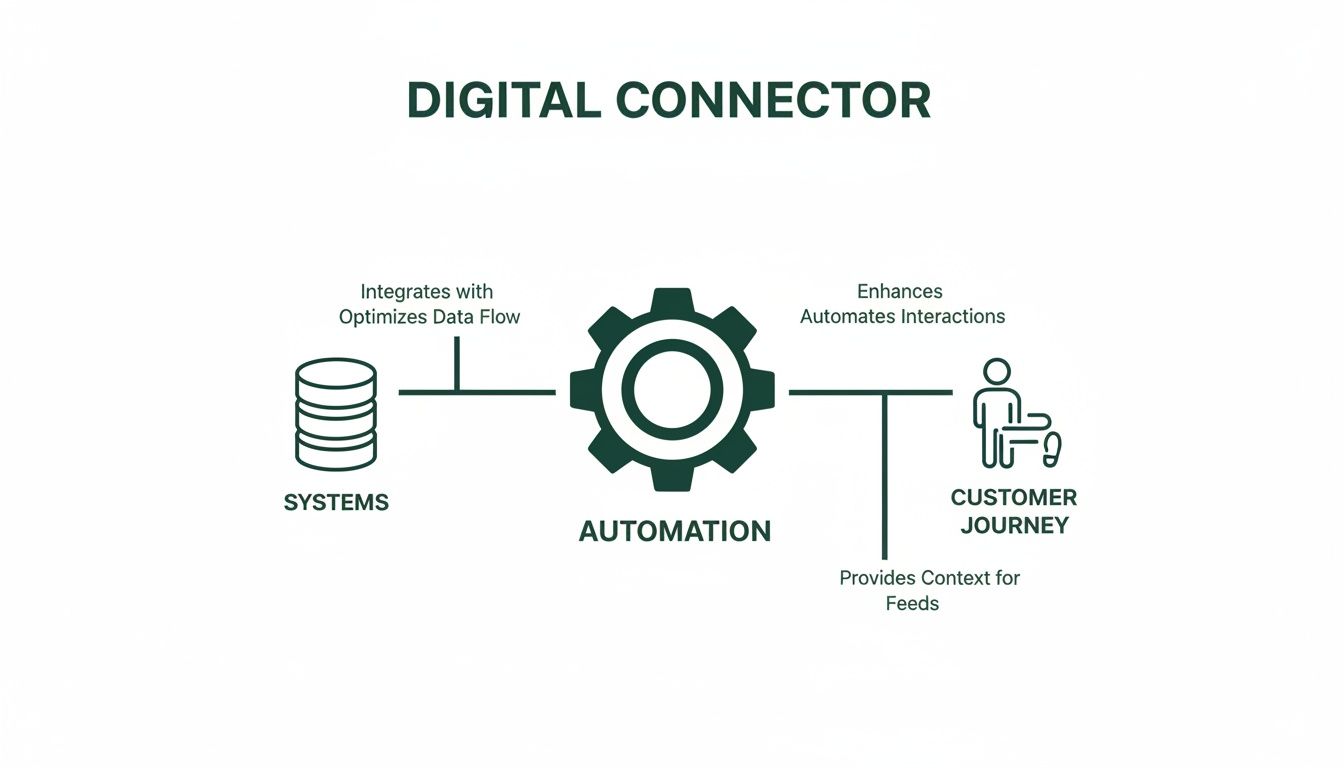
As you can see, automation isn't a standalone tool. It’s the engine that powers a connected ecosystem, driving consistency, team performance, and visibility from contract to close and beyond.
The Power of an Integrated Experience Layer
Implementing a dedicated customer experience layer creates real, measurable operating leverage—the ability to grow revenue faster than headcount.
For example, instead of hiring more coordinators to manage closings, you can automate 70-80% of the routine communication. This frees your existing team to handle higher volume and focus on the complex buyer situations that require a human touch.
This integrated approach also reduces risk. When your team relies on personal texts or one-off emails, communication is untrackable and inconsistent. It creates a "he said, she said" environment that can lead to disputes and damage your brand.
An automated workflow ensures every communication is logged, standardized, and delivered on-brand. This creates a complete, auditable record of the buyer journey, reducing risk for your business while building trust with the homeowner.
Ultimately, this unified view gives leadership a level of visibility they've never had before. You can finally see where bottlenecks are forming, identify at-risk customers based on their engagement, and standardize best practices across every community. It’s a shift from reactive problem-solving to proactive experience management.
To see how this works in practice, explore the deep integration and automation capabilities that connect your core systems.
By linking your essential software, you transform fragmented transactions into a single, cohesive, and memorable journey. That’s how you drive satisfaction, earn referrals, and build a brand that lasts. This isn't just about efficiency; it's about building a scalable model for customer-centric growth.
How Automation Directly Impacts Your Bottom Line
Adopting workflow automation is not a technology decision—it's a strategic investment in profitability. For homebuilder executives, the value is measured in tangible financial and operational outcomes. Think of it as a direct lever for boosting revenue, improving margins, and building long-term brand equity, all without adding headcount to manage the process.
This shift transforms your operations from a model dependent on individual effort to one built on a consistent, scalable system. By automating the routine communication and administrative tasks that drain your teams, you unlock measurable gains in four critical areas that define a high-growth homebuilding operation.

Pillar 1: Increase Sales Velocity and Team Capacity
Your top sales agents are your most valuable asset, yet they spend a significant amount of time on non-revenue-generating activities. Manually tracking closing documents, answering repetitive buyer questions, and chasing construction updates are necessary but low-value tasks that pull your best people away from selling homes.
Workflow automation gives them that time back. By automating post-contract communication—from construction milestones to document reminders—you can give your sales team back weeks of selling time per year. This directly increases sales velocity by allowing them to focus on what they do best: nurturing new leads and closing deals, not playing project manager.
Pillar 2: Create Powerful Operating Leverage
Growth shouldn't demand a one-for-one increase in your back-office staff. A common growing pain for builders is the ballooning headcount needed to manage closing and warranty processes. An automated, digital closing concierge standardizes the journey from contract to keys, guiding buyers through every step.
This creates powerful operating leverage, allowing your current team to manage a much higher volume of closings without sacrificing quality or burning out. Instead of hiring more coordinators, you empower your existing team with a system that handles up to 80% of routine communication, freeing them to focus on exceptions and complex buyer needs. You can grow revenue and expand into new markets without a proportional spike in operational costs.
The core principle here is scalability. Automation allows you to codify your best practices and deliver them consistently across every single home, in every community, without relying on individual heroics. It’s how you scale excellence.
Pillar 3: Reduce Operational and Financial Risk
Inconsistent communication is a massive source of risk. When updates are delivered via personal text messages or one-off emails, there's no single source of truth. This ambiguity leads to buyer frustration, disputes, and potential legal issues, creating a "he said, she said" environment that erodes trust.
A centralized workflow automation platform mitigates this risk by creating a complete, time-stamped record of every interaction.
Standardized Communication: Ensures every buyer receives the same accurate, on-brand information at the right time.
Complete Audit Trail: Creates a definitive log of all messages, documents, and milestone completions, providing clarity and protection.
Proactive Issue Flagging: By tracking buyer engagement, you can spot at-risk customers early and intervene before minor issues become major problems.
This systematic approach doesn't just reduce disputes; it builds homeowner confidence through transparency and consistency, which directly anchors to improved team performance.
Pillar 4: Improve Brand Equity and Drive Referrals
Your customer experience extends far beyond closing day. A smooth, modern, and transparent buying process directly translates into higher customer satisfaction scores and stronger brand loyalty. Happy homeowners who feel informed and cared for are your most powerful and cost-effective marketing engine.
Automation extends this positive experience into the crucial post-close and warranty phases. By providing a white-labeled homeowner portal for documents, service requests, and maintenance reminders, you reinforce your brand's value long after the sale. This transforms a transaction into a long-term relationship, dramatically increasing referrals and repeat business—the most profitable sources of new revenue.
Real-World Automation Use Cases for Homebuilders
For executives, the theory behind workflow automation is interesting, but its real value becomes clear when it solves the specific, costly problems your teams face daily. Let's move beyond concepts and examine four high-impact ways this technology drives measurable results across the entire homeowner journey.

Use Case 1: The Automated Closing Concierge
The journey from a signed contract to closing is often the most fragmented and anxious part of the homebuying experience. It's a flurry of chasing documents, answering repetitive questions, and managing buyer anxiety. All this manual work drains team efficiency and slows sales velocity.
An Automated Closing Concierge changes the game. By integrating with your CRM and ERP, it creates a single, white-labeled digital destination for the buyer.
Automated Milestone Updates: Buyers receive timely, personalized emails and texts as they hit key transaction and construction milestones.
Centralized Document Hub: All necessary documents reside in one secure, accessible location, eliminating the need to dig through email threads.
Automated Task Management: The system prompts buyers to complete tasks—like submitting loan documents or making design selections—with automated reminders.
This single shift can reduce inbound calls and emails by up to 70%, handing back weeks of productive time to your closing coordinators and sales agents annually. To see this in practice, check out how builders are boosting sales productivity with Foundation.
Use Case 2: Proactive Construction Updates
Few things build more excitement and trust than watching a new home come to life. Yet, for most builders, construction updates are sporadic at best—a random text from a busy superintendent. This information vacuum breeds buyer anxiety and reflects poorly on your brand.
Workflow automation solves this by pulling data directly from your construction management software (like Procore or Hyphen Solutions) to send proactive, branded updates. When a stage like "framing complete" is marked, it automatically triggers a personalized email to the homeowner with photos and a note from the field team.
This creates a consistent, high-touch experience that builds anticipation and dramatically reduces "Where are we at?" calls, saving your field teams valuable time.
By strategically choosing which processes to systematize, businesses can learn how to automate repetitive tasks, leading to significant time savings and increased team performance. For builders, this means turning routine updates into powerful brand-building moments.
Use Case 3: A Seamless, Modern Warranty Experience
The warranty period is a critical moment in the customer journey, but it's often an afterthought. A clunky, confusing process can erase all the goodwill built during the sale. Homeowners get frustrated with unclear submission processes, and your warranty team gets buried under untracked requests from phone calls, emails, and texts.
A modern workflow platform provides homeowners with a seamless, branded portal to manage their warranty.
Effortless Submission: Homeowners can submit service requests, upload photos, and describe issues through a simple online form.
Automated Triage: The system instantly creates a ticket, notifies the right internal team member or trade partner, and keeps the homeowner informed with status updates.
Full Leadership Visibility: A clear dashboard shows common issues, team response times, and overall homeowner satisfaction, transforming warranty from a cost center into a source of operational insight.
This streamlined approach reduces warranty overload, reinforces your commitment to quality, and strengthens brand trust long after closing.
Use Case 4: The Post-Close Owner Network
Your happiest past customers are your single greatest, and most cost-effective, source of new business. The problem? Most builders lack a systematic way to stay engaged, leaving a massive opportunity for high-quality referrals and repeat business on the table.
Workflow automation can power a builder's Owner Network, intelligently re-engaging past buyers at key moments. This could be an automated one-year home anniversary message, a seasonal maintenance checklist, or an announcement about a new community opening nearby.
These thoughtful touchpoints keep your brand top-of-mind and make it easy for homeowners to refer friends and family. This strategy turns your portfolio of past buyers into a powerful, long-term revenue engine. This forward-thinking is mirrored in market trends, with the workflow management system market projected to hit $79.26 billion by 2032, fueled by the same drive for scalable efficiency that pushes builders to modernize operations.
Evaluating Your Workflow Automation Strategy
Selecting the right workflow automation software is not about adding another tool to your tech stack; it's about choosing a strategic partner to help modernize your operating model. Once you understand the ‘what’ and ‘why,’ the next step is evaluating your options.
The right platform must do more than solve today's pain points. It needs to scale with your business and adapt to evolving customer expectations. A successful rollout hinges on finding a solution that enhances your existing core systems, not one that tries to replace them. The goal is a unified customer experience that integrates everything—from your CRM to your ERP to your construction management software.
Key Evaluation Criteria for Homebuilder Executives
When evaluating potential partners, look beyond feature lists. Focus on the core capabilities that will enable you to scale, maintain control of your brand, and deliver the performance a growing business demands. A rushed decision can lead to a fragmented system that creates more work than it saves.
Use this checklist to guide your search and ensure you choose a platform that understands the unique realities of homebuilding.
Seamless Core System Integration: Does the platform offer deep, pre-built integrations with the CRM, ERP, and construction software you already use? A true customer experience layer must both pull and push data to automate workflows effectively. The last thing you need is another data silo.
Enterprise-Grade Scalability and Security: Can the platform scale across multiple divisions, new communities, and different user roles? Look for enterprise features like Single Sign-On (SSO), robust user permissions, and a partner-friendly API to ensure it is secure and ready for growth.
Full White-Labeling and Brand Ownership: Who owns the customer relationship—you or the software vendor? Every touchpoint, from an automated email to the homeowner portal, must reflect your brand, not a third-party tech company's. Your brand, data, and customer relationships should always belong to you.
Deep Homebuilding Expertise: Does the provider understand homebuilding? Do they grasp the journey from contract-to-close and the complexities of post-close warranty management? A partner with genuine industry experience will provide a solution built for your specific workflows, not a generic tool that requires extensive customization.
A structured approach ensures you're investing in a strategic asset, not just another piece of software.
A Phased Rollout for Maximum Impact
You don't need a massive, all-at-once overhaul to get started. The most successful builders take a phased approach, targeting the highest-impact areas first to secure quick wins and build internal momentum. This methodical rollout minimizes disruption and proves the value of your investment at each stage.
A smart implementation strategy focuses on solving the most expensive problems first. By targeting areas like the closing process or post-contract communication, you can immediately reclaim your team’s time and massively improve the buyer experience. That creates a strong foundation for everything else you want to automate.
Consider a phased plan that tackles your biggest pain points in a logical order:
Automate the Closing Concierge: Start by standardizing the journey from contract to closing. This is a game-changer that immediately reduces inbound calls, frees up your sales and closing teams, and provides every buyer with a consistent, modern experience.
Integrate Proactive Construction Updates: Next, connect your construction software to send automated milestone updates. This builds excitement and trust with buyers while reducing the communication burden on your field teams.
Launch the Seamless Warranty Experience: Once the buying and building processes are streamlined, roll out a branded portal for warranty and service requests. This transforms a common point of friction into an opportunity to strengthen your brand and gather valuable data on home performance.
This step-by-step approach gives your teams time to adapt, delivers clear proof of value, and ensures your automation strategy provides real, long-term ROI. It’s about building a better operating system for your business, one smart move at a time.
The Future Is an Automated Customer Experience
Workflow automation isn't just another piece of software. It represents a fundamental shift in how successful homebuilders operate and scale their businesses.
The conversation is no longer if you should automate, but how you can architect a customer experience that enhances your brand, creates operating leverage, and drives long-term profitability.
This requires leaders to move beyond thinking in terms of disconnected, manual handoffs. The objective is to design a single, seamless journey for every homebuyer—a move away from relying on individual heroics and toward a system that delivers excellence automatically.
From Tool to Operating Model
The builders who are winning see technology as a strategic advantage, not just an expense. Automating the customer journey is about more than efficiency—it's about codifying your best practices into a repeatable system and deploying it across every project and division.
When you achieve this, the results are clear:
You Give Your Best People Their Time Back: It frees your team from low-value administrative work so they can focus on what they do best: selling homes and managing complex customer situations.
You Achieve Predictable Customer Satisfaction: It ensures every buyer receives the same high-quality, transparent experience, which builds trust and generates powerful word-of-mouth referrals.
You Create Lasting Revenue Streams: It turns past customers into a thriving network of homeowners, creating a reliable pipeline for repeat business and referrals.
The Next Frontier: AI-Powered Personalization
Looking ahead, the combination of automation and artificial intelligence will unlock even greater possibilities. Imagine AI-driven workflows that not only react to construction milestones but also anticipate a homeowner's needs before they even ask.
This could be as simple as sending a proactive maintenance reminder based on local weather patterns or suggesting a helpful service based on the age of their home.
The builders who win in the next decade will be those who master the intersection of technology, operations, and a genuine focus on the customer. An automated, integrated customer experience isn't a luxury anymore—it is the operating model for scalable, sustainable growth in homebuilding.
The ultimate goal is to forge a customer relationship that feels deeply personal yet is delivered with the flawless precision that only automation can provide. This is how you build a brand that homeowners trust and recommend for years, turning your customer experience into a durable competitive advantage.
The time to start building that future is now.
Frequently Asked Questions
Does This Kind of Software Replace Our CRM or ERP?
Not at all—it's designed to make them more powerful. A modern customer experience platform does not replace your core systems. Instead, it acts as an intelligent layer on top, connecting them.
It pulls data from your Salesforce or MarkSystems and pushes updates back, automating the manual communication that happens between your systems today. Think of it as the customer experience layer that orchestrates the journey, while your CRM manages leads and your ERP manages financials.
How Much of a Lift Is This for Our IT Team?
A valid concern, and the answer should be "very little." An enterprise-ready platform is built to integrate with your existing tech stack without causing a massive implementation headache.
Look for a partner with pre-built integrations for key homebuilder software (like Hyphen Solutions), a robust API, and SSO capabilities. A strong technology partner will handle the heavy lifting of implementation, offering white-glove service that minimizes the burden on your internal IT resources.
The whole point is to add power to your current tools, not to kick off another huge internal project. This approach gets you to a return on your investment much faster and with way less disruption, letting you focus on results instead of technical hurdles.
Can We Customize Workflows and Ensure It's Our Brand?
Absolutely—in fact, this is non-negotiable for any enterprise-level builder. It’s critical for keeping your brand front-and-center and ensuring operations run consistently.
A true enterprise solution must be fully white-labeled. Every email, every customer portal, and every update will carry your branding, not the software vendor's. The brand, data, and customer relationship must always belong to the homebuilder.
Furthermore, the workflows must be flexible enough to match your unique processes for sales, closing, and warranty. The software must adapt to how you operate, not force you into a predefined box. This is how you standardize best practices across every division and deliver the predictable, high-quality experience your buyers expect.
Ready to see how an automated customer experience can accelerate your sales cycle and create operating leverage for your team? Foundation is the customer experience platform built specifically for homebuilders, connecting your systems, teams, and buyers into a single, seamless journey under your brand.
More from Foundation

Marketing
New Home Portal: A Builder's Guide to the Buyer Journey
Learn what a new home portal is, the core features builders need, and how it shapes the buyer-to-owner experience across closing and early ownership.
Sep 16, 2026

Marketing
Home Warranty Software: A Practical Buyer's Guide
Compare home warranty software for homebuilders. Evaluate work orders, vendor coordination, customer communication, integrations, and implementation.
Sep 15, 2026

Marketing
How to Improve Team Accountability in Homebuilding
Improve team accountability in homebuilding with clear owners, reliable handoffs, practical metrics, and less manual follow-up from contract through warranty.
Sep 14, 2026