Jan 17, 2026
Home builder marketing is no longer about maximizing lead volume. It’s about building a predictable, efficient engine that accelerates sales velocity, increases team capacity, and transforms satisfied homeowners into a powerful referral source. This requires a strategic shift—moving from fragmented marketing tactics to a unified customer experience that directly impacts business outcomes.
A New Blueprint for Home Builder Marketing
The traditional marketing playbook for builders is obsolete. For years, the strategy relied on a disconnected collection of channels—paid search, social media campaigns, and model home events. While these tactics generate leads, this fragmented approach creates significant operational drag and a disjointed, frustrating journey for buyers. It leaves leadership guessing which activities actually drive sales and create long-term brand value.
Today’s market demands a more sophisticated operating model. Success is not measured in leads; it’s measured in tangible business outcomes:
Sales Velocity: How can we accelerate the journey from a signed contract to a closed deal, improving cash flow and reducing carrying costs?
Operating Leverage: Can we sell more homes and increase team capacity without adding headcount?
Customer Lifetime Value: How do we convert a one-time transaction into a reliable stream of referrals and repeat business?
This new blueprint treats marketing as the first step in a long-term relationship, not a departmental function that ends at lead handoff.
From Disconnected Tactics to an Integrated Journey
Consider the friction—and cost—created when marketing, sales, construction, and warranty teams operate in silos. Buyers receive inconsistent information, follow-ups are dropped, and the brand experience feels fractured. This operational inefficiency slows down closings, frustrates customers, and mires sales teams in administrative tasks instead of high-value selling activities.
These internal gaps become critical liabilities in a challenging market. According to the National Association of Home Builders (NAHB), builder confidence remains a significant concern, with 67% of builders using sales incentives to move inventory. In this environment, a seamless, transparent, and superior customer experience becomes your most potent competitive advantage—one that defends your value far beyond price. You can read more about the current state of builder sentiment from NAHB.
A modern marketing framework directly impacts profitability by connecting every customer touchpoint. It transforms the buyer journey from a series of isolated events into one cohesive, branded experience that accelerates revenue and builds long-term brand equity.
For executives, the mission is to invest in the connective tissue that links core operational systems—your CRM, ERP, and construction software. By layering a customer experience platform like Foundation over this existing tech stack, you can automate communication, standardize workflows, and gain a clear, unified view of the entire customer lifecycle. This is not about replacing systems that work; it’s about unlocking their combined power to create a scalable, efficient, and profitable growth engine.
Modern Home Builder Marketing Pillars and Business Outcomes
The shift from a traditional, siloed marketing mindset to a modern, CX-driven approach is a change in business philosophy. This new model directly connects marketing activities to the C-suite's most critical financial and operational goals.
Marketing Pillar | Traditional Approach (Siloed) | Modern Approach (Integrated CX) | Executive-Level Business Outcome |
|---|---|---|---|
Lead Generation | Focus on lead quantity from isolated channels (PPC, Zillow, Social). | Focus on lead quality and full-funnel attribution across all channels. | Lower Customer Acquisition Cost (CAC) |
Buyer Journey | Disconnected handoffs between marketing, sales, and construction teams. | A seamless, automated, and self-service journey from first click to close. | Increased Sales Velocity & Team Capacity |
Website & Digital | Static brochure-ware with basic floor plans and lead forms. | Interactive, personalized digital storefront with real-time updates and CX portal. | Higher On-Site Conversion Rates |
Post-Close | Transactional warranty portal and sporadic email blasts. | Proactive owner engagement, automated referral engine, and service marketplace. | Higher Customer Lifetime Value (CLV) |
The modern approach recognizes that every interaction is a marketing opportunity. It’s about building a brand that people not only buy from but actively recommend, creating a durable competitive advantage.
Mapping the Modern Home Buyer Journey
To win in today's market, builders must master the entire buyer journey—a complex path that begins long before a model home visit and extends well into homeownership. This is where brand trust is forged, deals are accelerated, and future referrals are earned.
For too long, builders have operated with fragmented systems, leading to clumsy handoffs between marketing, sales, construction, and warranty. The result is a frustrating buyer experience, extended sales cycles, and eroded profit margins.
The modern approach treats this entire process as one continuous, branded experience, managed through a central customer experience layer. It’s a strategic shift from a disconnected process to an integrated engine for growth.
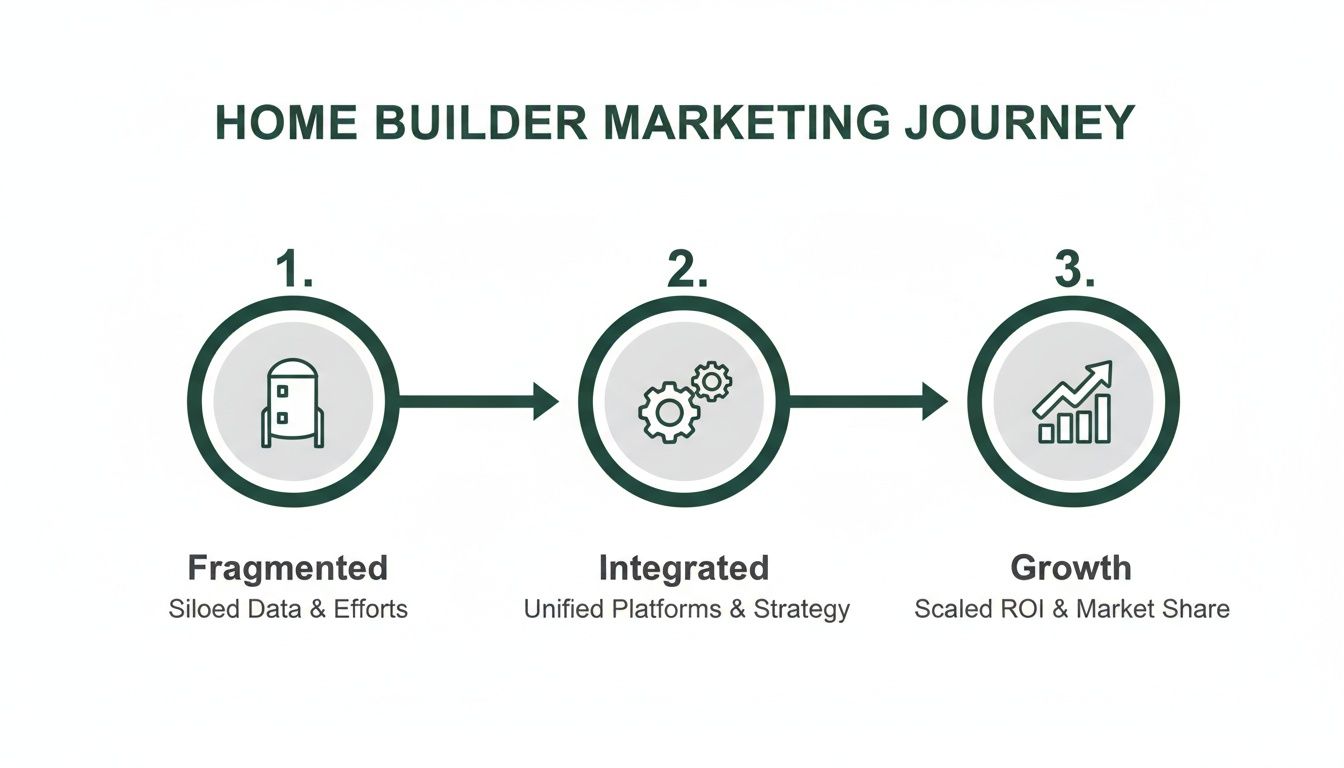
This evolution makes one thing clear: connecting your disparate systems is how you scale growth and deliver a superior buyer experience without increasing headcount. By identifying the key phases and common points of failure, you can unlock significant opportunities for operational improvement.
Phase 1: Acquisition
This phase is about capturing the attention of qualified, high-intent buyers. The primary challenge is not generating a high volume of leads, but cutting through the digital noise to connect with prospects who are serious about purchasing a new home.
Common pain points at this stage include:
Inconsistent Brand Messaging: Disjointed ads, landing pages, and social content create brand confusion and dilute marketing impact.
Limited Visibility: A lack of clear attribution leaves leadership unable to determine which marketing channels are delivering qualified, ready-to-buy leads.
Manual Lead Nurturing: Sales teams spend valuable time on repetitive follow-up, detracting from high-value conversations with serious buyers.
To succeed, you must build trust from the first click by delivering valuable content that answers buyer questions proactively.
Phase 2: Conversion
The journey from contract to close is the most critical—and emotionally charged—phase. This is where brand promises are tested. A seamless experience builds loyalty; a fragmented one creates lasting frustration. The primary cause of buyer anxiety and closing delays is fragmented communication between sales, design, and construction teams.
A seamless conversion experience directly accelerates your sales cycle. Providing buyers with a transparent, self-service portal for updates and documents dramatically reduces inbound calls and emails, freeing up your team to focus on selling the next home.
A modern customer experience platform like Foundation acts as the connective tissue, linking your CRM and construction software to create a single source of truth. It automates milestone updates and centralizes documents, ensuring every buyer receives a consistent, high-touch experience without adding manual work for your team.
Phase 3: Retention
The customer relationship doesn't end at closing; it enters a new, high-value phase. This is your opportunity to convert new homeowners into brand champions and a predictable referral engine. Unfortunately, most builders treat this stage as a cost center dominated by reactive warranty claims.
This is a massive strategic oversight.
By providing homeowners with a branded digital hub—complete with documents, maintenance reminders, and service requests—you can proactively manage the ownership experience. This not only reduces the burden on your warranty team but also keeps your brand top-of-mind. This consistent, helpful presence is the foundation for driving high-quality referrals and repeat business, creating a powerful, low-cost revenue stream from your most valuable asset: your existing customers.
Executing High-Impact Buyer Acquisition Strategies
A predictable pipeline of qualified buyers is the engine of sustainable growth. In a market where buyers conduct extensive online research before considering a model home visit, your acquisition strategy must be digital-first and data-driven.
The goal is to build a precise, measurable system to attract and convert serious prospects efficiently. This means shifting your mindset: your website isn't just a digital brochure; it's your primary sales and conversion tool.
Optimizing Your Digital Front Door
Your website is your single most valuable marketing asset. It’s where serious buyers validate their interest and decide whether to engage with your sales team. A slow, confusing site actively sends your best leads to the competition.
To transform your site into a conversion engine, focus on these key areas:
High-Intent Paid Search (SEM): Target long-tail keywords that signal purchase intent, such as "new construction homes in [City] with first-floor master," to connect with buyers who are further down the funnel.
Data-Driven Social Advertising: Move beyond generic brand awareness. Use platform data to target ads based on life events (e.g., newlyweds, growing families) and demonstrated interest in real estate to ensure your message resonates.
Authoritative Content Marketing: Create content that answers your buyers' most pressing questions—from neighborhood guides to financing options. This builds trust and positions you as an indispensable expert.
For a primer on fundamentals, understanding lead generation marketing is a great resource for building a more robust pipeline.
Bridging the Physical and Digital Divide
The model home tour remains a powerful sales tool, but its role has evolved. It’s now a critical mid-funnel touchpoint where buyers confirm their online research. The key is to create a seamless experience that connects their digital journey with their in-person visit.
Implement digital check-in systems to capture visitor information and trigger automated follow-up sequences. Use QR codes throughout the home to link to virtual tours and design galleries. This integration ensures no leads are lost and provides your sales team with valuable context for each prospect’s interests.
The impact of mobile cannot be overstated. With 78% of local mobile searches leading to a purchase within 24 hours, optimizing every touchpoint for mobile is non-negotiable. Furthermore, 40% of home services consumers who call from a search ad make a purchase, demonstrating the power of high-intent channels.
By connecting these digital and physical experiences, you create a rich data trail for every prospect. This visibility allows leadership to track engagement, measure the true ROI of model home investments, and refine strategies based on real-world buyer behavior.
Automating Engagement to Increase Capacity
Your sales team's most valuable resource is time. Manual, repetitive follow-ups drain their capacity and prevent them from focusing on high-value conversations. This is where automation becomes a strategic advantage.
By implementing intelligent automation, you can standardize initial engagement and nurture early-stage leads, ensuring every prospect receives timely, relevant communication. This creates a consistent brand experience that scales without adding headcount. For executives, this translates directly to increased operating leverage; your existing team can manage a larger pipeline more effectively, accelerating sales velocity.
An integrated system can put your lead generation on autopilot, freeing your team to focus exclusively on closing deals.
Navigating the Journey From Contract to Close
Securing a purchase agreement is the start of the most critical phase—one that cements your brand reputation, ensures the deal closes, and earns future referrals. For homebuilder executives, mastering this journey is the most direct path to accelerating sales and improving operational efficiency.
This is precisely where processes often break down. Communication becomes scattered across siloed sales, construction, and design teams. Left in the dark, buyers become anxious, leading to a flood of inbound calls and emails that consume team capacity and create last-minute fire drills that erode margins.
The root cause is disconnected systems and manual workflows. Information is trapped in separate CRMs, construction software, and ERPs, creating friction for everyone and slowing down the entire process.
Unifying the Experience Without Replacing Core Systems
The solution isn't to rip out the core systems your teams rely on. The strategic move is to add a customer experience layer—like Foundation—that sits on top of your existing tech stack, acting as the connective tissue.
This layer serves as the single source of truth for the customer, pulling key milestone data from your internal systems and presenting it in a simple, self-service portal branded as your own. This approach shifts the journey from a high-touch, manual process to a high-tech, high-trust automated one.
For leadership, this is an operating model designed for efficiency. By automating routine updates and centralizing communication, you give your sales team back weeks of their year—time they can reinvest in selling more homes instead of chasing down information.
This approach transforms a chaotic part of the buyer journey into a predictable, measurable, and scalable process.
Accelerating Closings with a Digital Concierge
Imagine providing every buyer with a personalized, digital concierge. This central hub offers 24/7 access to everything they need, dramatically reducing "just checking in" calls to your team.
A digital experience can deliver:
Automated Construction Updates: The system can automatically push notifications for key milestones like "Foundation Poured" or "Framing Complete," building trust and setting clear expectations without manual effort.
Centralized Document Access: Buyers can securely access contracts, design selections, and closing documents in one place, eliminating frantic email searches.
Task and Milestone Tracking: A visual timeline shows buyers exactly where they are in the process and what’s next, from securing financing to scheduling the final walkthrough.
Empowering buyers with this transparency and control transforms the dynamic. They feel informed and confident, resulting in fewer panicked calls and a smoother path to closing. This efficiency boost allows your existing team to manage more closings simultaneously without sacrificing quality.
From Reactive Firefighting to Proactive Management
A fragmented closing process forces your teams into a constant state of reactive firefighting. An uncommunicated construction delay can quickly escalate, creating stress and risk.
An integrated customer experience platform provides leadership with a clear line of sight. You can track buyer engagement, monitor milestone completion rates across communities, and identify potential bottlenecks before they derail a closing. This data enables you to proactively manage the process instead of just reacting to problems.
This operating model is a key component of a modern home builder marketing strategy, leveraging the customer experience itself as the most powerful tool for building brand trust, accelerating revenue, and creating a scalable foundation for growth.
Turning Homeowners Into a Powerful Referral Engine
The customer relationship does not end at closing; it enters its most valuable and often-neglected phase. For most builders, the post-close experience is a reactive warranty process viewed as a cost center. This is a significant strategic error. The real opportunity is to transform this period into a proactive, brand-building engine that drives long-term revenue.
A happy homeowner is your most credible and cost-effective marketing channel. By shifting focus from simply fixing problems to actively managing the ownership experience, you convert an operational drag into a predictable source of high-quality referrals and repeat business. This directly builds enterprise value by creating a sustainable, low-cost customer acquisition channel.
This is about moving from a transactional service model to one of long-term engagement, keeping your brand top-of-mind long after the final walkthrough.
From Reactive Warranty to Proactive Ownership
The traditional warranty model is broken. It’s reactive: a homeowner submits a ticket through a clunky portal and waits, creating frustration for them and an administrative burden for your team.
A modern approach flips this model. By providing every homeowner with a branded, self-service digital hub, you can anticipate their needs and solidify your role as a trusted partner. This is not a replacement for your core construction or ERP systems; it’s the customer-facing layer that connects everything.
This hub becomes the homeowner's single source of truth, offering instant access to:
Essential Documents: Closing paperwork, floor plans, and appliance manuals are organized and easily accessible.
Proactive Maintenance Reminders: Automated alerts for tasks like changing air filters help homeowners protect their investment and reduce preventable warranty claims.
Streamlined Service Requests: A simple, trackable system for submitting and monitoring warranty claims reduces inbound calls and sets clear expectations.
This proactive stance significantly reduces the volume of low-level questions, freeing your warranty team to focus on complex issues where their expertise is most valuable.
Building an Intelligent Referral and Repeat Buyer Program
Once you've established this foundation of trust, you can activate your customer base as a powerful sales force. A generic "refer a friend" email is no longer sufficient.
An effective program is integrated directly into the ownership experience, making it effortless for satisfied homeowners to become brand advocates.
By integrating referral tools within the owner portal, you can prompt advocacy at moments of peak satisfaction—such as immediately following a positive warranty experience. This turns passively satisfied customers into active brand promoters.
An integrated system allows you to track referrals from submission to closing, providing clear attribution and proving the ROI of your post-close engagement. You can finally identify and reward your biggest champions, creating a powerful loyalty loop. For a deeper dive, there are many powerful referral marketing strategies you can adapt.
This platform also keeps your brand front-and-center for years. When a homeowner is ready to move up or invest in another property, you become their first call. This is the ultimate long-game in home builder marketing, ensuring the value of each customer relationship grows long after the sale.
ROI of an Integrated Ownership Experience
Shifting from a reactive warranty department to a proactive, branded ownership experience has a tangible impact on the bottom line. It's about running a smarter, more efficient, and more profitable business.
Operational Area | Traditional Model Pain Point | Integrated Platform Solution | Measurable Business Outcome |
|---|---|---|---|
Warranty & Service | High volume of inbound calls and emails; slow response times; frustrated homeowners. | Self-service portal with proactive maintenance alerts and streamlined ticket tracking. | 20-30% reduction in inbound support volume; faster ticket resolution time. |
Referral Marketing | Ad-hoc, low-engagement "refer a friend" emails; zero tracking or attribution. | Automated, in-app referral tools prompted at moments of high satisfaction; full tracking. | 2-3x increase in qualified referral leads; direct ROI attribution for post-close efforts. |
Repeat Business | No consistent post-close communication; brand is forgotten after the first year. | Ongoing engagement through the ownership hub keeps the brand top-of-mind. | Measurable increase in repeat buyer rates over a 5-7 year horizon. |
Team Efficiency | Sales and warranty teams bogged down with repetitive administrative tasks and questions. | Centralized hub for documents and communication automates rote tasks and answers. | Sales team saves 5+ hours per week to focus on new leads; increased team capacity. |
An integrated ownership platform is not a cost center—it's an investment in a predictable, low-cost customer acquisition channel that pays dividends for years.
Designing Your Marketing and CX Technology Stack
Your technology stack is the backbone of your entire customer experience strategy. For executives, selecting the right technology is a core business decision that directly impacts sales velocity, operational leverage, and long-term brand value.
The objective is not to accumulate more software, but to build a cohesive system where each component serves a clear strategic purpose. Your core systems—CRM for lead management, construction software for project tracking, and ERP for financials—are indispensable. The challenge is enabling them to communicate effectively.
The Role of a Customer Experience Layer
A customer experience (CX) platform serves as the critical connecting tissue for your existing systems. It acts as the single source of truth for every customer interaction, pulling data from your other platforms to create a seamless, branded journey for your buyers.
It is the customer-facing operating system for your business. It does not replace your CRM or construction software; it unlocks their combined power by automating communication, standardizing workflows, and providing an unprecedented view of buyer engagement from contract to closing and beyond.
This is how you scale a consistent, high-touch brand experience without scaling headcount or operational complexity.
A well-designed tech stack is a growth engine, not a cost center. By automating routine communication and providing buyers with self-service options, you return your team's most valuable asset: time. This time can be reinvested into high-value activities that drive revenue.
Achieving this alignment is crucial. The global home builder market is projected to grow from $900 billion to $1.5 trillion by 2033, intensifying competition for every buyer. You can explore the data in this market growth projection from HTF Market Insights. In this environment, a superior customer experience is the defining competitive advantage.
Key Considerations for Your Technology Stack
When evaluating technology, shift your focus from feature lists to business outcomes. The right platform should feel like a natural extension of your brand, allowing you to own your data, your brand, and your customer relationships completely.
From an executive perspective, the criteria are clear:
White-Labeled Experience: The platform must feel like yours. Your brand should be front-and-center, not a third-party tool that creates confusion.
Deep Integration Capability: Look for platforms with a robust, API-first architecture that can seamlessly plug into the core systems you already rely on.
Enterprise-Ready Security: The system must meet the highest standards for data security and privacy to protect your business and your customers.
Scalability and Flexibility: The technology must adapt to your unique workflows and be capable of growing with you as you expand into new divisions and communities.
Your tech stack should be a strategic asset that reduces risk, enhances team performance, and helps you build a defensible brand that customers trust and recommend.
Common Questions About a Modern Home Builder Marketing Strategy
Transitioning to a modern, customer-first marketing strategy is a significant operational shift. Leaders naturally have practical questions about implementation, integration with existing systems, and measuring real-world impact.
Here are the most common questions we address.
How Does This Kind of Platform Fit with My Existing CRM?
A modern customer experience platform does not replace your core systems; it enhances them. It is not another CRM.
Think of it as the missing integration layer that connects your CRM, ERP, and construction software. It acts as the customer-facing hub, pulling milestone data from your construction software while syncing all buyer communications back to your CRM. The result is a unified view of the customer journey without disrupting the workflows your teams already depend on. It’s about creating synergy, not starting from scratch.
What Is the Actual ROI of Investing in the Customer Experience?
The return on investment is measured in tangible business outcomes that impact the bottom line. By automating routine communication and providing buyers with a self-service portal, we see sales teams regain 5+ hours per week—increasing their capacity to nurture leads and close deals faster.
The true value extends further. It’s about accelerating sales velocity, reducing inbound support calls by up to 30%, and building a powerful, predictable referral engine. You transform a traditional cost center (like warranty) into a low-cost, high-performance customer acquisition channel.
How Do I Future-Proof My Marketing and Sales Operations?
Future-proofing your business means owning your customer relationships and the associated data. Relying on third-party channels and fragmented systems leaves you vulnerable to market shifts and algorithm changes.
By centralizing your customer journey on a white-labeled platform, you build a direct, branded channel to every buyer and homeowner. This puts you in control. You own the narrative, gather firsthand engagement data, and cultivate a loyal community that drives long-term brand equity. This is how you build sustainable growth on an asset you completely own, insulating your business from market volatility.
A modern, integrated customer experience is the single most powerful advantage a homebuilder can have. Foundation provides the enterprise-ready platform to connect your systems, automate your workflows, and turn every buyer into a lifelong brand advocate. Learn more at https://buildwithfoundation.com.
More from Foundation

Technology
What's New - September 2026
WarrantyOS, from work order to payment. September’s updates bring more of the day-to-day warranty workflow into one connected experience.
Sep 30, 2026

Marketing
New Home Portal: A Builder's Guide to the Buyer Journey
Learn what a new home portal is, the core features builders need, and how it shapes the buyer-to-owner experience across closing and early ownership.
Sep 16, 2026

Marketing
Home Warranty Software: A Practical Buyer's Guide
Compare home warranty software for homebuilders. Evaluate work orders, vendor coordination, customer communication, integrations, and implementation.
Sep 15, 2026