Jan 22, 2026
For homebuilder executives, new home sales management is no longer just about transactions. It has evolved into a core strategic function that drives enterprise value, protects margins, and builds a sustainable competitive advantage. Mastering it means drawing a direct line from your sales team's daily operations to critical business outcomes like sales velocity, higher conversion rates, and increased operating leverage. It's the art of orchestrating people, processes, and technology across the entire buyer and homeowner lifecycle.
From Transactions to Enterprise Value
In today's market, the greatest risk to a homebuilder's brand and bottom line isn't a single lost sale. It's the cumulative cost of fragmented communication and offline workflows that erode margins, drain team capacity, and damage customer trust. When sales, construction, and closing teams operate in silos, the buyer’s journey is defined by friction, manual follow-ups, and inconsistent brand messaging.

This disjointed approach kills team productivity and directly impacts profitability. Sales associates spend hours chasing construction updates or answering repetitive questions, pulling them away from high-value sales activities. This operational drag slows down closings, invites costly errors, and makes it impossible to scale without adding headcount.
Shifting Focus to the Buyer Journey
Effective new home sales management views the process not as a simple lead-to-close funnel, but as a continuous, connected customer lifecycle. The goal isn't just to accelerate the current deal; it's to create a seamless, branded experience that builds a foundation for long-term loyalty and future revenue. This modern operating model recognizes that the post-contract experience is just as critical as the pre-sale journey.
This requires leaders to move beyond departmental spreadsheets and focus on the entire customer lifecycle, addressing key business imperatives:
Operational Efficiency: Automate routine communication and milestone updates to reclaim your teams' time and increase capacity.
Brand Consistency: Ensure every buyer receives the same high-quality, on-brand experience, regardless of community or sales agent.
Data Visibility: Gain a clear, real-time view of buyer engagement and satisfaction at every stage, from contract to post-close warranty.
Future Revenue: Transform happy homeowners into a powerful engine for referrals and repeat business, significantly lowering customer acquisition costs.
To illustrate this strategic shift, here is a comparison of the traditional, high-friction model versus a modern, customer-centric approach.
Traditional Versus Modern Sales Management
Key Area | Traditional Approach (High Friction) | Modern Approach (High Velocity) |
|---|---|---|
Primary Goal | Close the current deal. | Build a lifelong customer relationship. |
Communication | Siloed, manual, and reactive. | Integrated, automated, and proactive. |
Buyer Experience | Fragmented across teams and channels. | A single, seamless, branded journey. |
Team Focus | Chasing down information and updates. | Selling homes and building relationships. |
Business Impact | High operational drag, slow closings, eroded margins. | Increased sales velocity, lower acquisition costs, brand loyalty. |
The takeaway for leadership is clear: transitioning from a transactional model to a relational one is a fundamental operational shift that directly impacts efficiency, profitability, and long-term brand equity.
Connecting Your Core Systems
This transformation doesn't require replacing core systems like your CRM or ERP. The real leverage comes from adding a customer experience layer that acts as the connective tissue between them. This layer unifies data from disparate systems and automates cross-functional workflows, creating a single source of truth for every customer interaction.
For example, integrating comprehensive 3D architectural rendering services can elevate the initial sales presentation, giving buyers a powerful visual connection to their future home and accelerating their decision-making process.
For homebuilder executives, the ultimate goal is to build an operating model where a superior customer experience becomes the primary driver of growth. It’s about turning a series of complex, high-friction interactions into a smooth, predictable, and profitable journey that builds lasting brand equity.
Pinpointing Friction In The Homebuyer Journey
To improve your new home sales management, leaders must first identify where operational friction is eroding margins and compromising the customer experience. The journey from contract to close is rarely as linear as internal process maps suggest. For the buyer, it is often a landscape of disjointed communication, confusing handoffs, and anxious silences that diminish trust.
These gaps create significant strategic risks. When a sales associate spends hours each week chasing construction updates, that is measurable time not spent generating new sales. When a buyer receives conflicting information from sales and closing coordinators, your brand's credibility suffers. These are not minor operational hiccups; they are hidden drags on the business that slow sales velocity and bleed profitability.
From Contract Signing To Construction Chaos
The moment a purchase agreement is signed, the customer relationship transitions from being sales-led to operations-led. This handoff is where the first critical fractures often appear. The buyer, once the center of attention, can feel abandoned as their file moves from the sales office to back-office systems.
Without a unified communication platform, critical details are lost in translation between sales, the design center, and construction managers. This fragmentation leads to predictable and costly pain points:
Manual Follow-Ups: Sales teams are pulled back into a customer service role, fielding questions about construction timelines instead of focusing on their next sale.
Inconsistent Messaging: Buyers receive conflicting information from different departments, creating confusion and eroding confidence in your process.
Lack of Visibility: Leadership lacks real-time insight into buyer sentiment post-contract, making it impossible to proactively manage at-risk deals.
This period should build excitement and reinforce the buyer’s decision. Instead, for many builders, it becomes a reactive cycle of problem-solving that drains team capacity and sets a negative tone for the remainder of the journey.
The Closing Crunch And Warranty Overload
As the closing date nears, communication frequency may increase, but so does the potential for friction. Last-minute document requests, scheduling conflicts, and unclear instructions create a stressful final sprint for buyers and your team. A disorganized closing can sour the entire experience, negating months of positive relationship-building.
The journey doesn't end at closing. The post-close experience, particularly the first year of ownership, is a direct extension of your sales cycle. A high volume of warranty calls for simple operational questions—like how to use an appliance—indicates a failure in homeowner education. Each preventable service call is a tax on your warranty team and a drain on profitability.
The reality is that the buyer's journey doesn't conclude at the closing table. It extends through the first year of ownership, where their experience directly shapes your brand's reputation and your ability to generate high-margin revenue from referrals and repeat purchases.
In the current market, managing these interactions with precision is paramount. For instance, the median price of newly sold homes recently dropped 7.52% year-over-year to $403,600 as builders used incentives to stimulate demand. You can find more detail in the U.S. home price history on Global Property Guide. This price sensitivity means every customer interaction counts; a fragmented communication process can lead to missed opportunities or even lost sales over minor frustrations.
This is where a connected customer experience platform becomes a strategic asset. By mapping these friction points, leaders can see how a platform—acting as the integration layer between CRM and ERP systems—transforms these liabilities into assets that drive referrals and protect the bottom line.
Measuring The KPIs That Actually Matter
For too long, homebuilder executives have relied on surface-level metrics like website traffic and lead volume. In today’s market, this is akin to navigating a ship by observing its wake. The true measure of business health—the metrics directly impacting your P&L, operating leverage, and long-term brand equity—is found in a select set of key performance indicators (KPIs). Focusing on these outcomes transforms data from a rearview mirror into a real-time dashboard for proactive leadership.
Successful builders don't track dozens of metrics; they obsess over a focused set that reveals the health of the entire buyer journey. These are direct measures of team efficiency, brand resonance, and capacity for profitable growth. Without them, you're managing by assumption, not by fact. An integrated customer experience platform surfaces this critical data by connecting your CRM, ERP, and construction systems, making it visible and actionable for your leadership team.
From Lagging Indicators To Actionable Insights
Traditionally, metrics like customer satisfaction were measured months after closing—far too late to influence the outcome. A modern approach brings these metrics forward, providing a live pulse on your operational health.
Here are the core KPIs that should be on every homebuilder executive's radar:
Sales Velocity: This measures the time from a signed contract to a successful closing. A shorter cycle means faster revenue recognition and improved capital efficiency. A customer experience platform accelerates this by automating communication and removing friction from the closing process.
Net Conversion Rate: A powerful metric of sales and marketing effectiveness: what percentage of qualified leads convert to sales? For more on this, read our guide on improving your lead-to-sale conversion rate.
Customer Satisfaction (NPS) at Key Milestones: Don't wait until the warranty period. Measure Net Promoter Score at critical touchpoints—such as contract signing, construction start, and closing—to gain a real-time gauge of buyer sentiment and identify at-risk deals before they escalate.
Percentage of Sales from Referrals: This is the ultimate report card on your customer experience. A high referral rate signifies that you are creating brand advocates, which is the most cost-effective and powerful engine for sustainable growth.
The goal is to shift from looking back at performance to proactively managing it. When you can see buyer engagement and satisfaction in real time, you empower your sales leaders to coach their teams effectively, put resources where they'll have the most impact, and forecast revenue with much greater accuracy.
Turning Market Dynamics Into A Competitive Advantage
Recent market data underscores the importance of this visibility. In March, new home sales rose by 7.4% as builders leveraged incentives and price adjustments to move inventory and drive sales velocity. Such strategies demand dynamic sales management. Modern platforms amplify these efforts by automating post-contract communications, which frees up your sales team to focus on what they do best: selling the next home. You can learn more about how builders are navigating the market with dynamic sales strategies from recent industry analysis.
By tracking the right KPIs, you turn market volatility from a threat into an opportunity. Early visibility into customer sentiment allows your team to identify promoters, mitigate risks with detractors, and ensure that a temporary sales surge translates into sustained, profitable growth.
Building An Operating Model For a Scalable Customer Experience
Effective new home sales management is about building a modern operating model where technology serves as the central nervous system for your entire customer journey. This represents a fundamental shift from managing siloed transactions to orchestrating a seamless, scalable, and profitable customer experience.
The core of this model is a dedicated customer experience (CX) layer, such as Foundation, that integrates with your existing systems. It acts as the connective tissue linking your CRM, construction management software, and ERP to create a single source of truth for every customer interaction, eliminating the fragmented communication that erodes margins and team capacity.
Connecting Systems to Automate Outcomes
Consider a common scenario: a buyer calls seeking a construction update. In a traditional model, this simple request initiates a manual, time-consuming process. The sales associate fields the call, tracks down the construction manager, awaits a response, and relays the information back to the buyer—a process that can take hours or even days.
Now, imagine the same scenario powered by an integrated CX layer:
Data Trigger: Framing is completed, and the construction management system is updated.
Automated Action: This single update automatically triggers a pre-approved, on-brand message through the CX platform.
Buyer Notification: The homebuyer receives a personalized email or text with photos of their new home’s progress, creating a moment of delight.
System Sync: The communication is automatically logged in the CRM, giving the sales team full visibility without any manual effort.
This approach doesn't replace your team; it amplifies their effectiveness. It frees them from low-value administrative tasks so they can focus on what drives revenue: building relationships and selling more homes. The result is immediate time savings, reduced errors, and a consistent brand experience that scales effortlessly across one community or one hundred.
The infographic below illustrates how key performance indicators like velocity, conversion, and referrals are the direct result of a superior, well-managed customer experience.
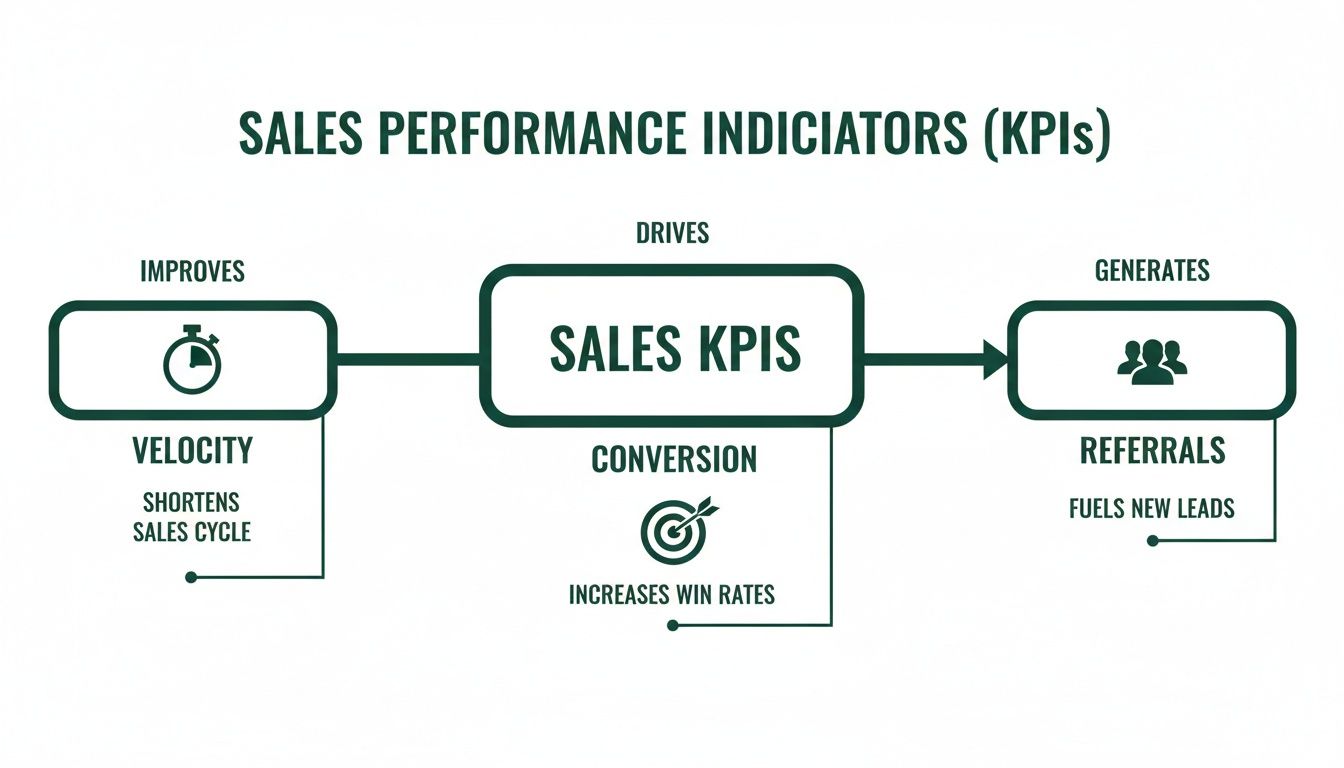
This demonstrates that sales velocity and conversion rates are the direct outcomes of a customer journey so positive that it naturally generates referrals.
Gaining Leverage in a Competitive Market
This integrated operating model provides more than just efficiency; it offers a significant competitive advantage, particularly in the current market. New home inventory recently reached 481,000 units for sale—its highest level since 2007, placing immense pressure on builders to accelerate sales. For more context, see J.P. Morgan's housing market outlook.
A centralized platform that automates milestone updates, closing processes, and new homeowner onboarding provides a massive lift to teams managing this inventory. By dramatically reducing inbound "just checking in" inquiries, this automation can reclaim weeks of sales capacity annually.
An operating model built on a connected customer experience is your greatest source of operating leverage. It allows you to grow your business without proportionally increasing headcount, turning your customer journey into a predictable, measurable, and profitable engine.
A digital Closing Concierge, for example, streamlines the final, most stressful stage of the homebuying process, delivering the transparency buyers demand and boosting close rates. When supply is high, superior management through a tech-enabled customer journey differentiates top performers. It’s how you turn high inventory into accelerated revenue and create brand loyalists for life. This is the new standard.
Your Framework For Modernizing Sales Management
Overhauling your sales management is a strategic journey, not a weekend project, typically unfolding over 6 to 18 months. The key for executive leadership is a phased approach that de-risks the investment and builds momentum by delivering measurable wins at each stage. The goal is to evolve from disconnected, manual workflows to a unified, scalable system without disrupting daily operations. This framework prioritizes process and people, then empowers them with the right technology.
Phase 1: Audit And Align Your Teams
Before considering new software, conduct a candid audit of your current processes. The mission is to identify the single greatest point of friction in your buyer's journey—the one creating the most significant pain for both your customers and your team.
Assemble leaders from sales, construction, and warranty to map the entire customer lifecycle, from contract signing to post-close ownership.
Ask the critical questions at each stage:
Where does communication consistently break down?
What repetitive, manual tasks are consuming our sales team’s capacity?
At what points does customer satisfaction decline?
What are the top five questions our teams answer repeatedly?
This collaborative audit does more than just identify problems; it builds cross-departmental alignment, creating a shared sense of urgency and a unified vision. The outcome should be a clear consensus on the #1 friction point to address first.
Phase 2: Define Your Technology Requirements
With the core problem identified, you can define the solution. This is not about chasing a long list of features. It's about finding a platform that serves as a strategic customer experience layer—one that integrates seamlessly with the core systems you already rely on, such as your CRM, ERP, and construction software.
Frame your requirements around business outcomes, not technical jargon. A strong set of requirements includes:
Integration: Must connect to our existing CRM and construction software to automate milestone updates without manual data entry.
Scalability: Must support division-specific branding and workflows while providing corporate with a unified view of performance.
Visibility: Must provide leadership with a real-time dashboard of buyer engagement and satisfaction scores.
Ownership: Must be fully white-labeled. Our brand, our data, and our customer relationships belong to us—period.
The right technology doesn't replace your core systems; it unlocks their value. It acts as the connective tissue that standardizes communication and automates workflows, creating a single, measurable, and on-brand experience that scales without adding headcount.
Phase 3: Implement And Drive Adoption
With the right platform selected, begin with a pilot program laser-focused on the single friction point identified in your audit. This controlled rollout allows you to prove the concept, gather real-world feedback, and create internal champions before a company-wide deployment.
Driving adoption is paramount. Success hinges on demonstrating to your teams how the new system makes their jobs easier, not more complex. Frame it as a tool that eliminates administrative work, freeing them to focus on high-value activities: building relationships and selling homes.
As you modernize your internal processes, don't neglect the top of the funnel. Effective digital advertising is essential for lead generation. A practical next step is exploring a guide on PPC management for real estate.
By following this phased approach, you can systematically transform your sales management from an operational liability into your most powerful competitive advantage.
Building Your Most Defensible Moat: The Connected Customer Journey
In a competitive market, what truly differentiates your business? It’s no longer just land positions or floor plans. Your most defensible moat—the asset that protects your business long-term—is the quality and consistency of your customer experience. The buyer’s journey is a continuous loop, not a linear path that ends at closing.
The experience you deliver after the contract is signed has a significant ripple effect on your most critical business outcomes. A smooth, automated post-close journey does more than satisfy buyers; it proactively educates homeowners, reducing your warranty load. It builds brand trust, turning customers into advocates who generate a steady stream of high-quality, low-cost referrals. Ultimately, it drives invaluable revenue from repeat buyers.
From Transactional Success to Enterprise Value
Every interaction, from the first construction update to the final warranty sign-off, is either a deposit into or a withdrawal from your brand's equity. Fragmented communication and clunky manual processes are the silent killers of enterprise value. They introduce risk, create operational drag, and leave future revenue on the table.
Conversely, investing in a seamless, branded customer journey creates a powerful flywheel effect:
Reduced Operational Costs: Automation minimizes warranty overload and frees team capacity, allowing you to scale revenue without scaling headcount at the same rate.
Increased Revenue Predictability: A steady pipeline of referrals and repeat business creates more stable and predictable revenue streams, insulating your business from market volatility.
Enhanced Brand Equity: A reputation for an exceptional post-close experience becomes a key market differentiator that commands respect and earns true customer loyalty.
This strategic focus on a unified customer experience is what separates market leaders from the rest. It is about transforming a series of disjointed transactions into a cohesive journey that builds lasting relationships.
For homebuilder executives, the forward-looking takeaway is clear. Your customer experience is not a cost center; it is your most powerful asset for building a resilient, efficient, and profitable business for the long term.
The New Competitive Imperative
An integrated, white-labeled, and enterprise-ready platform enables this modern operating model. It allows builders to own the customer relationship, control their brand narrative, and scale an exceptional experience without adding complexity. As you map out your strategy for the next 6-18 months, view this not as a technology decision, but as a core business strategy. In a market where buyers have more choices than ever, the builder who delivers the best end-to-end journey wins. This is your most defensible moat.
Your Top Questions About New Home Sales Management
When we talk with homebuilder executives about modernizing their sales process, a few key strategic questions always come up. Here are the answers to the most common ones we hear from leadership teams planning for the next 6-18 months.
Will A New Platform Rip and Replace Our Existing Systems?
No. A modern customer experience platform is not designed to replace your existing systems. It is a strategic layer that sits on top of and connects your current CRM, ERP, and construction management software. Think of it as the customer-facing orchestration engine that leverages the backend systems you already trust. It pulls the right data at the right time to automate workflows and create a unified, branded experience for the buyer without disrupting your core operations.
How Does Improving The Post-Contract Experience Actually Impact Sales?
It has a massive, direct impact on your sales team's capacity and your future revenue. When you automate routine "what's next?" updates and manual communications, you give weeks of productive time back to your sales team annually—time they can dedicate to selling more homes.
A seamless closing and ownership experience creates brand advocates, dramatically increasing high-quality referrals and repeat buyer opportunities—some of the most cost-effective sources of new business.
Furthermore, a genuinely positive experience builds a powerful brand reputation that attracts new buyers and provides leverage to defend your margins. It becomes your most effective marketing.
Can A Single System Really Work For All Our Different Divisions?
Absolutely. An enterprise-ready platform is specifically built for this complexity. A core capability is the ability to configure workflows, communication templates, and branding for each division or community, ensuring brand and data integrity are never compromised. This structure allows you to standardize critical parts of the customer journey and maintain corporate oversight while providing each division the flexibility needed to achieve its goals. The objective is consistency in quality, not a rigid, one-size-fits-all process. It’s a builder-first approach, ensuring your brand, your data, and your customer relationships always belong to you, providing a scalable model for growth.
Ready to turn your buyer journey into your most defensible competitive advantage? Foundation is the customer experience platform that connects your systems, automates communication, and gives your teams back weeks of valuable selling time. Schedule a demo with Foundation today and see how leaders are building more profitable, efficient, and customer-centric businesses.
More from Foundation

Marketing
New Home Portal: A Builder's Guide to the Buyer Journey
Learn what a new home portal is, the core features builders need, and how it shapes the buyer-to-owner experience across closing and early ownership.
Sep 16, 2026

Marketing
Home Warranty Software: A Practical Buyer's Guide
Compare home warranty software for homebuilders. Evaluate work orders, vendor coordination, customer communication, integrations, and implementation.
Sep 15, 2026

Marketing
How to Improve Team Accountability in Homebuilding
Improve team accountability in homebuilding with clear owners, reliable handoffs, practical metrics, and less manual follow-up from contract through warranty.
Sep 14, 2026