Jan 28, 2026
For many homebuilder executives, scaling the business feels like a constant battle against fragmentation. Critical data is scattered across disconnected spreadsheets, siloed software, and manual reports. This operational drag leads to slow decisions, messy job costing, and a chronic lack of visibility into project profitability. This is the exact problem a construction enterprise resource planning (ERP) system is designed to solve.
A construction ERP is the single source of operational truth for a homebuilding business, connecting all financial, project, and procurement data into one central system. It’s the digital foundation that every other business function—from accounting to project management—is built on for stability and scale.
The Operational Backbone of a Modern Homebuilder
When accounting, procurement, and construction teams work from different sets of numbers, the consequences directly hit your bottom line. Budget overruns are discovered too late, change orders create chaos for the finance team, and forecasting becomes a guess rather than a data-driven projection.
A construction ERP centralizes this information, creating an operational backbone for predictable growth. It ensures every department works with the same real-time data, eliminating the friction caused by siloed systems.
Moving Beyond Basic Accounting
While financials are a core component, a true construction ERP integrates multiple business functions into a unified database. It’s more than just a sophisticated accounting system; it's the engine for operational discipline.
When a project manager's update on material usage is instantly visible to finance, or a change order approved in the field immediately reflects in the budget, you eliminate the need to chase down information or work with outdated reports.
This integration delivers several key business outcomes:
A Single Source of Truth: It resolves data discrepancies between the field and the back office, so leaders make decisions based on what's happening now.
Improved Margin Control: With real-time visibility into job costs, you can make proactive adjustments to protect profitability before a project goes off track.
Enhanced Operational Scalability: Core processes like purchasing and payroll become standardized, allowing your business to handle more projects without proportionally increasing administrative headcount.
A construction ERP serves the same purpose as a home’s foundation. It’s largely invisible to the outside world, yet it provides the essential stability required to build anything of lasting value upon it.
Ultimately, an ERP brings predictability to internal operations. While it masters internal efficiency, its data becomes a strategic asset when connected to the customer journey. This link between back-office systems and front-office communication is what transforms operational gains into a world-class homebuyer experience, much like how modern residential construction management software bridges field operations and project oversight.
Unpacking The Core ERP Modules For Homebuilders
A construction enterprise resource planning system is a suite of interconnected modules. For a homebuilding executive, understanding these modules isn't about memorizing a feature list; it's about seeing how they solve the real-world problems that drain margins and slow growth.
Financial Management: The Command Center
The Financial Management module is the heart of the operation. It manages the general ledger, accounts payable, and accounts receivable, providing a single source of truth for the company's financial health.
For a homebuilder, this module offers a live, consolidated view of cash flow across every project and the business as a whole. It’s the tool that answers critical questions: "Are we on budget?" "What's our cash position today?" and "Is our profitability trending up or down?"
Job Costing: Protecting Your Margins
If finance is the heart, Job Costing is the brain. This is where a construction ERP proves it’s built for the homebuilding industry. It meticulously tracks every dollar spent on a specific job—labor, materials, subs—and compares it against the budget in real time.
Imagine lumber prices spike on a new community. A COO with a solid job costing module sees the variance immediately, not in a report three weeks later. This allows for immediate action, like finding a new supplier or adjusting pricing on the next phase. It’s proactive control, not just historical tracking.
The real value of a Job Costing module isn't just tracking where money was spent; it's providing the foresight to control where it's going. It transforms financial data from a historical record into a forward-looking decision tool.
Project Management and Scheduling
This module connects financial data to field timelines. It manages schedules, allocates resources, and tracks progress to ensure construction milestones are met. A good ERP often integrates with specialized tools like construction takeoff software to ensure material estimates are accurate from the start.
When integrated, a delay flagged on-site automatically updates financial forecasts. This connection prevents the common problem of the back office working from an old schedule, which leads to inaccurate cash flow projections and payment timing.
Procurement and Supply Chain Management
Managing the flow of materials and services is a significant operational challenge. The Procurement module brings order by automating and tracking the entire purchasing cycle, from purchase orders and vendor management to invoicing and payments.
This module enforces consistency and control. It prevents unapproved spending, ensures volume discounts from preferred suppliers, and helps manage lead times to avoid crews waiting for materials. This disciplined process is a key benefit of well-implemented workflow automation software.
Here’s how these core components directly impact a homebuilder’s bottom line.
Key ERP Modules and Their Business Impact for Homebuilders
ERP Module | Core Function | Business Impact for Executives |
|---|---|---|
Financial Management | Manages general ledger, AP/AR, cash flow, and financial reporting. | Provides a real-time, consolidated view of company-wide financial health, enabling better strategic decisions and investor confidence. |
Job Costing | Tracks all job-related costs (labor, materials, subs) against budgets in real time. | Protects profit margins by immediately flagging cost overruns, allowing for proactive course correction instead of reactive damage control. |
Project Management | Handles scheduling, resource allocation, and construction progress tracking. | Ensures projects stay on schedule, improves resource utilization, and links field operations directly to financial forecasting. |
Procurement | Automates the entire purchasing lifecycle, from purchase orders to vendor payments. | Controls spending, reduces material costs through better vendor management, and prevents costly delays by optimizing the supply chain. |
A centralized construction ERP is no longer a luxury for homebuilders. It is a necessity for clear, confident leadership in an industry where disconnected information routinely drives projects past budget and timelines.
The Strategic Payoff of an Integrated ERP
The true value of a construction enterprise resource planning system is strategic. For an executive, adopting an ERP is about building an operation that is more resilient, predictable, and profitable. The ROI isn't just saved time—it's measured in improved operating leverage and the ability to grow without a proportional increase in back-office headcount.
An integrated ERP replaces guesswork with certainty. It creates a single source of truth for all financial and project data, reducing the operational risk that comes from running a business on a patchwork of spreadsheets. When teams work from the same real-time data, communication silos between accounting, purchasing, and construction dissolve.
Driving Profitability with a Single Source of Truth
The most immediate impact leaders feel is the shift from reactive fire-fighting to proactive, strategic decision-making.
Instead of discovering a budget overrun weeks after the fact, a centralized system flags margin erosion the moment it begins. This gives your operations team the opportunity to make immediate adjustments and protect a job's profitability before it spirals.
This real-time visibility creates a positive ripple effect across the business:
Confident Financial Forecasting: Cash flow projections become reliable because they are tied directly to live project schedules and purchasing data.
Reduced Administrative Drag: Manual data entry and reconciliation between different systems are automated, freeing your team for higher-value work.
Standardized Workflows: Processes for procurement, change orders, and invoicing become consistent across all projects—a requirement for scaling efficiently.
A construction ERP delivers the [advantages of business process automation](https://www.n2labs.ai/blog/advantages of business process automation) by simplifying workflows and eliminating manual effort. This builds a leaner, more agile organization.
Building a Foundation for Scalable Growth
As homebuilders face pressures from supply chain disruption to labor shortages, the need for a strong operational backbone has become critical. The global construction ERP software market is projected to grow from $4.0 billion in 2025 to $8.2 billion by 2032, a direct response to industry-wide pain points like cost overruns and operational bottlenecks.
A solid ERP provides the structure needed to navigate this complexity. It creates an operating model built for growth, not one that requires adding more people just to chase down information.
An ERP is not a cost center; it is a strategic investment in predictability. It transforms your operational data from a collection of historical records into a forward-looking asset that guides intelligent growth.
Getting your internal operations in order is the first step. The next is connecting this powerful back-office engine to your customers. Creating a unified customer experience that bridges this gap is how internal efficiency becomes a true competitive advantage.
Connecting Your ERP to the Customer Journey
A finely tuned construction enterprise resource planning system is a powerhouse for internal operations, offering a clear, real-time picture of job costs, financials, and schedules. But for all its internal strength, an ERP has a significant blind spot—it is completely disconnected from your customer.
This creates an "experience gap" between the valuable, live data locked in your back-office systems and the often-frustrating experience your homebuyers receive. Your ERP knows the foundation was just poured, but your customer is calling their sales contact for the fifth time to ask for an update.
That gap forces your team into a reactive mode, burning hours answering repetitive questions and manually passing along information that already exists in your systems. This operational drag reduces team capacity and creates an inconsistent, high-effort experience for homebuyers.
Bridging the Gap with a Customer Experience Layer
Closing this experience gap isn't about giving customers a login to your complex ERP. It’s about adding a dedicated customer experience layer that acts as the connective tissue between your internal systems and the external homebuyer journey.
This is the role modern platforms are designed to play. They connect to your core systems—your ERP, CRM, and construction management software—to orchestrate a seamless flow of information across the entire buyer-to-owner lifecycle. This layer translates raw operational data from your ERP into proactive, personalized, and builder-branded communication for your homebuyers.
Turning Internal Data into a Competitive Advantage
Consider a real-world scenario:
An ERP Milestone is Updated: Your project manager updates the schedule in the ERP, marking the "Drywall Complete" milestone. Normally, this information remains in the back office.
The Experience Layer Takes Action: A connected customer experience platform detects this ERP update in real-time, triggering a pre-built communication workflow.
The Homebuyer Receives a Proactive Update: The homebuyer gets a polished, builder-branded email or a notification in their portal, congratulating them on the progress and explaining what’s next.
This single, automated workflow solves multiple problems at once. You can learn more about how this works by exploring what a dedicated customer experience platform for homebuilders provides.
The infographic below breaks down how connecting your systems drives business results.
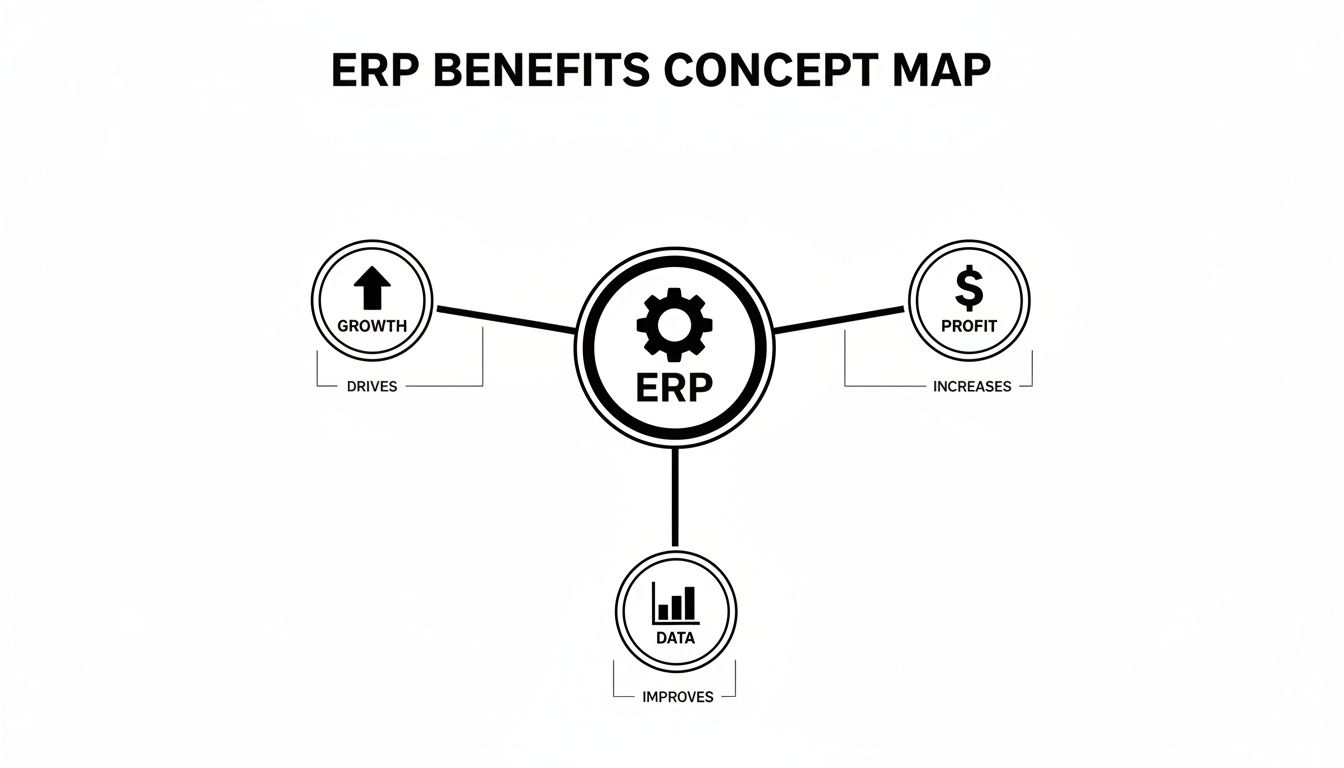
The key takeaway is that an integrated ERP becomes the engine for improving your bottom line, scaling growth, and providing the hard data needed for confident decisions.
By connecting your internal engine to your external experience, a routine operational update becomes a moment of customer delight. This simple shift has an outsized impact on your business:
It reduces inbound calls and emails, freeing up hours of your sales and construction teams' time each week.
It boosts team capacity without adding headcount, allowing them to focus on high-value work instead of repetitive follow-ups.
It delivers a superior, transparent experience that builds trust and fuels referrals.
This is where most builders see the experience break down. They invest heavily in perfecting internal operations but fail to translate that efficiency into a tangible benefit for the homebuyer. An integrated customer experience layer makes this connection scalable.
A construction ERP gives you control over your internal world. Connecting it to the customer journey is what allows you to build a modern, resilient, and customer-focused homebuilding brand.
Choosing the Right Construction ERP Partner
Selecting a construction enterprise resource planning partner is a six- or seven-figure strategic decision. This isn't just a software purchase; it's choosing the foundation for predictable profits and scalable growth. Getting it right enables smooth scaling. Getting it wrong results in a system that complicates operations and drains resources.
It’s easy to be swayed by a feature checklist or a polished demo, but a flashy presentation can hide an inflexible system that doesn't fit the unique workflows of residential construction. Leaders must focus on the partner's homebuilding expertise, the system's scalability, and the true total cost of ownership.
Do They Actually Know Homebuilding?
Many generic ERPs claim to handle construction, but homebuilding presents unique challenges like residential job costing, managing spec versus presale workflows, and handling a high volume of purchase orders across multiple communities.
If a vendor lacks deep industry experience, they will expect your team to change its processes to fit their software. This approach creates friction, hinders user adoption, and undermines the investment.
Can It Grow With You and Play Well With Others?
Your ERP must be able to scale. Ask potential partners how their system handles the jump from building 50 homes a year to 500. If the answer involves manual workarounds or expensive custom development, it's a significant red flag.
Equally critical is the system's ability to connect with your other tools. An ERP is your internal backbone, but it cannot operate in a vacuum. It must integrate seamlessly with your CRM, construction management software, and customer experience platforms.
The real value of a modern ERP is in its ability to share data. An isolated system creates the very information silos you're trying to break down, trapping critical operational insights away from your sales, marketing, and customer-facing teams.
A Strategic Checklist for Cutting Through the Noise
Use these questions to move beyond the sales pitch and assess a potential partner's true capabilities. A knowledgeable vendor will provide clear, direct answers based on real-world builder scenarios.
Financials: How does your platform handle real-time job costing when we face change orders or sudden material price spikes?
Operations: Walk me through your implementation process for a builder of our size. What are the common roadblocks, and how do you help us overcome them?
Technology: What is your API strategy? Can you show me examples of how you’ve integrated with a CRM or a customer portal?
Partnership: What percentage of your customer base is residential homebuilders versus general contractors?
Future-Proofing: What does your product roadmap look like for the next 18-24 months? How do you incorporate feedback from builders?
The construction ERP market is growing at a 6.5% CAGR as builders are modernizing their tech stacks on futuremarketinsights.com to replace the fragmented systems that hinder growth. A leading cause of the 15-20% in annual overruns that plague firms is the continued reliance on spreadsheets for cost tracking. The right system can cut reporting times in half simply by connecting the dots.
Making the right decision requires a clear-eyed assessment of your current operational challenges and future growth ambitions. For a deeper analysis of this type of technology decision, see our guide on evaluating your build vs. buy options.
Your ERP Implementation Questions, Answered
Even with a clear business case, committing to a construction enterprise resource planning system is a major strategic decision. It is natural for leadership to have questions about the process.
Here are straightforward answers to the most common concerns we hear from homebuilding executives.
How Long Does This Actually Take for a Homebuilder?
For a mid-to-large homebuilder, implementation is typically a 6 to 18-month journey. The timeline depends on the complexity of your current processes, the volume of data for migration, and the level of customization required.
A phased rollout is often the most effective approach. Begin with core financials and job costing to secure an early win and demonstrate value quickly. From there, you can expand into procurement, project management, and other modules.
What Are the Biggest Risks We Should Watch Out For?
The most common pitfalls are budget overruns, missed deadlines, and low user adoption. These risks are almost always avoidable with strong executive sponsorship and a clear implementation plan from day one.
Here’s how to mitigate these challenges:
Conduct Deep Discovery: Map all business processes before starting. This is your best defense against the scope creep that derails budgets and timelines.
Ensure Data Integrity: Migrating messy data is a recipe for failure. Clean data is non-negotiable for system accuracy and team trust.
Invest in Change Management: Communicate the "why" behind the change to get your team on board. A solid plan fosters excitement, not resistance.
How Do We Get Our Team to Actually Use the New System?
Successful user adoption depends on three factors: visible leadership usage, role-specific training, and demonstrating that the system makes their jobs easier.
Involve key personnel from operations and finance in the selection process from the beginning to build a sense of ownership. When it comes to training, focus on how the ERP solves their specific daily challenges. After going live, celebrate early wins and use data from the system to highlight new efficiencies.
What’s a Realistic ROI We Can Expect to See?
Most builders realize a return on their investment within 12 to 24 months. Initial payback comes from direct cost savings, such as a 20-30% reduction in manual data entry and a faster monthly close process.
The strategic, long-term ROI manifests in better cash flow management, more accurate budgets that reduce costly overruns, and the ability to scale the company without a proportional increase in back-office staff.
While an ERP gets your internal house in order, the real competitive edge comes from connecting all that efficiency directly to your homebuyers. Foundation is the customer experience layer that bridges the gap between your back-office systems and the entire journey from buyer to happy homeowner. Learn more about connecting your systems to your customers.
More from Foundation

Marketing
New Home Portal: A Builder's Guide to the Buyer Journey
Learn what a new home portal is, the core features builders need, and how it shapes the buyer-to-owner experience across closing and early ownership.
Sep 16, 2026

Marketing
Home Warranty Software: A Practical Buyer's Guide
Compare home warranty software for homebuilders. Evaluate work orders, vendor coordination, customer communication, integrations, and implementation.
Sep 15, 2026

Marketing
How to Improve Team Accountability in Homebuilding
Improve team accountability in homebuilding with clear owners, reliable handoffs, practical metrics, and less manual follow-up from contract through warranty.
Sep 14, 2026