Jan 11, 2026
For today's homebuilder executives, customer service has outgrown its old definition. It’s no longer just a post-close department you call when something breaks. When executed correctly, it's a strategic growth engine that directly impacts sales velocity, operating leverage, and long-term brand equity.
When we talk about customer service in the construction industry today, we’re talking about an end-to-end buyer and homeowner experience that accelerates revenue, improves team capacity, and drives high-margin referrals. This isn't about tweaking a cost center—it's about re-architecting your operating model for scalable, profitable growth.
Why Customer Service Is Your New Growth Engine
For decades, "customer service" in construction meant one thing: managing warranty calls. It was a reactive, siloed function that kicked in only after closing. This outdated model creates significant operational drag, leaves revenue on the table, and exposes the brand to unnecessary risk.
The modern approach reframes this entirely. A continuous customer experience (CX) starts the moment a contract is signed and extends far beyond the warranty period. This is the strategic view that directly impacts the metrics your leadership team and board care about. A seamless, proactive journey doesn't just create happy homeowners; it builds operational momentum. It shortens closing cycles, frees up your team from manual follow-ups, and solidifies your brand reputation in a crowded market.
From Cost Center to Competitive Advantage
Every builder executive knows the pain points. Communication is fragmented across personal emails, texts, and offline workflows. There is limited visibility into buyer engagement and sentiment. The brand experience is inconsistent across divisions and project managers.
These aren't minor frustrations; they're systemic cracks in your operation that erode margins and inhibit your ability to scale.
By treating the customer journey as a core operational workflow, you can plug these leaks and realize immediate business outcomes:
Increased Sales Velocity & Conversion: Proactive updates and a transparent process reduce buyer anxiety, leading to faster, smoother closings with fewer last-minute obstacles that jeopardize revenue.
Improved Team Capacity & Operating Leverage: Automating routine communication frees sales, closing, and warranty teams from administrative tasks, allowing them to focus on high-value, revenue-generating activities without increasing headcount.
Stronger Referral Pipeline: An exceptional experience creates brand advocates. These homeowners become your most reliable and cost-effective source of high-quality new leads, lowering customer acquisition costs.
The data supports this focus. The construction industry boasts a high average customer retention rate of 80%, meaning loyal clients are a powerful engine for repeat business and referrals. Delivering an experience that locks in this long-term loyalty is a clear path to sustainable growth. This is why strong customer service for general contractors and remodelers is critical to their pipeline and business health.
Shifting from Traditional Support to Strategic CX
The move from a reactive support desk to a proactive customer experience strategy is a fundamental change in mindset and operations. It's not just semantics; the impact on your business is real and measurable. This table breaks down the difference between the old way and the new way of thinking.
Metric | Traditional Customer Service (Reactive) | Modern Customer Experience (Proactive) |
|---|---|---|
Primary Goal | Resolve issues and close tickets | Guide buyers, build trust, drive referrals |
Communication | Fragmented (email, text, phone); inconsistent | Centralized, branded, and automated |
Team Focus | Putting out fires; managing complaints | Preventing issues; creating brand advocates |
Business Impact | A necessary cost center; operational drag | A revenue driver; competitive advantage |
Buyer Feeling | Anxious, uncertain, often frustrated | Confident, informed, and valued |
The core takeaway for executives is this: Investing in a modern, integrated customer experience isn't about adding features—it's about fundamentally changing your operating model to build a more resilient, scalable, and profitable business.
Spotting the Cracks in Your Buyer Journey
For most builders, the path from contract to closing isn't a smooth, paved road. It’s a series of disconnected workflows, held together by the sheer manual effort of your team. While your people work hard to build a quality home, the operational cracks between sales, construction, and warranty are quietly draining profits and eroding customer trust.
The real cost here isn't just a nervous buyer. It's diminished team capacity, increased operational risk, and a growth engine that can't get out of first gear.
These gaps are the natural result of relying on a patchwork of personal emails, offline documents, and manual follow-ups to keep things moving. This creates a high-effort, inconsistent experience that simply doesn't scale. Let’s identify the points where this model most often breaks down.
The Post-Contract "Black Hole"
The moment a buyer signs the purchase agreement should kick off a phase of momentum and excitement. Instead, for many buyers, it’s the beginning of an information blackout.
This is where the first major crack appears: the handoff from sales to construction.
Your sales team moves on to the next prospect. Your construction team is focused on the build and isn't equipped for proactive customer communication. This leaves the buyer in a state of anxiety, initiating a constant stream of "just checking in" emails and calls that consume your team's time and create administrative drag. This isn't just an annoyance; it's a direct hit to your operating leverage.
The Mad Dash to Closing
As the home nears completion, a second crack widens: the chaotic scramble to the finish line. This phase often devolves into a flurry of last-minute, uncoordinated requests for documents, signatures, and scheduling.
It's a manual, stressful process for both the buyer and your internal teams, lacking a single, clear source of information.
This friction directly slams the brakes on sales velocity and complicates financial forecasting. Disorganized closings cause delays, potentially pushing revenue into the next quarter and leaving a poor final impression on the buyer. What should be a triumphant milestone becomes a frustrating exercise in administrative chaos.
Consider your current process. How many separate emails, calls, and text messages does it take to get a single buyer from contract to keys? Each interaction is a potential point of failure and a drain on your team's capacity.
Warranty Overload and a Leaky Brand
The final gap emerges after closing. The homeowner relationship is handed off to the warranty department, often without a clear, consolidated history of communication. The warranty team starts from scratch, trying to piece together context.
This disconnect fuels "warranty overload."
New homeowners, unsure who to contact or how to submit a request, initiate calls and emails to anyone they have contact information for. This creates internal chaos and a deeply frustrating experience for the customer who just made a significant financial investment with your brand.
This post-close friction is a direct threat to your brand reputation and referral pipeline. A homeowner who has to fight for warranty service will never become a brand advocate. In fact, a poor post-close experience is a primary driver of negative online reviews that deter future buyers. These aren't just customer service issues; they are fundamental business problems holding you back from profitable growth.
Speeding Up Sales from Contract to Close
The moment a buyer signs should accelerate momentum. Instead, for too many builders, this crucial phase—from contract to close—becomes a breeding ground for buyer’s remorse. Without a structured communication plan, excitement fades into an information vacuum, unleashing a flood of “where are we?” calls that swamp your team.
This isn't just an annoyance; it's a drag on your sales velocity and team capacity. The solution is to shift from a reactive to a proactive model. It's time to implement a guided, automated workflow that keeps buyers confident and engaged from signing day to closing day, without adding headcount.
A Game Plan for Proactive Communication
To shrink the contract-to-close timeline, you need a system that delivers consistent, meaningful updates without creating more manual work. The goal is to shift the communication burden from your people to a central platform—a customer experience layer that connects your existing CRM and construction management systems.
The core strategy is simple: put routine check-ins on autopilot. By linking data from your field teams directly to the homebuyer, you can trigger automated, branded messages at key construction milestones.
Foundation Poured: An automated email with a photo celebrates the first major step.
Framing Complete: A short video walkthrough helps make their future home feel real.
Drywall Up: An update explains what this milestone means for the interior timeline.
This is a strategic approach to risk reduction. You are actively reinforcing the buyer's decision, turning a period of natural anxiety into a positive, brand-building experience that protects the sale.
Turning Communication into an Operational Advantage
Automating routine updates is how you unlock significant team capacity. When buyers receive proactive, scheduled information, they don't need to call or email as often. This frees your sales and closing teams from administrative hand-holding, allowing them to focus on high-value, revenue-generating work.
The impact on operating leverage is substantial. If automation saves just two hours per week for each sales agent on a 20-person team, that's over 2,000 hours of capacity per year reclaimed for selling. That is how you scale revenue without scaling payroll.
A modern customer experience strategy isn't about sending more emails. It's about delivering the right information, at the right time, through the right channel—all without manual intervention. This consistency builds trust and directly translates to faster, more predictable closings.
This focus on operational excellence is a top priority across the industry. Recent research into customer service in the construction industry shows a massive strategic push toward optimizing delivery processes. The topic pulled in over 58,000 research spikes and consistent weekly interest from more than 1,100 businesses. The takeaway is clear: leaders see the timely delivery of information as a cornerstone of success.
Connecting Your Systems for a Frictionless Experience
True automation is only possible when your core systems are connected. A dedicated customer experience platform like Foundation serves as the connective tissue between your CRM (where buyer data lives) and your construction management software (which tracks field progress). This integration is what makes a seamless, hands-off journey possible, ensuring the builder—not the software—owns the customer relationship and data.
By acting as a central hub, this customer experience layer ensures every update is consistent, branded, and logged. No more fragmented conversations on personal devices or lost email threads. Leadership gains a single, reliable view of all buyer engagement.
This integrated approach enables builders to:
Standardize Workflows: Ensure every buyer receives the same high-quality experience, regardless of division or project manager.
Slash Inbound Calls: Answer questions before they're asked, dramatically reducing interruptions and freeing up team time.
Gain Unprecedented Visibility: Track every interaction to identify highly engaged buyers or flag at-risk customers who may need personal attention.
Ultimately, modernizing your contract-to-close phase is about building a more efficient, scalable, and profitable operating model designed for growth.
Modernizing the Closing and Homeownership Experience
The final stretch of the homebuying journey—closing and early homeownership—is where your brand promise is either realized or broken. It is a period of high friction and even higher emotions. A clumsy closing or chaotic warranty process can erase months of goodwill, damaging your reputation and stifling future referrals.
Conversely, a well-executed final stage can be your most powerful competitive advantage. By creating a clear, digitally-guided experience, you can dramatically reduce internal workload, decrease inbound service calls, and cultivate genuine brand advocates who drive long-term revenue.
The Digital Closing Concierge Model
The traditional closing process is often a messy scramble of emails, phone calls, and last-minute document hunts. It’s a manual, high-effort process that frustrates buyers, consumes team capacity, and slows your entire revenue cycle.
A "Digital Closing Concierge" model transforms this experience. It provides every buyer with a single, transparent digital hub to track milestones, access documents, and complete tasks on their schedule. This operational shift delivers significant results:
Faster Closings: A clear, step-by-step checklist eliminates guesswork and the back-and-forth that causes delays. You close homes faster, making revenue forecasting more predictable.
More Team Capacity: When buyers can self-serve for information, your closing team is freed from reactive problem-solving. They can manage more closings with greater accuracy and less stress.
Lower Operational Risk: Centralizing all closing communication and documents creates a permanent, auditable record, ensuring alignment and minimizing the risk of costly errors.
This isn't about adding headcount. It’s about leveraging a smart, centralized platform to guide buyers through the final steps with confidence and clarity.
The Digital Homeownership Hub
Great customer service in the construction industry doesn't end at closing. The post-close experience defines a homeowner's long-term perception of your brand. It is also where warranty overload can become a significant drain on resources and a major source of frustration for new owners.
Leading builders are addressing this by creating a digital homeownership hub. This centralized, white-labeled portal becomes the single source of truth for the homeowner, containing everything they need for years to come.
By providing a permanent digital home for documents, warranty information, and service requests, you transform the post-close experience from a reactive cost center into a proactive, relationship-building asset. This directly strengthens your brand and fuels your referral engine.
This hub is a powerful tool for streamlining operations and improving homeowner satisfaction. When an owner knows exactly where to find their appliance manuals or how to submit a warranty request online, they aren't calling your team for simple issues. This is a core component of a modern ownership experience designed to reduce operational drag for your team.
An effective homeownership hub allows you to:
Centralize All Home Information: From paint colors and floor plans to appliance warranties and HOA documents, everything is organized and instantly accessible.
Streamline Warranty Service: A digital submission process with a clear workflow routes requests to the right person efficiently, reducing resolution times and eliminating chaotic email chains.
Deliver Proactive Maintenance Tips: Automated seasonal reminders for tasks like changing HVAC filters or winterizing pipes add tangible value and reduce preventable service calls.
By modernizing the closing and ownership stages, you are building a more efficient, scalable operation that turns satisfied homeowners into your most powerful and cost-effective sales force.
Building Your Tech Stack for a Scalable CX
For a modern homebuilder, technology isn't just a feature—it's the core of your operating model. It dictates your capacity for growth, your operational efficiency, and the quality of your buyer experience. Building a scalable tech stack isn’t about replacing your core systems. It’s about strategically connecting them to deliver a consistent, branded customer journey.
Your existing platforms are essential: your CRM drives sales, your construction software manages the build, and your ERP handles financials. However, they rarely communicate with each other. This creates the exact information silos that frustrate buyers and burn out your team.
The Power of a Customer Experience Layer
The solution isn't another siloed tool. It's a dedicated customer experience (CX) layer—a fourth critical system designed to integrate with the technology you already own and trust. A platform like Foundation acts as this central hub for every buyer and homeowner communication. It sits on top of your other systems, pulling data from each to create one unified, seamless journey for the customer.
This approach breaks down the walls between sales, construction, and warranty. Information flows where it needs to, when it needs to. You can automate communication at scale, maintain brand consistency across all touchpoints, and gain complete visibility into every customer interaction without disrupting existing operations.
This journey map highlights the long-term nature of the homeowner relationship—this is where you win loyalty or lose it for good.
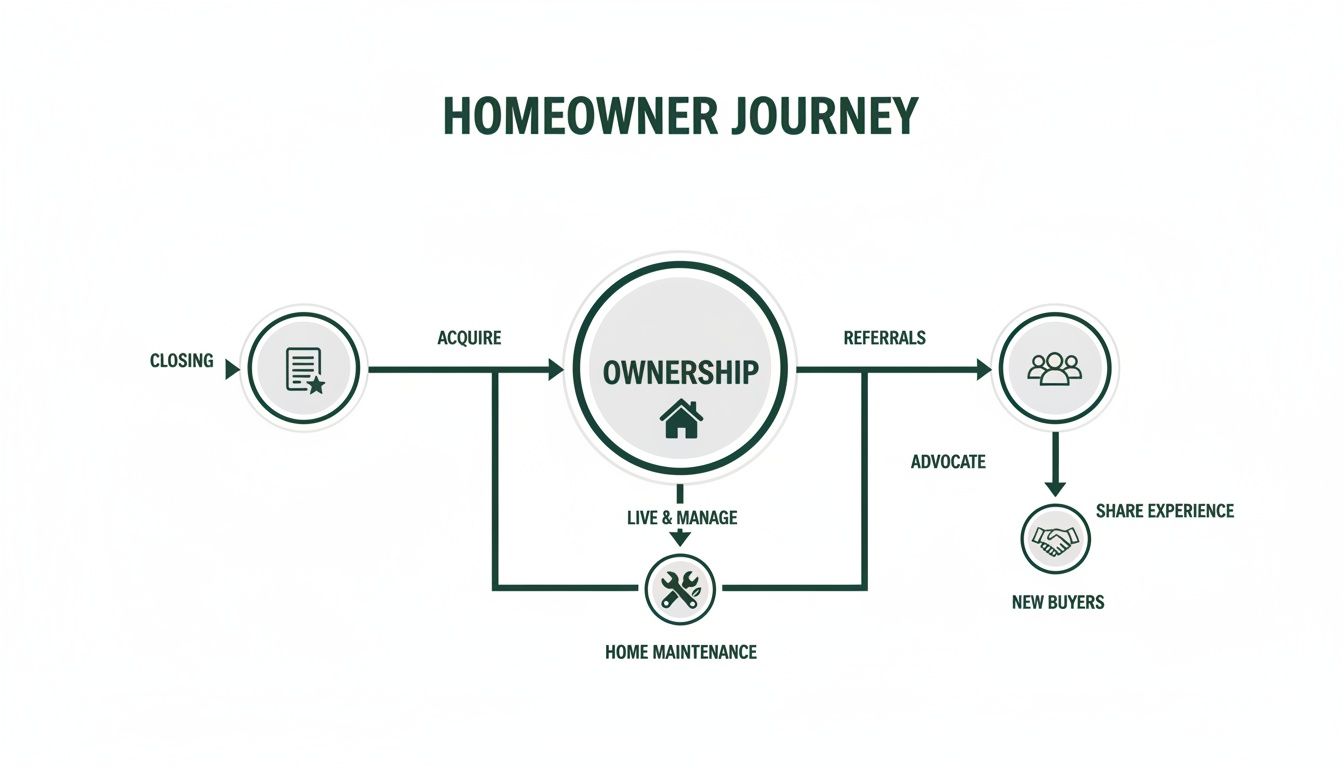
Managing these touchpoints—from closing through years of ownership and into referrals—is precisely why a unified system is no longer a "nice-to-have." It's essential for scalable operations.
A well-integrated tech stack is the key to creating a unified, efficient, and scalable customer experience in homebuilding. Below is a breakdown of the core systems and how a CX platform connects them.
The Modern Homebuilder's Core Systems
System Type | Primary Function | Role in Customer Experience |
|---|---|---|
CRM (Salesforce, etc.) | Manages leads, sales pipeline, and initial buyer relationships. | The starting point. Houses all pre-contract buyer data and communication history. |
Construction Mgmt. (Procore, etc.) | Schedules tasks, tracks project progress, and manages subcontractors. | Powers real-time construction updates that a CX platform can share with buyers. |
ERP (Oracle, etc.) | Handles accounting, financials, purchasing, and back-office operations. | Manages the financial side of the transaction, including closing and option costs. |
CX Platform (Foundation) | Integrates the systems above to unify all buyer/homeowner communication. | Acts as the "single source of truth" for the customer, providing updates and resources. |
Ultimately, this isn't just about connecting software; it's about connecting your teams to your customers in a way that feels personal and proactive, no matter how many homes you're building.
From Disconnected Tools to a Cohesive Operating Model
An integrated tech stack allows you to shift from reactive problem-solving to proactively guiding customers. New technologies are constantly evolving what's possible. For a look at innovation on the job site, consider how tools like Augmented Reality in Construction are making operations safer and more efficient.
This move toward a connected ecosystem is happening globally. The customer service software market is valued at around $14.9 billion in 2025 and is projected to hit $68.19 billion by 2031. This growth signals a clear trend: businesses recognize that a sophisticated, unified platform is essential for managing the modern buyer's journey.
When you view technology as a strategic operating model, the goal becomes clear: build a cohesive system that standardizes your process, scales your business with intelligent automation, and ensures your brand, data, and customer relationships remain firmly in your control.
An integrated, enterprise-ready platform is the only way to deliver a high-caliber experience consistently across every community and division. It transforms fragmented interactions into a powerful brand statement that drives measurable, long-term value. This is how you modernize customer service in the construction industry without increasing complexity or headcount.
Measuring the ROI of Your Customer Experience
For executives, customer experience must be a predictable, measurable driver of revenue and operational efficiency. The conversation needs to shift from "improving satisfaction" to achieving concrete business outcomes like "reducing the sales cycle by 10 days" or "increasing team capacity by 15%." This is the language of the C-suite, and it is entirely achievable with the right strategy and systems.
Key Performance Indicators for the C-Suite
To prove the return on your customer experience investment, focus on KPIs that directly impact the bottom line. These are the metrics that guide capital allocation and strategic priorities.
Here are the core metrics that builder leadership should be tracking:
Sales Cycle Length (Contract-to-Close): A smooth, transparent process with automated updates reduces friction and buyer anxiety, directly shortening this critical window and accelerating revenue recognition.
Contract-to-Close Conversion Rate: Proactive communication and a centralized hub for tasks and documents dramatically reduce the risk of deals falling through due to confusion or delays.
Team Capacity Gains (Operating Leverage): By automating routine follow-ups, your sales, closing, and warranty teams can handle more volume without adding headcount. This is pure operating leverage.
Reduction in Inbound Warranty Calls: A digital homeownership hub with self-serve resources and streamlined service requests can significantly slash inbound ticket volume, reducing overhead.
Referral and Repeat Buyer Rate: This is the ultimate metric for CX success. It validates that your experience is turning past customers into your most powerful and cost-effective sales channel.
From Data Points to Data-Driven Decisions
A fragmented process running on personal emails and offline communication provides zero visibility. You cannot identify top performers, spot at-risk buyers, or pinpoint where your process consistently breaks down.
A unified platform that tracks every customer interaction gives leadership a real-time, dashboard view of performance they've never had before. It aggregates data from across divisions and communities, transforming scattered conversations into actionable business intelligence.
This is what enables data-driven decision-making. You can identify project managers who excel at communication and scale their best practices. You can flag at-risk buyers showing low engagement and intervene before their frustration escalates into a negative review or a canceled contract.
This level of insight is impossible when communication is siloed. By bringing the entire homebuyer journey into a single, measurable system, you provide your leadership team with the data required to manage growth, mitigate risk, and build a more profitable, predictable business.
Ready to transform your customer experience from a cost center into a measurable growth engine? Foundation is the customer experience layer that integrates with your existing CRM, construction, and ERP systems to unify the entire buyer journey. See how top builders are increasing sales velocity and team capacity. Schedule a demo today.
More from Foundation

Technology
What's New - September 2026
WarrantyOS, from work order to payment. September’s updates bring more of the day-to-day warranty workflow into one connected experience.
Sep 30, 2026

Marketing
New Home Portal: A Builder's Guide to the Buyer Journey
Learn what a new home portal is, the core features builders need, and how it shapes the buyer-to-owner experience across closing and early ownership.
Sep 16, 2026

Marketing
Home Warranty Software: A Practical Buyer's Guide
Compare home warranty software for homebuilders. Evaluate work orders, vendor coordination, customer communication, integrations, and implementation.
Sep 15, 2026