Feb 23, 2026
For decades, a homebuilder’s success was defined by a straightforward playbook: sales velocity, construction timelines, and hitting the budget. But as buyers come to expect a seamless digital experience, those operational KPIs only tell half the story. The greatest opportunities for growth—and the most significant risks to profitability—are in the unmeasured interactions between major milestones. This is where customer engagement metrics become a critical strategic tool for leadership.
Why Traditional Homebuilder Metrics Create Operational Drag

Running a homebuilding operation on outputs like homes sold or days to close is like driving a car by only looking at the speedometer. It tells you your speed but not if you're headed for a cliff. When you treat the customer journey as a series of disconnected transactions, you create blind spots where brand trust erodes and operational friction silently eats into your margins.
For any homebuilder executive planning for the next 6 to 18 months, the core problem is a lack of visibility. When critical buyer and homeowner conversations are fragmented across personal emails, text messages, and offline phone calls, you cannot effectively manage the customer experience. You have no way to spot growing buyer anxiety or proactively address issues before they escalate into costly warranty claims and negative reviews.
The Limits of Siloed KPIs
While essential, traditional metrics often mask serious problems that damage long-term profitability and brand reputation.
Consider these common scenarios for homebuilders:
High Sales Velocity, Low Post-Close NPS: Your sales team is exceeding targets, but buyers feel abandoned after signing the contract. This disconnect surfaces later as a surge in warranty calls and poor online reviews, revealing a broken ownership experience.
On-Time Construction, High Inbound Volume: The home is completed on schedule, but your team is buried under a constant stream of "just checking in" calls from buyers asking for status updates. This indicates a failure in proactive communication, draining team capacity that could be focused on sales or high-value service.
Budget Adherence, Poor Referral Rates: You deliver the project on budget, but the confusing and stressful process for the homeowner means they won't recommend you. You've lost a critical, low-cost engine for future growth.
This is the type of lifecycle gap that modern customer experience platforms are designed to solve. They don't replace your core CRM or construction management system; they serve as the connective tissue, orchestrating workflows and providing a unified view of the customer relationship across sales, construction, closing, and ownership.
The greatest risk for builders today isn’t a single delayed project. It’s the cumulative damage from thousands of unmeasured, inconsistent customer interactions that destroy brand equity and choke off future growth.
Shifting focus to holistic customer engagement metrics is not about adding more dashboards; it’s about gaining the clarity needed to simplify operations. It’s the mechanism to move from a reactive, fire-fighting model to a proactive, data-informed strategy.
When you understand how buyers and homeowners interact with your brand at every stage, you can pinpoint the exact sources of operational drag, increase team capacity without adding headcount, and build a more resilient business. As you refine your strategy for home building marketing, these engagement signals are what transform one-time customers into lifelong brand advocates.
Measuring The Pre-Close Buyer Journey
The period between contract and closing is often where a strong sales experience begins to fragment. This "long middle" is filled with buyer anxiety and repetitive questions for your team. Without clear visibility, you cannot distinguish an engaged, confident buyer from one who is becoming disengaged or developing cold feet, creating risk at the closing table.
This critical phase requires its own set of customer engagement metrics. Focusing only on your lead-to-sale conversion rate tells you nothing about a buyer's confidence after they sign. Tracking their digital interactions during construction provides a direct pulse on the health of the relationship and the efficiency of your operation.
Key Pre-Close Engagement Metrics
To shift from a reactive to a proactive model, you must track the right signals. The metrics below expose communication breakdowns and provide early warnings on issues that drain team capacity and reduce buyer satisfaction.
We've summarized the metrics that matter most during this "long middle" phase, explaining what they measure and why they are crucial for protecting both buyer confidence and your bottom line.
Key Pre-Close Engagement Metrics for Homebuilders
Metric | What It Measures | Strategic Importance |
|---|---|---|
Digital Document Interaction Rate | The percentage of buyers opening, reviewing, and acknowledging key documents (e.g., design selections, closing disclosures) in a customer portal. | A low rate is a red flag for a disengaged or confused buyer who may cause closing delays. |
Milestone Acknowledgment Speed | How quickly buyers confirm they've seen major construction updates, such as "Foundation Poured" or "Framing Complete." | Slow acknowledgments signal that updates aren't landing, predicting an increase in "just checking in" calls. |
Inbound Inquiry Rate | The volume of questions your team fields from buyers already under contract, especially for repetitive information. | A high rate of simple questions points directly to a failure in proactive communication and a significant time sink for your team. |
These metrics are not vanity numbers; they are leading indicators of buyer sentiment and team workload, allowing you to allocate resources precisely for a smoother journey to closing.
A buyer’s silence between contract and closing isn't always golden. It often signals growing anxiety—a problem that will surface later as last-minute closing delays or post-close frustration.
The data confirms this. According to Zillow's 2023 research, 91% of successful new construction buyers used at least one digital tool in their home search. They expect technology to simplify the process, and extending that into the construction and closing phases is a natural progression.
Turning Pre-Close Data Into Action
Once you start tracking these metrics, you gain a clear framework for operational improvement. A low document interaction rate can automatically trigger a personalized check-in from your closing coordinator. Consistently slow milestone acknowledgments might indicate a need for clearer or more frequent updates for a specific community.
This is the type of operational gap a modern customer experience platform is built to fill. By centralizing communication and automating routine updates, these systems provide the data needed to manage the buyer journey at scale. As you measure this journey, remember that learning how to build rapport with clients is the foundation for it all.
Ultimately, a well-managed pre-close journey does more than reduce inbound calls. It builds buyer confidence and momentum straight through to the closing table, setting the stage for a happy homeowner and your next high-quality referral.
Tracking the Post-Close Ownership Experience
For many homebuilders, the customer relationship effectively ends when the keys are handed over. This is a significant strategic blind spot. The post-close ownership phase is not a warranty cost center; it's where brand reputation is cemented and your next wave of low-cost referrals is generated.
Focusing on post-close customer engagement metrics is how you convert a one-time transaction into a long-term asset. Engaged homeowners are not just happier—they are more profitable. They are less likely to burden your service team with preventable issues and far more likely to become powerful advocates for your brand.
Metrics That Define the Ownership Experience
What you track after closing provides direct insight into both operational efficiency and future revenue. It reveals weaknesses in your post-close process that lead to warranty overload and brand erosion while highlighting opportunities to build loyalty.
Key metrics to monitor include:
Warranty Claim Frequency: How often do homeowners submit service requests? A high volume often points to issues with construction quality or a lack of homeowner education, resulting in a reactive service model that drains resources.
Time to First Service Request: How soon after closing does a new homeowner submit their first warranty ticket? A short timeline can be a red flag for unresolved punch-list items or a feeling of being unprepared to manage their new home.
Homeowner Portal Login Rate: What percentage of homeowners actively log into a builder-branded portal? This directly measures their use of self-service resources you provide, from document access to maintenance guides.
Referral Lead Conversion Rate: Of the leads generated from past buyers, what percentage convert into new sales? This is the ultimate metric for measuring brand loyalty and the tangible ROI of a positive ownership experience.
These numbers provide the data needed to shift from a reactive support model to a proactive, brand-building one. To understand the complete lifecycle, from first look to long after move-in, sophisticated tools for Customer Journey Analytics can offer powerful insights.
Proactive Engagement vs. Reactive Service: A Scenario
Imagine two homeowners, six months post-closing.
Homeowner A (The Disconnected Owner): Received a binder at closing and hasn't heard from you since. When a GFI outlet trips, they can't find the manual and file an "urgent electrical issue" warranty ticket. Your team spends time diagnosing a non-issue, and the homeowner's trust erodes.
Homeowner B (The Engaged Owner): Was onboarded to your branded ownership portal. When the GFI trips, they find a 30-second video tutorial, reset it themselves, and feel empowered. This positive micro-interaction strengthens their confidence in your brand.
The difference is not the home; it's the experience. Homeowner B never became a service ticket because proactive engagement solved the problem before it started. This is how you scale consistency without scaling your warranty team.
This scenario highlights a critical operational gap that integrated, white-labeled platforms are designed to fill. An ownership experience platform acts as a central hub, providing homeowners with the documents, guides, and self-service tools they need. This not only deflects preventable warranty claims but reinforces your brand as a trusted partner.
By tracking these post-close customer engagement metrics, you can directly measure the impact of your efforts. A rising portal login rate paired with a falling warranty claim frequency demonstrates that your investment in the ownership experience is delivering a clear return, reducing operational drag and turning happy homeowners into your most effective marketing channel.
Connecting Engagement Metrics to Financial Outcomes
Engagement data is simply noise unless it connects directly to the bottom line. For time-constrained executives, tracking customer engagement metrics is only valuable if they predict and improve financial performance.
The connection is more direct than most leaders realize.
Improved engagement is a direct lever for increasing operational leverage. It drives a lower cost to serve each customer, generates more long-term revenue from every homeowner, and builds a powerful brand that fuels itself with low-cost referrals. This is where a unified customer experience proves its strategic value.
Lowering the Cost to Serve
Every buyer call asking for a construction update has a cost. Every preventable warranty ticket for a tripped breaker consumes valuable team hours. Each of these reactive interactions creates operational drag, pulling your team away from high-value work like selling the next home.
A proactive engagement strategy directly targets these costs.
Consider the impact of a 10% reduction in routine, preventable warranty inquiries, achieved by providing homeowners a self-serve digital hub with maintenance guides. For a builder handling thousands of requests annually, this small percentage translates into hundreds of saved operational hours.
The most expensive customer question is the one that has to be answered twice. Scaling your business means moving from a reactive, one-on-one service model to a proactive, one-to-many communication strategy that answers questions before they're even asked.
This is the type of efficiency gain that modern customer experience platforms are built to deliver. By connecting your CRM, construction, and warranty systems, they create the visibility needed to automate key communications and place the right information in front of homeowners at the right time.
Increasing Customer Lifetime Value and Referrals
A homeowner's value extends far beyond the initial sale. Their long-term value lies in their potential as a referral engine—a value that often evaporates after closing due to a fragmented ownership experience.
Industry data tells a stark story. In new construction, customer satisfaction begins high at 92.8% during the sales phase but plummets to 75.8% during the warranty phase. This drop is reflected in Net Promoter Scores (NPS), where a buyer's willingness to recommend the brand falls from 97% at purchase to just 71% after move-in.
This steep decline is a direct result of a disconnected post-close experience. It is the moment brand trust breaks and future revenue is lost.
This is where tracking post-close engagement—metrics like Homeowner Portal Login Rate and Referral Lead Conversion Rate—becomes a strategic imperative. By actively managing the ownership experience, you protect that future value. An engaged, supported homeowner is far more likely to recommend you, turning your customer base into your most effective sales channel.
For homebuilder executives, this isn't just about customer service; it's about balance sheet performance. Our comprehensive guide on how to measure customer engagement with a sharp eye on financial impact provides a deeper look. Tying these metrics to business outcomes makes it possible to manage what truly matters and build a more profitable, resilient operation.
A Framework for Implementing Engagement Metrics
Knowing which customer engagement metrics to track is the first step. Building a system to act on them is what truly drives operational improvement. For homebuilder leadership, this is not about a massive IT project but a practical, phased approach to gain visibility across the entire customer lifecycle.
A smart framework helps you graduate from fragmented communication and reactive fire-fighting to a streamlined, data-informed operation focused on connection and orchestration—not ripping and replacing the core systems you rely on.
Identify Critical Engagement Gaps
First, take an honest look at where your process breaks down. Focus on the most common points of friction that consume team resources and frustrate your buyers.
Pre-Close Bottlenecks: Where do repetitive questions arise between contract and closing? Is it confusion around construction status, closing documents, or design selections? This friction points to a communication gap ripe for automation.
Post-Close Overload: Analyze your warranty calls. How many are for simple, educational issues like a tripped GFI or appliance usage? This volume represents the lowest-hanging fruit for proactive engagement.
By mapping these pain points, you can select one or two areas where a unified communication strategy will deliver the fastest, most significant impact.
Select the Right Technology Layer
With your highest-impact gaps identified, the next step is selecting the right tool. The goal is not to replace your CRM or ERP. The goal is to add a customer experience layer that connects to these siloed systems.
This is the lifecycle gap modern customer experience platforms are built to solve. They act as connective tissue, pulling relevant data from your core systems to create a seamless, builder-branded journey for the buyer. This approach delivers immediate visibility without the disruption of a major data migration project.
Establish Baselines and Set Goals
You cannot improve what you do not measure. Before implementing a new process, establish clear baseline metrics for the friction points you identified.
For example, a builder overwhelmed with warranty calls might set these starting points:
Baseline: The warranty team fields 150 calls per month for non-structural, educational issues.
Goal: Reduce this specific inbound volume by 30% within 90 days by launching a proactive, white-labeled homeowner resource hub.
This simple exercise transforms a vague goal like "improve the ownership experience" into a measurable, outcome-driven objective. For a deeper dive, see our guide on what customer experience management means for builders.
This process demonstrates how proactive engagement directly improves financial outcomes by reducing operational drag and increasing homeowner lifetime value.
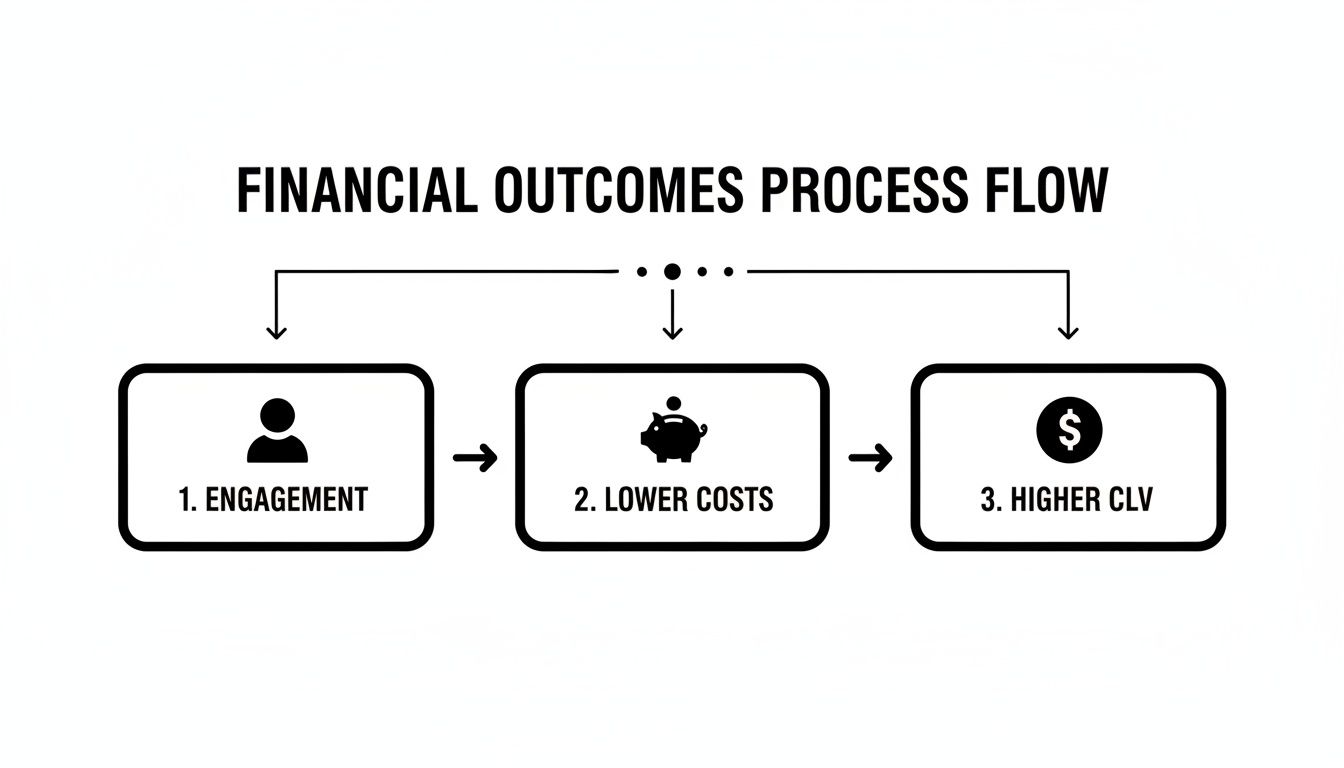
The key takeaway is that a superior customer experience is a direct line to lower operating costs and a higher Customer Lifetime Value.
Empower Teams with Proactive Visibility
Finally, this is about empowering your people. Provide your sales, closing, and warranty teams a single view of each customer's journey. When they can see which buyers haven't reviewed closing documents or which new homeowners are searching for appliance guides, they can intervene before a small issue becomes a major problem.
This shifts their roles from reactive problem-solvers to proactive experience managers. The right platform makes this possible at scale without adding complexity, ensuring every interaction builds trust and reinforces your brand.
Common Questions About Homebuilder Engagement Metrics
Adopting a new set of customer engagement metrics represents a strategic shift. It is natural for pragmatic, results-driven leaders to have questions about the practical implications for their operations.
This is not about adding another layer of complexity. It is about gaining the clarity needed to simplify operations and scale growth efficiently.
Below are answers to the most common questions from homebuilder executives as they transition toward a more customer-centric, data-driven operating model.
We Already Use a CRM. Why Do We Need More Metrics?
This is a critical distinction. A CRM is your system of record for the sales pipeline, managing leads and tracking activities from initial interest to a signed contract. Its job is typically complete once the purchase agreement is executed.
Customer engagement metrics pick up where the CRM leaves off. They measure what happens during the long, often fragmented journey through construction, closing, and the first few years of homeownership—the period where brand perception is either cemented or shattered.
Think of it this way:
A CRM tracks sales activities and tells you if you won the deal.
Engagement metrics track buyer and homeowner interactions and tell you how you are delivering on the promises made during the sale.
A CRM cannot tell you if a buyer is anxiously reviewing their construction timeline daily or if a new homeowner is frustrated trying to find their appliance warranty. A dedicated customer experience layer connects to your CRM but extends visibility across the entire lifecycle, providing a complete picture that enables you to build long-term value.
How Do We Start Measuring Engagement Without a Huge IT Project?
The fear of a disruptive IT project is valid. The solution is to adopt a platform designed for integration, not replacement. A modern customer experience layer avoids the old "rip and replace" model entirely.
This layer acts as connective tissue, pulling necessary information from your existing systems—CRM, ERP, and construction management software—without requiring you to rebuild your core tech stack. Implementation focuses on orchestrating workflows and unifying communication, not on a painful data migration.
The objective is scalability without complexity. You can start small by focusing on a single high-impact area, like automating construction updates, to secure a quick win and demonstrate immediate value.
This approach reduces manual work for your teams and cuts down on repetitive inbound questions, laying the groundwork for a fully connected experience you can expand over time with a clear return at every stage.
What Is the Single Most Important Metric for a Homebuilder?
If you could only track one metric to gauge the health of your customer experience, it should be the Post-Close Net Promoter Score (NPS), segmented by community and time since move-in.
While pre-close satisfaction is important, post-close NPS is the ultimate litmus test. It reflects the cumulative reality of your entire delivery process, from sales and construction quality to, most critically, your warranty service. A high NPS at closing that plummets within six months is an undeniable signal of a broken ownership experience.
This single metric is directly tied to the most powerful drivers of long-term profitability: referral potential and brand reputation. Tracking it provides an unvarnished view of where your experience creates brand promoters versus detractors.
How Do We Ensure Our Brand Stays Front and Center?
This is non-negotiable. The solution is to prioritize a "white-labeled" customer experience platform. This ensures every digital touchpoint—from the buyer portal for construction updates to the homeowner hub for maintenance guides—is fully branded as your own.
The builder must own the brand, the data, and the customer relationship. A white-labeled platform functions as your company's proprietary system, reinforcing brand trust and consistency with every interaction. It transforms the customer experience into a durable competitive advantage that you control, strengthening your brand equity instead of diluting it.
At Foundation, we provide the customer experience layer that connects your existing systems, giving you the visibility to manage what matters most. Our white-labeled platform helps you automate communication, reduce operational drag, and deliver a consistent, branded journey from contract through ownership. Learn how Foundation can help you build a more profitable and resilient business.
More from Foundation

Technology
What's New - September 2026
WarrantyOS, from work order to payment. September’s updates bring more of the day-to-day warranty workflow into one connected experience.
Sep 30, 2026

Marketing
New Home Portal: A Builder's Guide to the Buyer Journey
Learn what a new home portal is, the core features builders need, and how it shapes the buyer-to-owner experience across closing and early ownership.
Sep 16, 2026

Marketing
Home Warranty Software: A Practical Buyer's Guide
Compare home warranty software for homebuilders. Evaluate work orders, vendor coordination, customer communication, integrations, and implementation.
Sep 15, 2026