Jan 20, 2026
For homebuilding executives, measuring customer engagement is not a marketing exercise—it's a direct line of sight into sales velocity, operational efficiency, and long-term brand value. True engagement measurement moves beyond lead volume and vanity metrics. It focuses on the specific buyer and homeowner actions that predict faster closing cycles, higher customer satisfaction, and a stronger referral pipeline.
Moving Beyond Leads to Strategic Customer Engagement
The traditional homebuilder growth model—generating more leads at the top of the funnel—is no longer sufficient. Today's market demands a sophisticated understanding of the entire customer lifecycle. Strategic engagement is the core driver of predictable revenue, operating leverage, and the premium brand experience that buyers now expect.
The focus must shift from lagging indicators like website traffic to leading indicators that reveal the health of each customer relationship. A high volume of leads or social media likes provides a false sense of security; it does not guarantee a faster close, a satisfied homeowner, or a future referral. Real measurement begins by tracking meaningful buyer interactions that directly impact your bottom line.
The True Cost of a Disconnected Customer Experience
The most significant operational drag for many builders is the communication "black hole" between contract signing and closing. Critical interactions are fragmented across emails, personal text messages, and offline conversations, leaving leadership with zero visibility. Without a central system of record for the customer journey, you cannot measure what works, identify friction points, or intervene before a buyer becomes a risk.
This lack of visibility creates predictable and costly problems:
Drained Team Capacity: Sales and closing coordinators are consumed by manual follow-ups and repetitive inquiries, diverting their time from high-value activities that drive sales.
Inconsistent Brand Representation: The customer experience becomes dependent on individual employees, eroding the consistent, premium brand you have worked to build.
Costly Closing Delays: Missed deadlines for document submissions or option selections trigger a cascade of delays, pushing back revenue recognition and impacting cash flow.
By treating customer engagement as a central pillar of your operating model, you can directly address these challenges. The objective is to implement a consistent, measurable, and scalable experience that empowers your team, reduces operational risk, and builds lasting trust with every homebuyer.
Instead of tracking superficial metrics, the focus shifts to KPIs that accurately predict business outcomes. This table illustrates the pivot from a traditional mindset to a strategic one.
From Traditional Metrics to Strategic Engagement KPIs
This is not about abandoning traditional metrics. It's about augmenting lagging indicators with leading indicators that provide a real-time pulse on the health of your customer relationships and your operational pipeline.
A New Framework for Measurement
A modern approach to how to measure customer engagement connects every buyer interaction to a tangible business outcome. This is the role of a customer experience layer like Foundation. It integrates with your existing CRM, construction management, and ERP systems—without replacing them—to make previously invisible interactions visible and measurable. To explore this concept further, read our guide on what is customer experience management.
Ultimately, tracking strategic engagement provides the data needed to modernize your entire operation. It is the foundation for delivering a superior experience that drives higher conversion, accelerates closings, and builds a powerful referral engine—all without increasing headcount.
Choosing the Right Metrics for Each Step of the Homebuyer Journey
You cannot improve what you do not measure. However, effective measurement is not about creating a data deluge; it is about focusing on the vital few metrics that provide actionable insight into customer behavior and operational performance.
To accurately assess engagement, you must map specific metrics to each phase of the homebuyer journey: pre-contract, during construction, and post-close. A buyer's needs and your business objectives evolve at each stage, and your metrics must reflect this reality.
For instance, pre-contract engagement centers on identifying high-intent buyers. Digital signals like time on site or social media interactions are useful, but they lack context. While benchmarks show average website engagement is 66%, the alarming 46.85% bounce rate reveals a critical gap: generic content fails to capture and hold qualified attention.
Builders who provide an interactive and personalized experience see a marked improvement. For builders using Foundation, this detailed tracking extends well past contract signing. Our white-labeled Closing Concierge portals increase buyer session time by providing features such as real-time construction progress updates. This proactive communication consistently reduces inbound "what's next?" questions and frees up team capacity.
Pre-Contract: Identifying High-Intent Buyers
Before a contract is signed, the primary objective is to identify serious buyers and nurture their interest effectively. The right metrics help separate casual browsers from future homeowners.
Website Page Views: Are prospects spending significant time on specific community pages or interacting with floor plan galleries? This indicates strong interest.
Form Submissions for Tours: A request for a virtual or in-person tour is a clear signal of high intent, moving a prospect from passive research to active consideration.
Email Click-Through Rates: When you distribute a community update or financing information, click-throughs confirm that your content is relevant and resonating with the target audience. Understanding essential email marketing KPIs is critical for optimizing this outreach.
This timeline highlights the shift from lead generation to strategic engagement that drives revenue.
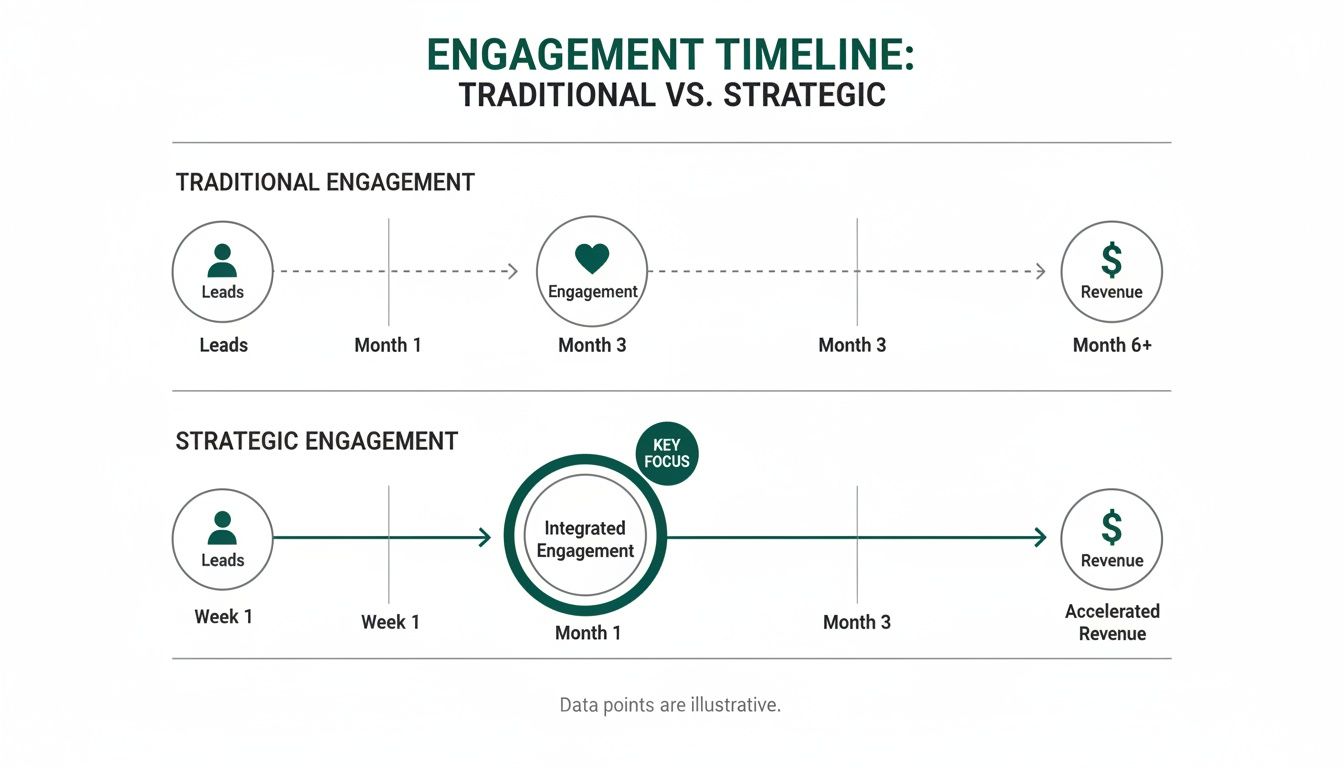
As shown, a strategic approach prioritizes the quality of post-lead interactions, directly connecting engagement to accelerated closing timelines and revenue.
During Construction: From Interest to Execution
Once a contract is signed, the focus shifts from nurturing interest to ensuring flawless execution. Engagement during this phase is a primary predictor of a smooth, on-time closing and a positive customer experience.
When communication is fragmented across emails, calls, and texts, you operate without visibility, unable to detect early warning signs. A unified customer experience platform consolidates these critical signals into a single, measurable view.
By tracking every post-contract interaction in a central hub, you transform the chaotic "black box" between sales and closing into a predictable, manageable process. This allows you to proactively identify friction, prevent closing delays, and restore valuable time to your team.
Key metrics that leading builders track include:
Portal Activation Rate: What percentage of new buyers log into their personalized portal within 48 hours of receiving access? A high activation rate signals immediate buy-in.
Document Upload Timeliness: Are buyers submitting financial and legal documents on schedule? Delays here are a significant red flag for potential closing date slippage.
Task Completion Rate: When you assign a task, such as finalizing design selections, how quickly is it completed? This indicates their level of organization and commitment.
By defining these stage-specific metrics, you build a clear framework for how to measure customer engagement that links directly to operational efficiency and profitability. This data empowers your team to shift from reactive problem-solving to proactive relationship management, delivering a consistently superior experience that drives results.
Building a Measurement System Without Adding Headcount
Data is only valuable when captured and analyzed systematically. When team communication is fragmented across personal text messages, email chains, and offline notes, you create operational blind spots where critical engagement signals are lost.
This is not a mere inconvenience; it directly contributes to preventable closing delays, frustrated homebuyers, and an overwhelmed warranty department.
The solution is not to increase headcount. Leading builders are modernizing their operating model by implementing a dedicated customer experience layer, like Foundation, at the core of their process.
This layer does not replace your CRM or construction software; it connects them, serving as the central hub for every buyer touchpoint. It enhances your existing technology stack by enriching it with clean, real-time engagement data that was previously unavailable.
This approach automatically transforms previously invisible interactions into measurable data points. Every document upload, task completion, and message sent becomes part of a clear, evolving picture of that customer's journey and health.
Unifying Data for Clear Visibility
When all customer interaction data resides in a single system, your teams gain a unified dashboard to monitor customer health across the entire portfolio. This consolidated view is the key to creating operating leverage, enabling you to scale a consistent, high-touch experience without scaling your headcount.
By consolidating every interaction into one builder-branded platform, you can achieve significant business outcomes:
Increased Team Capacity: Automation handles routine follow-ups and status updates, freeing your sales and closing teams to focus on high-value activities that drive revenue.
Reduced Operational Risk: Standardized, templated communication ensures every buyer receives the same high-quality, on-brand experience, mitigating the inconsistencies that erode brand reputation.
Proactive Problem Solving: With a complete view of engagement, leadership can identify trends and at-risk buyers early, allowing for intervention before a minor issue escalates into a major crisis.
A customer experience layer is the most efficient path to gaining control over your data. It eliminates fragmented workflows and empowers you to manage the entire customer journey with precision, consistency, and a clear line of sight to business impact.
The objective is to instrument your customer journey so that measurement becomes an automatic byproduct of daily operations. The system captures data as your team performs their work, eliminating the need for manual data entry.
From Manual Tracking to Automated Insight
Implementing a customer experience layer fundamentally changes your approach to how to measure customer engagement. You transition from relying on anecdotal feedback and lagging indicators to having a real-time, data-driven pulse on every homebuyer.
This visibility allows you to identify which communities are meeting engagement targets and which may require additional support. You can pinpoint top-performing team members, codify their successful processes, and replicate them across the entire organization.
This is not just about better measurement. It is about building a more efficient, predictable, and profitable business.
Having real-time data is one thing; turning it into decisive action is another. This is the transition from measuring engagement to actively managing it. By learning to interpret the signals, your teams can identify enthusiastic brand advocates and—more critically—flag at-risk buyers long before a small issue becomes a crisis that threatens a closing.
This data-driven approach moves your teams out of a reactive posture. Instead of waiting for an angry phone call, you can use data to get ahead of problems. Automated alerts for low engagement or missed deadlines empower your team to intervene with precision, preserving deals and protecting your brand reputation.
Using NPS as a Customer Health Check
One of the most effective metrics for gauging customer sentiment is the Net Promoter Score (NPS). This simple metric asks how likely a buyer is to recommend your company, but the insight it provides is profound.
According to the 2025 State of CX Report from ECI Solutions, which analyzed over 350,000 homebuyer surveys, engagement declines sharply after the sale. While satisfaction during the sales process is a strong 92.8%, it drops to just 75.8% during the warranty period. The likelihood to recommend falls to 71%.
This 26-point drop is a direct result of fragmented, inconsistent communication that erodes the trust built during the sales process. You can explore the full report to see how top builders are addressing this challenge.
We have observed that builders using an integrated platform to automate feedback loops at key milestones consistently achieve 10-15% higher NPS scores and reduce inbound inquiries by up to 30%.
By systematically capturing NPS from contract signing through the first year of ownership, you create a vital health check for the entire customer journey. It is not just a score; it is an early warning system that protects your bottom line and your referral pipeline.
This continuous stream of feedback provides a clear roadmap for improvement. When you observe scores dipping in a specific division or during a particular stage of construction, you can investigate the root cause. This data-driven approach helps you pinpoint operational weaknesses and replicate successes across your entire organization.
Identifying Promoters and At-Risk Buyers
Beyond the aggregate NPS score, individual engagement signals provide a richer narrative. A buyer who consistently meets deadlines and sends positive messages through their portal is a future five-star review. Conversely, a buyer who goes silent or ignores document requests is a clear risk signal.
By automating workflows and alerts, your team can act on these signals in real time:
For Promoters: When a buyer provides a high NPS score, an automated workflow can immediately request a public review or testimonial, capturing that positive sentiment at its peak.
For At-Risk Buyers: If a buyer's engagement drops below a predefined threshold, the system can automatically notify the appropriate team member to initiate personal outreach. This transforms a potential crisis into a trust-building opportunity.
This type of system turns customer data from a passive report into an active tool for mitigating risk and driving growth. It enables your team to spend less time on administrative tasks and more time building the relationships that create customers for life.
Driving Long-Term Value with Post-Close Engagement
The customer relationship does not conclude at closing. For forward-thinking builders, handing over the keys marks the beginning of a new, critical phase—one that fuels the referral pipeline and solidifies long-term brand loyalty. The first year of homeownership is the prime opportunity to convert satisfied buyers into vocal brand advocates.
Too often, however, the post-close and warranty period becomes a reactive, high-cost operational burden. Homeowners with simple questions navigate a confusing contact maze, and the goodwill established during the build process begins to erode. This high-friction, manual process overloads your warranty team and damages your brand reputation.
A modern operational model transforms this liability into a strategic asset. By providing homeowners with a single, builder-branded digital hub for all documents, service requests, and communications, you can dramatically reduce inbound calls and gain clear visibility into their post-close experience.
From Warranty Noise to a Predictable Revenue Engine
This is not merely about efficiency; it's about creating an "Owner Network" that becomes a predictable source of high-quality, low-cost leads. The key is to measure and manage homeowner engagement through structured, automated check-ins at critical milestones.
Data shows that touchpoints at 30, 90, and 365 days are crucial for cultivating advocacy. The 2025 Homebuyer Experience Trend Guide, for instance, revealed a 10% drop in satisfaction in Ontario when these follow-ups were missed.
Builders that leverage automated survey platforms like Foundation see warranty callback expectations met at a significantly higher rate. They reduce service-related communication by 35% and achieve a 15% lift in one-year anniversary satisfaction scores. In a market where 67% of builders are using incentives to close deals, this structured communication provides a distinct competitive advantage.
The warranty period should be your greatest trust-building opportunity, not your largest cost center. By systematizing post-close communication, you are not just managing risk—you are actively cultivating your next wave of referrals and repeat buyers.
To build these enduring relationships, communication is paramount. For more on this topic, review our guide on client communication best practices.
Key Metrics for Post-Close Success
To assess the effectiveness of your post-close engagement strategy, focus on a few high-impact metrics that link directly to homeowner satisfaction and future revenue.
Milestone Survey Response Rates: Are homeowners completing your 30, 90, and 365-day surveys? High response rates indicate they feel heard and valued.
Warranty Service Request Volume: Monitor the number of inbound requests. A downward trend confirms that your proactive communication and self-service portal are effectively empowering homeowners.
Referral Source Tracking: This is a critical business metric. When a new lead is generated, do you systematically track its source? Attributing new sales directly to recent homeowners provides a clear ROI on your customer experience investment.
Focusing on these metrics transitions your post-close operation from a defensive, reactive function to a proactive, relationship-building engine. This disciplined approach to how to measure customer engagement after the sale ensures you capture the full lifetime value of every customer, creating a powerful and sustainable growth flywheel for your business.
Your Top Questions, Answered
Homebuilding executives frequently ask how to translate the concept of measuring customer engagement into practical, on-the-ground action. Here are the most common questions and direct answers.
What Are the Most Critical Engagement Metrics for a Homebuilder?
It is essential to cut through the noise of vanity metrics and focus on the numbers that directly predict revenue and operational efficiency.
For leaders just beginning this journey, concentrate on these four:
Net Promoter Score (NPS): This is the single best indicator of customer loyalty and referral potential. Measure it at key milestones, such as post-contract and 90 days post-closing, to track sentiment throughout the journey.
Time to Close: Correlate this timeline with buyer activity in their digital portal. You will find that consistent engagement leads to fewer administrative delays and a more predictable closing schedule.
Inbound Query Volume: Track the volume of calls and emails from buyers after contract signing. A sustained reduction is tangible proof that your proactive, automated communications are increasing team capacity.
Referral Rate: This is the ultimate validation of a superior customer experience. Systematically track how many new sales originate from recent homeowners to prove the ROI of your engagement strategy.
How Can We Start Measuring Engagement with a Limited Budget?
You do not need a significant upfront investment to begin. The first step is to standardize your current manual processes to establish a baseline.
Start by using accessible tools like SurveyMonkey or Google Forms to automate satisfaction surveys at key milestones. Critically, create a shared spreadsheet for your team to log the reason for every inbound buyer call and email. This simple exercise will provide an unfiltered view of your most significant communication gaps and customer pain points.
This initial data, while not a long-term solution, builds an undeniable business case for investing in a dedicated customer experience platform. It quantifies the cost of inefficiency and demonstrates how automation and a unified system will deliver a clear return.
How Does Measuring Engagement Improve Sales Velocity?
The connection is direct and measurable. When buyers are actively engaged through a dedicated digital portal, they have greater confidence and clarity on what is required of them. As a result, they provide necessary items—such as document submissions and design selections—more quickly.
This reduces the administrative friction that creates bottlenecks and extends contract-to-close timelines. Furthermore, a transparent and positive experience builds significant trust, making buyers far less likely to cancel a contract due to uncertainty or feeling ignored. When you measure and optimize for engagement, you are actively removing the friction that slows down revenue.
Ready to turn engagement data into your greatest competitive advantage? Foundation is the customer experience layer that connects your systems, automates communication, and delivers the visibility needed to drive growth, efficiency, and lasting brand loyalty. Learn how Foundation can modernize your operations.
More from Foundation

Technology
What's New - September 2026
WarrantyOS, from work order to payment. September’s updates bring more of the day-to-day warranty workflow into one connected experience.
Sep 30, 2026

Marketing
New Home Portal: A Builder's Guide to the Buyer Journey
Learn what a new home portal is, the core features builders need, and how it shapes the buyer-to-owner experience across closing and early ownership.
Sep 16, 2026

Marketing
Home Warranty Software: A Practical Buyer's Guide
Compare home warranty software for homebuilders. Evaluate work orders, vendor coordination, customer communication, integrations, and implementation.
Sep 15, 2026