Jan 24, 2026
For most homebuilder executives, the word ‘warranty’ likely brings to mind unpredictable costs, operational drag, and escalated customer service calls. Traditionally, the home builders warranty has been treated as a reactive cost center—the final, often painful, step in a long customer journey. This guide is designed to reframe that perspective entirely.
From Cost Center to Growth Engine
The warranty period is far more than a legal obligation. It's a critical and frequently overlooked opportunity to drive significant business value. A reactive approach to warranty claims creates a financial drain and slowly erodes brand reputation. But when viewed as a core component of the homeowner experience, it becomes a powerful tool to build loyalty, streamline operations, and drive long-term revenue.
This is not a conversation about tweaking a process; it’s a strategic shift focused on measurable business outcomes. The objective is to move from a defensive posture to a proactive customer experience model that reduces operational costs, decreases inbound service calls, and increases team capacity—without adding headcount.
The Financial Reality of Warranty Operations
The financial stakes are significant. In a single year, U.S. homebuilders paid out an astounding $1.071 billion in warranty claims for new homes. This figure underscores the immense financial weight of standing behind your product. The data also reveals seasonal pressures, with costs peaking at $288 million in Q2, highlighting the strain that can impact warranty budgets and team capacity. You can explore the specifics of these financial trends in the full report.
From Reactive Burden to Proactive Advantage
A fragmented, disconnected warranty process creates friction for everyone. Homeowners are left navigating confusing offline forms and wondering who to call, while your team is buried under manual follow-ups and repetitive questions. This chaos doesn't just inflate costs—it actively undermines the trust you’ve built with your customers at a pivotal moment.
The core problem isn't the warranty itself; it's the broken communication layer surrounding it. A modern, integrated approach closes these gaps, creating a seamless, branded experience that builds trust long after closing.
This transformation requires a disciplined approach to Customer Experience Management, the key to forging genuine homeowner loyalty. By modernizing the post-close journey, builders can achieve significant business wins:
Reduced Inbound Calls: A self-serve digital hub empowers homeowners to access documents, understand warranty coverage, and submit service requests independently, immediately deflecting routine inquiries.
Increased Team Capacity: Automating follow-ups and status updates frees your warranty and customer service teams to focus on resolving complex issues, not managing administrative tasks.
Stronger Brand Loyalty: A transparent, low-friction ownership experience turns satisfied homeowners into powerful brand advocates who generate referrals.
Here’s a breakdown of how this strategic shift impacts key business metrics:
Strategic Shift From Traditional To Modern Warranty Management
Metric | Traditional Approach (Reactive) | Modern Approach (Proactive & Integrated) |
|---|---|---|
Operational Model | Manual processes, phone calls, emails | Automated workflows, self-serve portal |
Customer Experience | High-friction, frustrating, inconsistent | Low-friction, transparent, branded |
Team Focus | Reactive problem-solving, data entry | Proactive communication, high-value tasks |
Cost Structure | High operational overhead, unpredictable costs | Reduced call volume, reclaimed team capacity |
Brand Impact | Negative reviews, brand erosion | Positive reviews, increased referrals & loyalty |
Data & Insights | Siloed data, limited visibility | Centralized data, actionable performance insights |
Ultimately, a superior post-close experience is one of the most strategic investments a builder can make. It delivers on the brand promise made during the sales process and creates a foundation for sustainable, profitable growth. For more on this, our guide on improving customer service in the construction industry offers a wealth of actionable strategies.
Understanding the Modern Home Warranty Landscape
For most builders, the warranty has been categorized as a legal obligation and a financial risk—a pure cost center. However, to truly optimize post-close operations, leaders must recognize the warranty for what it is: a core pillar of your brand promise and a critical driver of long-term customer value.
When coverage is ambiguous or communication is inconsistent, you create friction. That friction grinds down your team’s capacity and directly erodes profitability.
At its core, a new home warranty is a multi-layered promise, typically structured around the 1-2-10 year model. Each number represents a different coverage timeline. Communicating this structure with absolute clarity is the first step toward building a scalable process that prevents misunderstandings and reduces frustrated calls from homeowners.
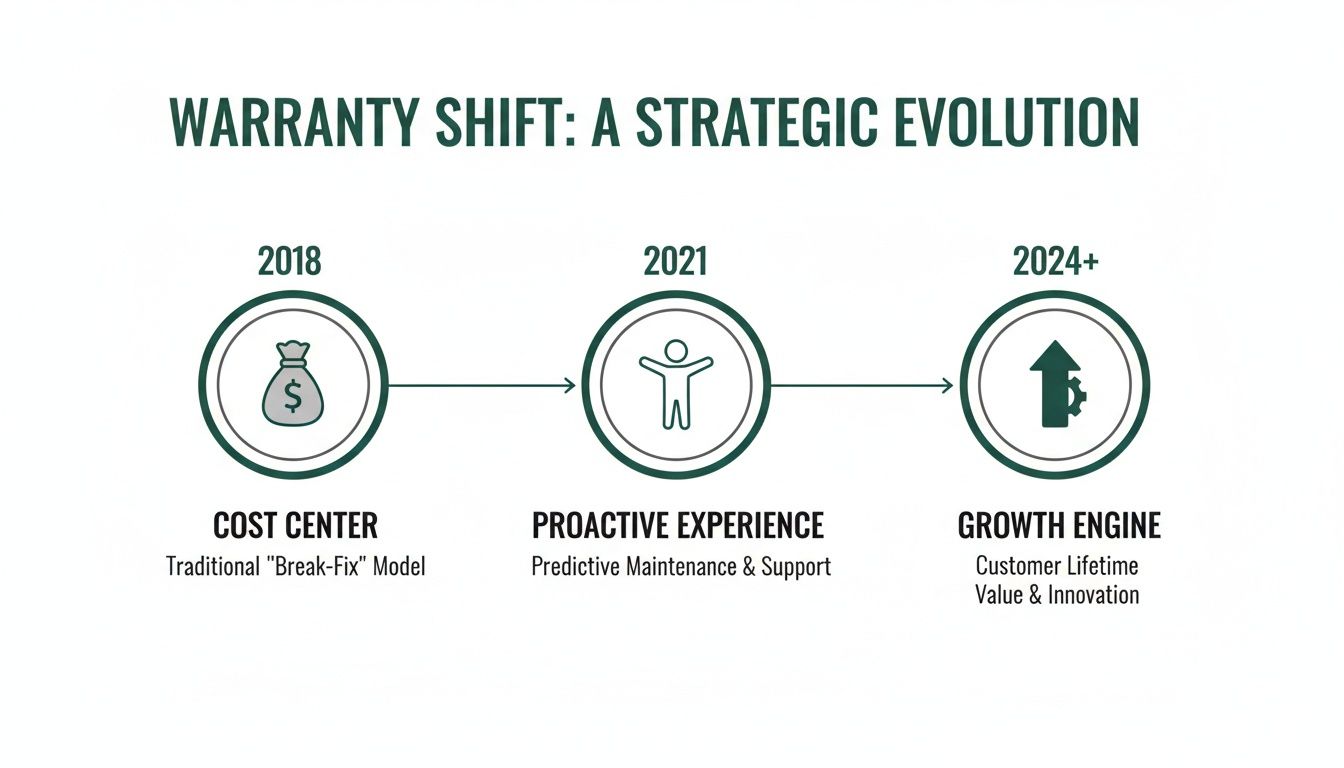
This timeline illustrates the strategic shift required to evolve your warranty operations from a reactive expense into a proactive experience—and ultimately, a powerful growth engine.
This isn’t about adopting new technology for its own sake. It’s a fundamental change in your operating model that delivers measurable returns to your bottom line and brand equity.
The Standard 1-2-10 Warranty Structure
The well-established 1-2-10 model provides a clear framework for what’s covered and for how long. Each stage addresses different components of the home, from cosmetic details to the foundational structure.
Year 1 Workmanship: This covers the fit and finish. The first year addresses defects in materials and labor—items like drywall cracks, paint touch-ups, and flooring issues. This period represents the highest volume of homeowner interaction.
Year 2 Systems: The two-year coverage addresses the home’s essential distribution systems: electrical, plumbing, and HVAC. It protects the homeowner from defects related to the installation and function of these vital systems.
Years 3-10 Structural Integrity: This is the long-term coverage. The final warranty stage protects against major structural defects affecting the home's designated load-bearing components, such as the foundation, beams, and roof framing—the core elements that ensure the home is stable and safe.
This structure is designed to provide homeowners peace of mind, but its effectiveness is entirely dependent on clear communication. If homeowners misunderstand the distinctions, every minor issue can feel like an emergency, quickly overwhelming your warranty team.
A strong warranty is one of the clearest signals that a builder stands behind their product. It's not just a legal document; it's a marketing asset that demonstrates quality and builds the trust required to convert prospects into buyers.
The Gray Areas That Erode Trust and Profit
While the 1-2-10 model provides a solid foundation, the greatest operational challenge lies in managing what is not covered. Exclusions are the primary source of homeowner frustration. This is where negative online reviews originate, referral opportunities are lost, and your team wastes countless hours navigating disputes.
Common exclusions often include:
Household Appliances: These are nearly always covered by the manufacturer's warranty, not the builder's.
Damage from Natural Disasters: Issues caused by floods, storms, or other "acts of God" are typically covered under the homeowner's insurance policy.
Problems from Lack of Maintenance: If a homeowner neglects basic upkeep, such as cleaning gutters or servicing an HVAC unit, the resulting issues are their responsibility.
The ambiguity surrounding these exclusions is precisely where brand trust breaks down.
Without a centralized, digital hub to educate homeowners and provide clear, accessible documentation, your team is forced to have these difficult conversations reactively. This inconsistency creates a poor customer experience and can escalate a manageable issue into a brand-damaging conflict. By framing the warranty as a clear, consistent part of the ownership experience from day one, you can eliminate this friction and protect both your reputation and your bottom line.
The High Cost of a Disconnected Homeowner Experience
The purchase agreement is signed, the keys are handed over, and the deal is closed. For many builders, this moment feels like the finish line. But for the homeowner, it’s just the beginning—and the post-close period is where your brand promise is either solidified or shattered.
This is where the relationship is truly tested, and it’s where operational disconnects often turn minor issues into major crises. The cost of a fragmented, high-friction warranty process extends far beyond the direct expense of a repair.
When a homeowner submits a service request, they are seeking more than a fix; they are seeking reassurance that they chose the right builder. If their first post-close interaction is a confusing maze of offline forms, unreturned voicemails, and conflicting information, the trust you spent months building begins to erode instantly. This initial friction is the true source of homeowner frustration and a significant drain on your team's capacity.
From Simple Request to Escalated Crisis
Consider a common scenario: a homeowner notices a minor drywall crack a few months after moving in. In a disconnected environment, their journey likely involves searching for a contact number, leaving a message, and waiting.
When they finally connect with someone, that person must manually track down the project manager and the appropriate trade partner, often juggling communications across personal cell phones and disparate email threads.
This manual, high-friction process creates a domino effect of operational problems:
Delayed Resolutions: What should be a straightforward fix becomes bogged down in follow-ups, extending resolution times from days to weeks.
Increased Inbound Volume: Anxious homeowners call and email repeatedly for updates, burying your customer service and warranty teams.
Inconsistent Communication: Without a central system of record, different team members may provide conflicting information, destroying your credibility.
Suddenly, a simple request has spiraled. It has consumed hours of your team’s time and caused homeowner satisfaction to plummet. This is precisely how a $150 drywall repair can escalate into a scathing online review that poisons future sales opportunities. The problem isn’t the warranty item; it’s the broken communication layer surrounding it.
The Quantifiable Impact on Your Business
The consequences of this operational drag appear directly on your balance sheet and in your brand’s reputation. Without a clear, unified view of the post-close journey, these costs remain hidden within departmental budgets, often dismissed as "the cost of doing business."
But the impact is real and measurable:
Lower Team Morale and Capacity: Your warranty and service teams burn out managing homeowner frustration instead of solving problems, leading to higher turnover and an inability to scale.
Negative Brand Perception: Dissatisfied homeowners are vocal. Negative reviews and poor word-of-mouth damage your Net Promoter Score (NPS) and deter prospective buyers.
Lost Referral Opportunities: A satisfied homeowner is your most effective salesperson. A frustrating warranty experience eliminates any chance of a referral—one of your most critical and cost-effective sales channels.
The market is evolving. The global home warranty service market, valued at $8.87 billion, is projected for double-digit growth. In North America, a staggering 83% of U.S. homeowners faced unexpected repairs last year. Today’s buyers expect a modern, predictable experience. You can read more about these homeowner trends and market statistics to understand the shifting landscape. This is not a threat; it is a massive opportunity for builders who can deliver a modern, proactive service model.
A disconnected warranty process is a silent killer of profitability and brand equity. It creates operational drag that limits your team’s capacity and turns your biggest potential advocates into vocal detractors.
By addressing the root cause—fragmented communication and the lack of a unified system—builder leadership can reclaim lost revenue, boost team efficiency, and transform the homeowner experience from a liability into a strategic asset that fuels long-term growth.
Building the Solution: An Integrated Digital Ownership Hub
The operational drag from a disconnected warranty process isn't an unavoidable cost—it's a solvable problem. The solution isn’t about replacing your core systems; it’s about moving beyond scattered manual workflows to implement a unified, branded digital platform: an integrated digital ownership hub that serves as the customer experience layer for your entire organization.
To be clear, this is not a replacement for your CRM, ERP, or construction management software. Those are the operational engines of your business. This hub acts as the connective tissue that augments your existing tech stack, bridging the critical communication gaps that frustrate homeowners and bury your teams in administrative work.
The primary goal is to create a single source of truth for the homeowner. Imagine a secure, builder-branded portal where they can access all their documents, instantly understand their home builders warranty coverage, submit a service request with photos from their phone, and receive real-time updates—all without making a single phone call.
Centralizing Communication and Control
For builder leadership, this model provides a level of visibility into post-close engagement that has been previously unattainable. Critical homeowner interactions are no longer lost in personal text messages or siloed email inboxes. Every message, request, and document is tracked in one centralized, accessible system.
This centralized approach delivers immediate business outcomes:
Standardized Processes: Every homeowner receives the same high-quality, on-brand experience, regardless of which team member they interact with.
Automated Communications: Routine acknowledgements and status updates are automated, freeing your warranty team from the endless cycle of manual follow-ups.
Actionable Data: Leadership gains a live dashboard to track warranty metrics, identify trends before they escalate, and measure team performance against clear KPIs.
When implementing an integrated hub, modern support tools like supportgpt can further enhance the homeowner experience by automatically handling common questions, further reducing the load on your team.
A digital ownership hub transforms the warranty process from a series of reactive, high-effort conversations into a structured, low-friction, and scalable system. It puts the builder back in control of the post-close narrative.
Driving Efficiency Without Adding Headcount
The most compelling aspect of this model is its ability to boost team capacity and reduce operational risk without increasing headcount. By automating low-value, repetitive tasks, you empower your skilled team members to focus on what they do best: solving complex problems and delivering exceptional customer service.
This directly improves your operating leverage. Instead of hiring more staff to manage a rising volume of service calls, you implement a system that deflects the majority of those calls from the outset. You are not just managing costs; you are building a more resilient, efficient operational model that can scale with your business.
To make this tangible, consider the real-world impact of transitioning from fragmented manual processes to a unified platform.
Impact of an Integrated CX Platform on Warranty Operations
Operational Area | Before Platform (Manual/Fragmented) | After Platform (Integrated/Automated) |
|---|---|---|
Homeowner Inquiries | High call/email volume for routine questions | 70%+ reduction in inbound calls via self-service |
Request Processing | Manual data entry, offline follow-ups | Automated ticket creation, centralized tracking |
Team Capacity | Overwhelmed by administrative tasks | Increased focus on high-value problem-solving |
Resolution Time | Weeks, due to communication delays | Days, due to clear workflows and accountability |
Leadership Visibility | Anecdotal, based on escalated complaints | Real-time dashboards with actionable KPIs |
Brand Risk | High risk of negative reviews, inconsistency | Consistent brand experience, proactive management |
Ultimately, an integrated digital hub is more than just software; it is a strategic operating model. It provides the capability to deliver a modern, seamless ownership experience that meets the expectations of today’s buyers, protects your brand, and unlocks new levels of efficiency across your post-close operations.
A Practical Plan for Modernizing Your Warranty Strategy
Transforming your warranty operations does not require a disruptive, all-or-nothing project. It can be approached as a strategic, phased process focused on delivering tangible business results. This framework provides a clear path for any builder executive to convert their post-close experience from a cost center into a powerful strategic asset, regardless of their current technology stack.
The key is to build momentum through incremental wins, which facilitates internal buy-in and demonstrates ROI at each stage.
The 5-Step Modernization Roadmap
1. Audit the Current Homeowner Journey
Begin by mapping every touchpoint a buyer has with your team, from contract signing through the end of the warranty period. Identify the friction points. Where does communication break down? Where are manual processes creating delays? Pinpoint the specific moments that erode trust and create operational drag for both homeowners and your team.
2. Quantify the Cost of Doing Nothing
Translate those friction points into financial metrics. Calculate the hours your team spends on manual follow-ups, the potential revenue impact of negative online reviews, and the cost of handling repetitive inbound calls. This data builds a compelling business case for change by quantifying the financial burden of an outdated process.
3. Define a Unified Communication Standard
Establish a single, consistent communication protocol for every post-close interaction. This standard ensures that whether a homeowner interacts with a warranty manager or their original salesperson, they receive the same on-brand, accurate information. Consistency is the bedrock of trust and the foundation of a scalable customer experience.
4. View Technology as a Strategic Enabler
Shift from viewing new technology as a replacement for core systems to seeing it as an integrated customer experience layer that connects what you already use. The right platform connects your CRM, ERP, and construction software to automate communication, standardize workflows, and provide leadership with clear performance visibility. You can see how an integrated platform streamlines the entire home builders warranty process here.
Technology should be judged on its ability to increase your team's capacity and reduce operational risk. The right solution simplifies complexity, not adds to it, by giving you a scalable operating model for customer experience.
5. Launch a Pilot Program
Do not attempt a company-wide overhaul at once. Select one division or community to launch a pilot. This controlled rollout allows you to measure the impact on key metrics—such as reduced call volume or faster ticket resolution—and create internal champions. Demonstrating success on a smaller scale is the most effective way to drive enterprise-wide adoption and prove the strategic value of a modern homeowner experience.
Turning Warranty Management Into a Long-Term Revenue Driver
The true measure of an effective home builders warranty program is not how quickly a service ticket is closed. It is about transforming the entire ownership experience into a system that creates brand advocates and drives future sales.
A seamless, positive post-close journey is one of the highest-ROI investments a builder can make, creating a direct line to sustainable, long-term revenue. By modernizing your warranty operations, you are not just mitigating risk—you are building the deep-seated trust that fuels referrals and repeat business. When homeowners feel supported long after closing, they become your most powerful marketing asset.
From Homeowner to Brand Advocate
Most builders view warranty as transactional: a problem arises, a fix is implemented. But a relational perspective changes everything. Every interaction is an opportunity to reinforce the quality of your brand and validate the homeowner’s decision to buy from you.
This mindset shift enables the creation of a branded "Owner Network," a powerful, builder-controlled ecosystem for long-term engagement. This is not another marketing list; it is a private community for connecting with past buyers in meaningful ways.
Share Real Value: Distribute home maintenance tips, community news, or information about new developments that may appeal to their friends and family.
Generate High-Quality Referrals: Launch structured, easy-to-use referral programs that reward past buyers for introducing new customers.
Drive Repeat Business: As a family’s needs evolve, remain the clear choice for their next home by maintaining a strong, positive relationship.
By keeping this ecosystem under your brand, you own the customer relationship and continuously build brand equity. You transition from being the company that built their house to a long-term partner in their homeownership journey.
Capitalizing on a Market Opportunity
The broader home services market highlights the scale of this opportunity. The U.S. home warranty industry generated $4.6 billion in revenue and is growing at a steady 3.9% annually.
However, only about 5% of U.S. households currently have a third-party home warranty. With the average homeowner spending $4,000 on repairs, there is a clear and substantial demand for reliable support. You can explore these home warranty market insights to see the full picture. This gap represents a significant upside for builders who can deliver a superior warranty experience as part of their core brand promise.
The post-close experience is your most underutilized asset for increasing the enterprise value of your company. By turning satisfied homeowners into a reliable source of new business, you create a predictable, low-cost sales channel that directly impacts your bottom line.
Investing in Your Long-Term Enterprise Value
For executive leadership, the takeaway is clear: your warranty process is not a budget line item; it is a strategic lever for growth. Investing in a modern, integrated customer experience platform is a decisive move to ensure sustainable growth in a competitive market.
It creates a powerful flywheel effect:
A seamless digital hub reduces friction and increases homeowner satisfaction.
Higher satisfaction leads to positive online reviews and powerful word-of-mouth referrals.
An engaged Owner Network generates a steady stream of low-cost, high-intent leads.
This reliable pipeline boosts sales velocity and reduces customer acquisition costs.
This is not about adding complexity or headcount. It is about implementing a scalable operating model that connects a superior customer experience directly to measurable financial results. By rethinking the role of your home builders warranty, you are not just managing risk—you are building a more resilient, profitable, and valuable business.
A Few Questions from Builder Executives
As a homebuilder executive, you are constantly seeking strategies to drive growth, improve team efficiency, and protect your brand. Re-evaluating your home builders warranty and the entire post-close experience is one of the highest-leverage initiatives you can undertake, as it directly impacts all three priorities.
Here are a few questions we often hear from leaders considering this strategic shift.
How Can We Reduce Warranty Claims Without Sacrificing Service?
This question gets to the core of a proactive strategy. The objective is not to deny claims or create barriers for homeowners, but to eliminate the "warranty noise"—the preventable, low-value inquiries that consume your team's time.
The solution is a fundamental shift from a reactive to a proactive model.
It begins by setting clear expectations and providing educational resources long before closing. A centralized, branded hub where new owners can find answers, access documents, and understand their responsibilities versus yours deflects a significant volume of routine calls and emails.
By preemptively addressing common questions, you dramatically reduce low-value service requests. This allows your team to focus their expertise on legitimate issues, resulting in more efficient operations and higher homeowner satisfaction.
Will New Technology Just Add More Work for Our Teams?
No, the objective is the exact opposite: increase team capacity without increasing headcount. A modern customer experience platform is not another piece of software to manage; it is a strategic tool designed to automate the manual, repetitive tasks that are currently overwhelming your team.
Consider the hours spent on status updates, answering redundant questions, and tracking communications in spreadsheets. By connecting your existing systems (CRM, ERP, construction software), a platform like Foundation automates much of this communication.
It liberates your team from administrative burdens, enabling them to focus on the high-impact work that enhances the customer experience and drives business value.
How Do We Actually Measure the ROI on This?
The return on investment in a modern customer experience platform is not ambiguous; it is reflected in clear, tangible business outcomes.
Operational Efficiency: Track the reduction in inbound call and email volume. Measure the decrease in the average time-to-resolution for service requests. You can calculate the precise hours reclaimed through automation.
Customer Satisfaction and Brand Equity: Monitor your Net Promoter Score (NPS) and the sentiment of online reviews. A low-friction ownership experience is one of the most effective ways to protect and grow your brand reputation.
Long-Term Revenue Growth: This is the ultimate metric. Track the rate of referrals and repeat purchases originating from satisfied homeowners. This is where a world-class post-close experience transitions from a cost center into a predictable, powerful revenue engine.
Ready to turn your warranty process into a strategic growth engine? Foundation provides the integrated, white-labeled customer experience platform that helps builders scale without adding complexity. Learn how Foundation can increase your team’s capacity and drive referrals.
More from Foundation

Marketing
New Home Portal: A Builder's Guide to the Buyer Journey
Learn what a new home portal is, the core features builders need, and how it shapes the buyer-to-owner experience across closing and early ownership.
Sep 16, 2026

Marketing
Home Warranty Software: A Practical Buyer's Guide
Compare home warranty software for homebuilders. Evaluate work orders, vendor coordination, customer communication, integrations, and implementation.
Sep 15, 2026

Marketing
How to Improve Team Accountability in Homebuilding
Improve team accountability in homebuilding with clear owners, reliable handoffs, practical metrics, and less manual follow-up from contract through warranty.
Sep 14, 2026