Jan 25, 2026
For homebuilding executives, the conversation around residential construction management software often misses the mark. It gets stuck on features like scheduling and budgeting, overlooking the far greater strategic opportunity: connecting day-to-day operations to sales velocity, operating leverage, and long-term brand equity.
The real goal isn’t just to build more efficiently—it’s to build a more profitable and scalable company that delivers an exceptional customer experience from the first sales call to the final warranty ticket.
Redefining Software as a Strategic Growth Engine
For a builder's leadership team, the real win from a modern tech stack isn't just managing projects better—it's about fundamentally reshaping the business. It's time to stop viewing software as a line-item cost and start seeing it as a strategic asset that directly drives measurable outcomes like higher conversion rates, faster closings, and stronger referral pipelines.
The ultimate goal is to build a more scalable and profitable operation without simply throwing more people at the problem. This demands a shift in perspective: from a messy collection of separate tools to a unified operating model designed to perfect the entire customer journey.
From Disconnected Tools to a Unified Operating Model
Most homebuilders operate with a patchwork of technology: a CRM for leads, construction software for the build, and an ERP system for financials. While each tool is powerful, the lack of connection between them creates significant operational friction and a fragmented buyer experience.
This disconnect is the source of many chronic pain points:
Fragmented Communication: Sales, construction, and closing teams waste countless hours on manual follow-ups, chasing down updates and relaying information to buyers. This is time that could be spent selling or proactively managing customer relationships.
Inconsistent Brand Representation: When emails, texts, and portal updates come from different systems (or people), the brand voice becomes disjointed, eroding the professional, high-touch image you’ve worked to build.
Limited Visibility into Buyer Engagement: After the contract is signed, leadership has almost no insight into buyer sentiment. This makes it impossible to get ahead of issues or identify at-risk customers before they become vocal detractors.
Warranty Overload: A clunky closing and move-in experience directly contributes to higher warranty call volume, draining resources and undermining the trust built during the sales and construction process.
The single biggest opportunity for growth isn't in any one department—it's in bridging the gaps between them. An integrated approach turns siloed data into your most powerful tool for boosting sales velocity and creating customers for life.
The solution isn't to rip and replace these core systems. It's to unite them. A modern customer experience platform, like Foundation, acts as the connective tissue—a dedicated layer that plugs into your existing CRM, construction software, and ERP. It is never a replacement for them.
You can explore how a dedicated customer experience platform for homebuilders pulls everything together to create a seamless, branded journey. This integrated model automates the flow of information, making every team smarter. A change order approved on-site can instantly update financial forecasts in the ERP, while a key construction milestone automatically triggers a beautiful, on-brand update to the homebuyer.
Connecting Customer Experience to the Bottom Line
This shift from siloed software to a unified operating model directly impacts profitability. By automating routine communications and providing buyers with a self-serve digital portal, you give your team back their most valuable resource: time. This isn't a small efficiency gain; you're giving your sales team back weeks of selling time every year.
It also dramatically reduces the inbound "what's the status?" calls that constantly interrupt your construction and closing coordinators. The result is increased operating leverage—the ability to grow revenue without overhead growing at the same rate. Ultimately, a superior customer journey becomes your best marketing tool, turning happy homeowners into a powerful referral engine that drives sustainable, long-term growth.
Getting to Grips with Core Software Features
To maximize the ROI of residential construction management software, leaders must look past feature lists and focus on capabilities that solve real-world business problems. This isn’t about finding the platform with the most bells and whistles. It’s about solving the challenges that keep executives up at night—protecting margins, increasing team capacity, and delivering a consistent brand experience at scale.
When you break down what these platforms really do, you can connect each function directly to a measurable business outcome, creating a more predictable, scalable, and customer-centric operation.
Project Scheduling and Task Management
At its core, this software provides centralized project scheduling. For an executive, the strategic value lies in creating a single source of truth accessible to everyone—from the superintendent in the field to the closing coordinator in the office. This eliminates the chaos of offline spreadsheets and manual updates.
When the schedule is live and accurate, the entire operation runs more smoothly. Teams spend less time hunting for information and more time managing projects. This increased efficiency means they can handle a larger workload without requiring additional headcount—a direct boost to operational leverage.
Business Outcome: Increased team capacity and fewer project delays.
Metric to Watch: Number of homes managed per superintendent or project manager.
Change Order and Selections Management
Nothing erodes margins faster than a messy change order process. Paper forms and endless email chains invite delays, errors, and frustrated homebuyers. Modern software digitizes this entire workflow, creating a transparent and defensible process.
By centralizing every request, approval, and communication, you protect your margins and create a bulletproof audit trail. When buyers approve changes in a dedicated portal, it reduces disputes and actually boosts their confidence in your process. This turns a potential point of conflict into an opportunity to build trust.
Effective change order management isn't just an administrative task; it's a critical defense for your profitability. Digitizing this process directly stops revenue leakage and strengthens the builder-buyer relationship through transparency.
Document Control and Communication Hub
The volume of documents in homebuilding—contracts, plans, permits, selections—is immense. When scattered across personal drives and email inboxes, they create significant operational risk. A core function of any good platform is to serve as the central library for all project files.
This ensures every team member works from the latest version. When this hub is connected to a customer experience layer like Foundation, it also powers automated, on-brand communications. For instance, a passed inspection can automatically trigger a progress update to the homebuyer. This simple automation reduces "just checking in" calls and builds confidence at every stage.
Warranty and Post-Closing Management
The customer relationship extends far beyond closing. A clunky, inefficient warranty process can tarnish your brand and drain your team’s resources. Leading platforms include robust warranty tools that bring order to the chaos of submitting, tracking, and resolving service requests.
This provides clear visibility into common issues, helping you spot recurring problems with trades or materials. It also gives homeowners a dedicated portal for claims, which drastically reduces frustrated phone calls and demonstrates your long-term commitment. This directly impacts referral rates and repeat business, turning a traditional cost center into a long-term brand asset.
To connect technology to strategy, it's essential to map these day-to-day software functions to the high-level business outcomes that every executive is measured against. This isn't just about making the field team's life easier; it's about driving tangible results that show up on the P&L.
Mapping Core Features to Executive-Level Business Outcomes
Core Software Feature | Primary Pain Point Solved | Strategic Business Outcome |
|---|---|---|
Project Scheduling | Disconnected teams, project delays from poor communication, and superintendent burnout. | Increased Team Capacity: Manage more homes per employee without sacrificing quality. |
Change Order Management | Margin erosion from unbilled changes, disputes with buyers, and administrative bottlenecks. | Improved Profitability: Protect gross margins and prevent revenue leakage. |
Document & Communication Hub | Information silos, version control errors, and inconsistent buyer communication. | Enhanced Brand Consistency: Deliver a scalable, high-touch customer experience. |
Warranty & Work Orders | High volume of service calls, poor visibility into defect trends, and damaged brand reputation. | Stronger Customer Loyalty: Increase referral rates and unlock repeat business opportunities. |
Ultimately, evaluating this software is about understanding how these individual features combine to create a more resilient and profitable homebuilding business. Each one addresses a specific operational vulnerability, and together they form a powerful strategic backbone.
Connecting Construction Sales and Finance
A standalone construction platform is just another data silo. The real competitive advantage emerges when your residential construction management software communicates seamlessly with your Customer Relationship Management (CRM) and Enterprise Resource Planning (ERP) systems.
This isn't about ripping and replacing your core systems. It’s about unifying them with a customer experience layer on top. The goal is to let data flow freely, creating a powerful engine that drives efficiency and growth. Leaders gain unprecedented visibility, tedious workflows are automated, and everyone—from sales to warranty—works from the same playbook. The result is superior operational leverage and a homebuyer experience that becomes a true market differentiator.
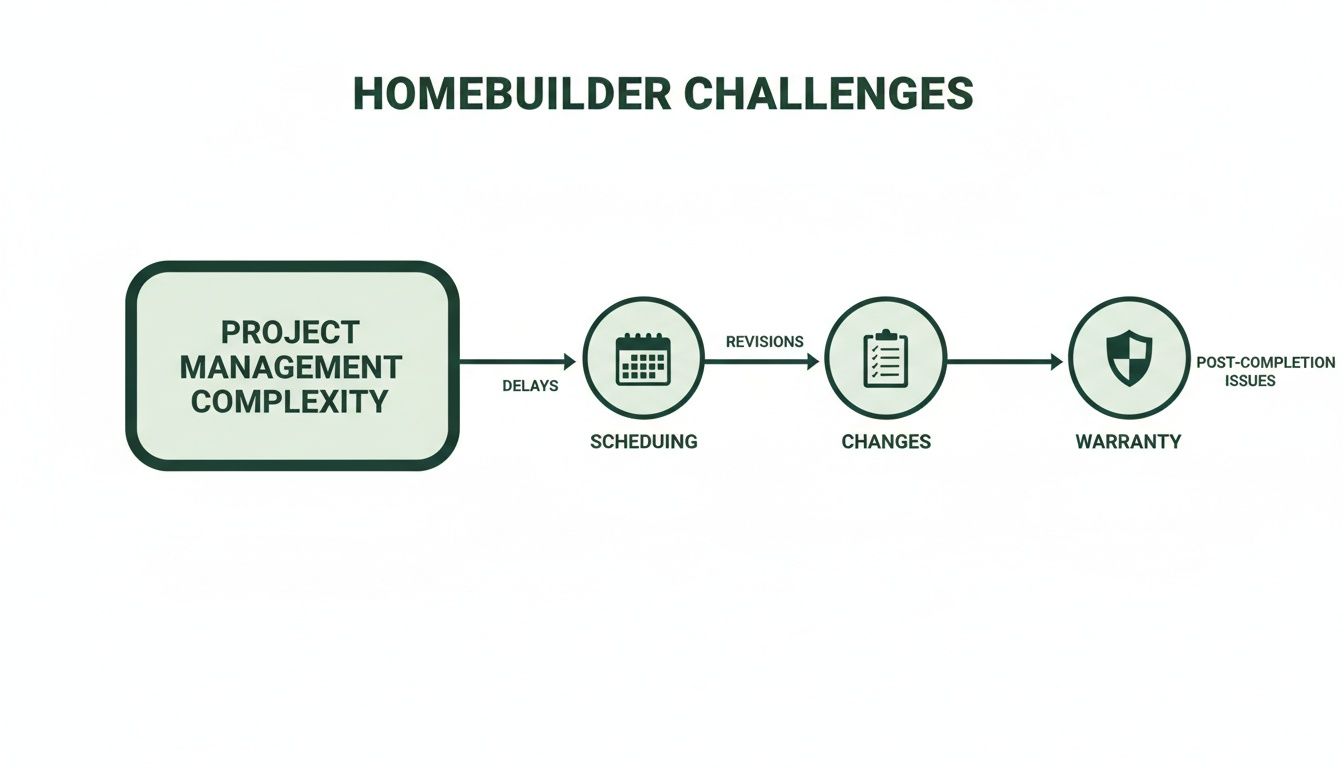
This flowchart highlights common pain points that are only amplified by disconnected systems, underscoring why an integrated workflow is so critical for modern builders.
From Siloed Data to Strategic Automation
When your systems don't communicate, your teams are stuck with manual, repetitive work. An integrated model automates these handoffs, creating a more responsive and scalable operation without adding headcount.
Here’s what that looks like in the real world:
Sales to Construction Kickoff: A deal is marked "won" in your CRM. This single action can automatically create the project in your construction software, notify the project manager, and trigger a branded "welcome" sequence for the new homebuyer. No more delays or clumsy handoffs.
Selections to Procurement: A homeowner finalizes their selections in their portal. That data flows directly into your ERP, instantly updating budgets and alerting the purchasing team. This reduces manual entry errors and ensures materials are ordered correctly and on time, protecting both the schedule and the margin.
Unifying Financial and Project Data
The connection between field operations and financials is where many builders unlock immense value. The market for this technology is projected to hit $27.28 billion by 2031, with financial management tools growing the fastest. This reflects a clear executive focus on controlling costs and protecting thin margins.
True operational intelligence comes from connecting what happens in the field to what happens on the balance sheet. An integrated system provides a real-time view of project financial health, turning reactive problem-solving into proactive management.
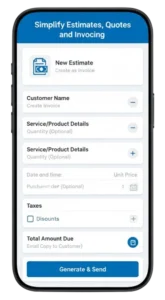
This connection provides tighter financial control. For instance, you can simplify estimates, quotes, and invoicing by linking job costs, change orders, and purchase orders directly to your ERP. Suddenly, you have a precise, up-to-the-minute view of each project’s profitability.
The Forward-Looking Takeaway
As you map out your tech strategy for the next 18 months, stop thinking about individual software solutions. Start thinking about an integrated operating model. The goal should be a frictionless flow of information between sales, construction, and finance. This is not an IT project; it is a core business strategy that directly impacts sales velocity, team capacity, and the long-term value of your customers.
How to Choose Your Strategic Software Partner
Selecting the right residential construction management software is a long-term strategic decision, not a short-term IT purchase. The right partner becomes an extension of your operating model, fueling growth for years to come. This requires looking beyond slick demos to evaluate how a platform aligns with your brand, your teams, and your strategic vision.
Go Beyond the Feature Checklist
Every software presentation is designed to impress. The real value, however, lies in a few non-negotiable pillars that separate a tactical tool from a strategic platform.
White-Labeled Brand Experience: Your brand is your most valuable asset. The software you choose must disappear into the background, allowing for a fully white-labeled experience. Every buyer interaction, from the login screen to an email notification, should feel like it comes from you, not a third-party vendor.
Builder-First Data Ownership: Your customer data and relationships belong to you. A true partner operates with a "builder-first" philosophy, guaranteeing you maintain 100% ownership and control over your data. This is a critical point for protecting your long-term brand equity.
Comprehensive Mobile Access: Your construction and warranty teams operate in the field. Any platform under consideration must offer a robust, full-featured mobile app to ensure real-time updates and maintain a single source of truth across the company.
Assess True Integration Capability
"Integration" is a commonly used but poorly defined term. For an executive, there’s a massive difference between a simple "connection" and a deep, workflow-driven integration that automates processes between your core CRM and ERP systems.
When evaluating construction platforms, it’s also wise to consult guides on choosing accounting software to ensure any financial modules or integrations meet your operational requirements.
A platform's real value isn't just what it does on its own. It's about how it makes your entire tech stack—and by extension, your people—more effective. A powerful API is the engine for this, turning a bunch of disconnected actions into a smooth, automated workflow.
Ask potential partners for specific, real-world examples. How does their API automate workflows? Can a change order signed in their platform automatically update the budget in your ERP? Does a project milestone trigger a personalized email from your CRM? The answers will reveal the difference between a simple tool and a strategic platform.
Strategic Software Partner Evaluation Checklist
This checklist is designed to help executive teams focus their evaluation on strategic alignment rather than tactical features, ensuring you select a partner equipped to support long-term growth.
Evaluation Criteria | Why It Matters for Growth & Scalability | Key Questions to Ask Vendors |
|---|---|---|
White-Labeling & Brand Control | Protects brand equity and ensures a consistent, high-quality customer experience across all touchpoints. | How deeply can we customize the platform to match our brand identity—from colors and logos to domain names? |
API & Integration Philosophy | Determines the platform's ability to automate workflows, eliminate data silos, and increase operational leverage. | Can you provide documentation and case studies of your API connecting to our specific CRM and ERP systems? |
Builder-First Data Ownership | Guarantees that your most valuable assets—customer data and relationships—remain yours exclusively. | What is your policy on data ownership, access, and portability if we choose to end our partnership? |
Mobile-First Field Support | Empowers field teams with the tools they need to be efficient, ensuring high adoption rates and accurate, real-time data. | What specific functionalities are available on your mobile app versus the desktop version for our construction and warranty teams? |
Ultimately, choosing a software partner is about finding a company whose vision aligns with yours—a team that understands your business and is committed to helping you succeed for the next decade and beyond.
Getting Real ROI from Your Software Rollout
The most powerful residential construction management software is useless if your team refuses to use it. A successful rollout is not an IT project; it's a change management initiative designed to weave new efficiencies into your existing workflows to maximize return on investment.
A phased approach that demonstrates value from day one is critical. The goal is to make the technology fit your established processes, not the other way around. This builds momentum and confidence across the company, ensuring high adoption.
Build an Internal Coalition
First, identify your champions—key individuals in sales, construction, and warranty who are respected by their peers and live the daily frustrations this software is designed to solve.
By involving them early, you empower them to shape the rollout and build an internal advocacy group that drives adoption from the inside out. Their peer-to-peer support and real-world feedback are infinitely more effective than any top-down mandate.
Focus on Solving Problems, Not Learning Software
No one wants to sit through generic software training. Frame the rollout around solving specific, high-impact problems your teams face every day.
For your sales team: Demonstrate how automated updates will reduce manual follow-up, giving them back hours each week to focus on selling.
For your construction managers: Show them how they can approve change orders or update schedules directly from their phone on-site, eliminating paperwork and trips to the office.
For your warranty team: Highlight how a central portal for homeowner requests brings order to the chaos of emails and phone calls, allowing them to be more proactive.
When your team sees the software as a direct solution to their biggest headaches, you don't have to force adoption. Enthusiasm builds on its own because you're making their workday better.
This approach ensures the platform becomes a natural part of your operational rhythm. Thinking through a build vs buy ROI calculation can also help crystallize how these small efficiency wins add up to major bottom-line impact.
Measure What Matters to the C-Suite
To prove the investment was worthwhile, define and track clear success metrics from the start. These KPIs must be tied directly to the business outcomes that leadership cares about.
Your success dashboard should track metrics like:
A 30% reduction in inbound status-update calls within the first six months.
Increased sales team capacity, measured by the time reclaimed from administrative tasks.
Improved CSAT or NPS scores from homebuyers post-closing.
Faster warranty ticket resolution times and fewer repeat service calls.
By following this strategic roadmap—building champions, focusing on workflows, and measuring real-world outcomes—you ensure your software investment delivers the promised efficiency gains and superior customer experience.
The Future Operating Model for Homebuilding Growth
The builders who win in the next decade will be those who see technology not as a tool, but as the core of their operating model. This shift in mindset is the single greatest competitive advantage available today—the engine that powers higher sales conversion, a stronger referral pipeline, and a more resilient bottom line.
A modern customer experience, powered by integrated residential construction management software and connected systems, is no longer a "nice-to-have." It is the most direct path to sustainable, profitable growth.
Rethinking Growth from Headcount to Capacity
For decades, the industry growth model was simple: sell more homes, hire more people. That playbook is broken. It’s expensive, difficult to scale, and often leads to an inconsistent customer journey.
The future of growth lies in shifting from a headcount-based model to one where technology creates scalable capacity. By automating routine communications, digitizing workflows, and providing buyers with self-serve tools, you give your existing teams tremendous operating leverage. Your sales team can handle more buyers and your project managers can oversee more builds—all without a corresponding spike in overhead.
The Customer Experience as Your Primary Asset
In a market of highly informed buyers, your brand is defined by the experience you deliver. Every fragmented communication and clunky, offline process erodes brand equity and creates unnecessary risk.
Investing in a unified, brand-first customer journey is the most direct path to building a more profitable and resilient homebuilding enterprise. It turns a series of transactions into a lasting relationship, creating a powerful moat around your business.
Placing the customer journey at the heart of your strategy delivers measurable business impact:
Higher Conversion Rates: A transparent, professional buying process builds the confidence that drives sales velocity and higher lead-to-contract conversion.
Stronger Referral Pipelines: Happy homeowners become your most effective sales force. A seamless experience from contract through ownership is the number one driver of high-quality, low-cost referral leads.
Reduced Operational Drag: Proactive communication and self-serve portals drastically reduce inbound "status update" calls, freeing your team to focus on high-value work.
Your Path Forward
For leadership, the takeaway is clear: the technology choices you make in the next 18 months will define your market position for the next decade. This is not an IT decision; it is a fundamental business strategy. Investing in a platform that unifies your CRM, construction management, and ERP systems is how you scale a premium customer experience without adding complexity or headcount.
By owning the customer journey and delivering a consistent, branded experience, you build a more efficient, profitable, and durable homebuilding company. That is the future.
A Few Common Questions
Any new technology investment raises tough but fair questions from leadership. Here are the most common ones we hear from homebuilding executives.
Does This Replace Our CRM or ERP?
No, and it shouldn't. A modern customer experience platform is a connective layer, not a replacement for your core systems. Your CRM is the engine for your sales pipeline, and your ERP is your financial command center. The right platform integrates with these essential tools.
It acts as the customer-facing hub that unites your internal systems, pulling the necessary data to create a single, seamless journey for the homebuyer—from contract signing through the warranty period. It ensures everyone is on the same page without forcing you to rip and replace what already works.
How Do We Justify the ROI on This?
The return on this investment is measured in fundamental operational shifts that directly impact the bottom line.
The real ROI isn't just saving time; it's about freeing up your team's most critical resource—their focus—for high-value work like selling the next home or getting ahead of customer issues. You're shifting from playing defense to playing offense. That's where the value explodes.
Justify the investment from these three angles:
Increased Sales Capacity: Calculate the hours your sales and closing teams reclaim by automating routine buyer updates. That time converts directly into selling capacity without adding headcount.
Reduced Inbound Volume: Measure the drop in calls and emails about construction status or warranty issues. When buyers have answers at their fingertips, your teams can focus on building and resolving issues, not just fielding calls.
A Stronger Brand That Sells Itself: Track customer satisfaction scores (CSAT or NPS). As they rise, you will see a corresponding increase in high-quality referral leads, driving long-term revenue growth and lowering customer acquisition costs.
How Can Our Teams Handle Another Software Rollout?
This is the most critical question. A disruptive implementation can kill adoption before it starts. That’s why you need a strategic partner, not just a vendor.
A true partner provides a structured, guided implementation that adapts to your existing workflows. The rollout should focus on your most visible pain points first to deliver quick wins and demonstrate immediate value. Ultimately, this technology should reduce complexity for your team, not add another headache. A real partner provides the training and hands-on support to make the transition feel effortless, allowing the platform to disappear into a daily workflow you can't imagine living without.
Ready to modernize your customer experience and build a more scalable, profitable operation? See how Foundation connects your systems, automates communication, and delivers a branded journey that turns buyers into lifelong advocates. Schedule your personalized demo today.
More from Foundation

Marketing
New Home Portal: A Builder's Guide to the Buyer Journey
Learn what a new home portal is, the core features builders need, and how it shapes the buyer-to-owner experience across closing and early ownership.
Sep 16, 2026

Marketing
Home Warranty Software: A Practical Buyer's Guide
Compare home warranty software for homebuilders. Evaluate work orders, vendor coordination, customer communication, integrations, and implementation.
Sep 15, 2026

Marketing
How to Improve Team Accountability in Homebuilding
Improve team accountability in homebuilding with clear owners, reliable handoffs, practical metrics, and less manual follow-up from contract through warranty.
Sep 14, 2026