Mar 6, 2026

For too many homebuilder executives, the daily operation is a battle against fragmentation. Communication is scattered across personal emails and texts, manual follow-ups drain team capacity, and your sales, construction, and warranty teams operate in silos. This isn't just an operational headache—it's a drag on growth, profitability, and customer experience.
This friction leads to stalled sales velocity, anxious buyers, and burnt-out teams. The core problem is that every critical customer touchpoint is disconnected, leaving your teams to answer the same questions repeatedly and your leadership with zero visibility into the buyer and homeowner journey.
Why Home Builder Software Is a Strategic Imperative
The real problem is that your existing systems—your CRM, ERP, and construction management platform—were never designed to manage an end-to-end customer journey. It creates a choppy, inconsistent experience for the buyer and leaves your leadership team with little insight into what’s actually happening from contract to close and beyond.
Your teams end up spending their days answering repetitive questions instead of focusing on high-value activities: driving sales, managing projects, and delivering exceptional service.
Moving Beyond Disconnected Systems
This is the exact operational gap that modern home builder software is designed to solve. It’s not about replacing your CRM or construction management platform. It's about connecting them. Think of it as the customer experience layer for your operations, orchestrating workflows and visibility across every team and touchpoint.
When you create a single source of truth for the customer's journey, you begin seeing immediate business impact. Modern platforms help builders address these challenges by connecting disparate systems and automating workflows to drive tangible outcomes.
Core Capabilities of Modern Home Builder Software
Core Capability | Primary Business Outcome |
|---|---|
Centralized Communication Hub | Eliminates scattered emails and texts, creating a single, auditable record of all buyer and homeowner interactions. |
Automated Buyer Updates | Proactively sends progress updates and milestone notifications, reducing inbound "just checking in" calls and emails. |
Digital Closing & Onboarding | Guides buyers through the complex closing process with checklists, document portals, and clear next steps, reducing delays. |
Post-Close & Warranty Management | Provides a dedicated homeowner portal for service requests, home information, and ongoing engagement, lowering service friction. |
These capabilities work together to create a seamless experience, but the true value lies in how they transform your business operations and financial results.
Here's what that looks like in terms of business impact:
Increased Team Capacity: By automating routine updates and communication, you can give your sales and closing teams weeks of their time back annually. That's more time to focus on driving revenue and growth.
Faster Sales Velocity: When buyers feel informed and guided, anxiety drops and delays disappear. This shortens the contract-to-close timeline and improves conversion rates.
Higher Customer Satisfaction: A self-serve digital hub for updates, documents, and questions is a game-changer for the buyer experience, directly translating to higher NPS scores and more referrals.
Improved Operating Leverage: With standardized processes and complete visibility, you can scale your business and deliver a consistent brand experience across every community—without scaling headcount.
The goal is to stop thinking in terms of fragmented handoffs and start building a single, builder-owned journey for your customer. This is how you attack the operational friction that's holding back your growth and profitability.
Ultimately, this isn't about buying another piece of software. It's an investment in building a more resilient, efficient, and customer-focused operating model. For leaders focused on the next 18 months, delivering a unified customer experience is the clearest path to a sustainable competitive advantage. You're not just adding a tool; you're building an infrastructure that will fuel growth for the next decade.
How to Structure Your Home Builder Tech Stack
Let’s be clear: the idea of a single, all-in-one program to run your entire homebuilding operation is a myth. Chasing that "one platform to rule them all" almost always ends in compromise, with clunky software that does nothing particularly well.
The most successful builders are building a strategic tech stack—a collection of specialized, best-in-class tools integrated to work together. This allows each department to use the right tool for their job while ensuring critical information flows freely across the business. This is the key to scaling without the communication black holes and data silos that trip up so many growing builders.
The end game is a systems architecture that drives efficiency, gives leadership total visibility, and, most importantly, creates a far better experience for your buyers and homeowners.
The Three Foundational Pillars
Most established homebuilders are already sitting on these core systems. The problem isn't the systems themselves; it's that they operate in separate worlds. The first step to building a connected ecosystem is understanding the role of each pillar.
Customer Relationship Management (CRM): This is your sales pipeline engine. Its primary job is to manage leads and opportunities from first inquiry to contract signing. A solid CRM gives your sales team the tools to track conversations and forecast revenue.
Enterprise Resource Planning (ERP): This is the financial core of your business. Your ERP handles accounting, purchasing, and job costing. It’s the single source of truth for the company’s financial health.
Construction Management Software: This is the command center for the build itself. It’s where your teams manage schedules, communicate with trade partners, track job progress, and handle quality control. Its entire focus is on getting the physical home built on time and to spec.
These three pillars are non-negotiable. But if they’re all you have, you’re creating predictable customer experience breakdowns. The moment a buyer signs a contract, they are handed off between the sales team's CRM and the construction team's software, while financial details remain locked in the ERP. This is precisely where the experience falls apart.
The Missing Piece: The Customer Experience Layer
The critical fourth piece that actually ties your tech stack together is the Customer Experience Layer. This isn’t a replacement for your core systems—it’s the connective tissue that bridges the gaps between them.
Think of it this way: Your CRM, ERP, and construction software are like different departments in a factory. Sales takes the order, finance processes the payment, and production builds the product. Without a central orchestrator ensuring everyone has the same information, you get chaos. The Customer Experience Layer is that orchestrator, ensuring a smooth, predictable process from start to finish.
This layer pulls key data from your existing systems into one place. It grabs buyer information from the CRM, project milestones from your construction software, and closing dates from the ERP to create a single, unified journey for the customer.
Suddenly, common operational headaches disappear. Instead of your teams chasing down information and buyers getting mixed signals, communication becomes automated and everyone works from the same playbook. For a deeper look, learn more about crafting a strategy for your homebuilder integrations to get this flow right.
When you structure your tech stack this way, you let your core systems excel at what they were built for while solving the fragmentation that kills team efficiency and damages the customer relationship. This is the blueprint for a modern, scalable homebuilding operation.
Mapping Software to the Homeowner Journey
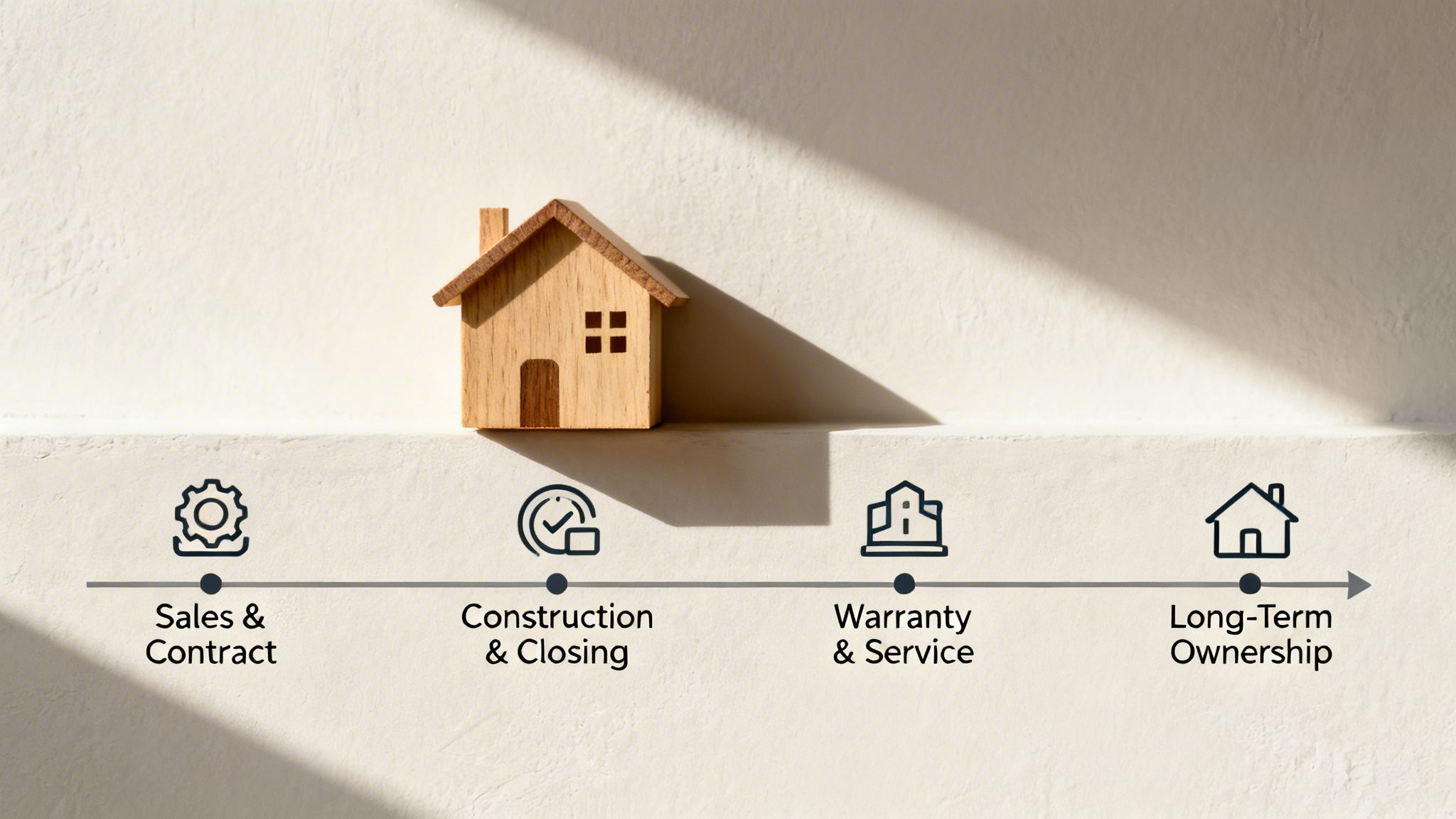
When your tech stack is a patchwork of disconnected systems, your customer journey feels just as fragmented. To see why modern home builder software is so powerful, you have to look at how it supports every phase of the lifecycle—from the day a contract is signed to years after you hand over the keys.
When you align your technology with each stage of this journey, you systematically eliminate the operational drag that slows your teams down. Instead of reactive chaos, you get a scalable, consistent process. This frees up your people, calms buyer nerves, and turns satisfied customers into a reliable source of new business.
Let’s walk through the four key stages to see how a unified customer experience layer makes a tangible difference.
Phase 1: Sales and Post-Contract Automation
Once a buyer signs a contract, your sales team should be focused on the next prospect. But in reality, they get stuck in a loop of post-contract hand-holding, fielding repetitive questions about next steps and construction schedules. All that manual follow-up is a massive drag on their capacity.
This is where automation delivers an immediate advantage. Instead of leaving communication to individual reps, a customer experience platform can orchestrate a series of pre-scheduled updates and tasks automatically.
Eliminate Repetitive Work: The system can send welcome emails, introduce the project manager, and outline key milestones. This gets your sales team out of administrative tasks and back to selling.
Increase Selling Capacity: By taking routine tasks off their plate, your sales team can focus their energy on nurturing new leads and closing more deals. It’s a direct line to improved sales velocity.
Guarantee Brand Consistency: Every buyer receives the same polished, on-brand messages. You eliminate the inconsistency that comes from reps firing off ad-hoc emails and texts.
While the customer experience platform orchestrates communication, specialized tools can enhance visual engagement. For more on this, consider resources like the Top 12 Best Virtual Tour Software for Real Estate.
Phase 2: Construction and Closing Concierge
For most homebuyers, the construction phase is a black box. This uncertainty creates anxiety, which translates into a constant stream of "just checking in" calls and emails to your construction and closing teams. This reactive cycle drains internal resources and erodes buyer trust.
A digital ‘Closing Concierge’ experience flips this dynamic by giving buyers a transparent, self-serve portal to follow progress.
This simple shift changes the entire dynamic. You move from reactive problem-solving to proactive guidance, giving everyone a single source of truth that builds trust and significantly reduces the communication burden for your team.
This concierge experience delivers:
Real-time Visibility: Buyers get their own branded hub where they can track construction milestones, see progress photos, and manage closing tasks.
Fewer Closing Delays: With automated reminders and a clear checklist, buyers know exactly what they need to do and when, preventing common slip-ups that push back closing dates.
Reduced Inbound Volume: When you answer questions before they’re asked, you slash the back-and-forth. This gives your closing coordinators more time to focus on high-impact work.
Phase 3: Proactive Warranty and Service
The warranty period shouldn't be a cost center defined by reactive service calls from frustrated homeowners. A reactive service model doesn’t just burn out your warranty team—it torpedoes your brand reputation right when future referrals are at stake.
By extending the digital experience into the ownership phase, you can finally get proactive. A branded homeowner portal becomes the single destination for everything post-close. You can learn more about the power of this approach by exploring what a modern homebuyer experience platform can achieve.
Phase 4: Long-Term Ownership and Referrals
Your relationship with a homeowner is one of your most valuable assets, but most builders let it go cold after the first year. A digital ownership hub allows you to maintain that connection, provide ongoing value, and turn past customers into your most powerful marketing channel. Top builders are already using this strategy to gain a significant competitive edge.
The global construction software market is projected to grow from USD 17.67 billion in 2025 to USD 51.42 billion by 2036. This explosive growth is driven by tools that deliver this kind of clear visibility and measurable results—like reducing service requests by up to 50% with a digital ownership hub or boosting referrals by 20% through ongoing engagement.
Essential Features Your Home Builder Software Needs
When evaluating home builder software, it's easy to get lost in a long checklist of features. For a strategic decision, leadership must look past the bells and whistles. The real focus should be on core capabilities that drive business outcomes.
The right platform isn't just another tool. It's the infrastructure for a new operating model that helps you scale efficiency and lock down your brand experience. A feature is useless if it doesn’t take work off your team’s plate, shorten cycle times, or improve customer satisfaction. The goal is to invest in technology that delivers measurable results from contract to long-term ownership.
Enterprise-Ready Integration and Automation
Your core systems—your CRM, ERP, and construction management software—aren’t going anywhere. They're essential. Any new platform you bring in must connect with them seamlessly, not force you into a massive, disruptive replacement.
This is where a robust, partner-friendly API is critical. It’s the connective tissue that links your core systems together, and it’s the foundation for eliminating the manual work holding your team back.
API-First Architecture: The software must be built to share data in both directions. For example, when a construction milestone is updated in your ERP, the buyer's status should automatically update in their portal. No human intervention needed.
Workflow Automation: Look for the power to design and automate entire communication sequences triggered by events in your other systems, ensuring buyers get the right information at the right time. Explore what's possible with modern workflow automation software.
Single Sign-On (SSO): For any enterprise-level company, SSO is a security and usability requirement. It simplifies access for your team and ensures your data remains secure within your existing IT framework.
White-Labeled Brand Control
Your brand is your most valuable asset. Every customer touchpoint should reinforce it, not advertise a third-party software company. Any platform you consider must be fully white-labeled. Your brand, your logo, and your voice must be the center of the experience.
This principle is directly linked to data ownership. The platform should be a conduit for your data, not a silo that holds it hostage. You must own and control every piece of customer information and every analytic that comes from their engagement.
This is a critical distinction. The builder, not the software provider, owns the customer relationship. The right technology strengthens that ownership by providing a branded, unified experience that feels like a natural extension of your company.
Full Lifecycle Visibility and Analytics
You cannot manage what you do not measure. A major blind spot in homebuilding has always been the lack of visibility into the customer journey after the contract is signed. Modern platforms solve this by tracking every interaction—every email opened, every update viewed, every document accessed—in one place.
This creates a powerful feedback loop for leadership. For the first time, you can see which communities have the most engaged buyers, which team members excel at communication, and which buyers might be at risk of becoming detractors. This data is invaluable for making strategic decisions about resource allocation and process improvement.
Scalable Communication Tools
The final piece is standardizing communication without sounding robotic. The software must allow you to build pre-approved templates and automated sequences that deliver consistent, on-brand messaging every time.
This ensures every buyer receives the same high level of service, regardless of which team member they're interacting with. It’s no surprise that investment in these platforms is surging. Builders and contractors are projected to account for nearly 42% of the total construction software market spend in 2025. With an expected spend of USD 972.44 million by 2026, the trend is clear: leaders are using technology to boost efficiency and customer satisfaction. You can dig deeper into these construction software statistics to see where the market is headed.
Calculating the ROI of a Unified Platform
Making a strategic investment in technology demands a clear financial justification. For a six or seven-figure decision on home builder software, skeptical executives will require a credible path to return on investment. The value of a unified customer experience platform is not abstract; it can be measured across four key areas of your business.
The financial impact comes from fixing the operational drag you’re already experiencing. Fragmented systems and manual back-and-forth communication carry significant hidden costs. By connecting your existing CRM, ERP, and construction software, you unlock efficiencies that appear directly on the bottom line.
Quantifying Increased Team Capacity
First, calculate the value of time saved. Consider how much time your sales, closing, and warranty teams spend on low-value, repetitive tasks like answering status update questions or sending manual follow-up emails.
A unified platform automates a significant portion of this communication, giving your teams back their most valuable asset: time. Imagine a sales team of five saving just four hours per person per week. That’s over 1,000 hours of selling time recovered in a year—the equivalent of adding a new team member without the associated payroll cost.
Modeling Accelerated Sales Velocity
Next, model the revenue impact of a shorter sales cycle. When the buyer's journey is disjointed, buyer anxiety often leads to decision paralysis and delays in signing contracts. A transparent digital experience builds confidence and helps deals close faster.
Even a modest reduction in your contract-to-close timeline—for instance, shortening it by just 10%—can have a massive revenue impact. This acceleration means you put capital to work more efficiently and recognize revenue sooner, directly improving cash flow.
Calculating Reduced Operational Costs
A proactive, self-serve ownership experience is a game-changer for warranty volume. When homeowners can easily find answers, access documents, and submit structured service requests through their own branded digital hub, the number of inbound calls and emails plummets. Builders we work with often see a reduction in warranty-related communication "noise" by 30-50%.
This is a shift from a reactive cost center to a streamlined, efficient service model. Every avoided truck roll and unnecessary service call represents a hard-dollar saving that directly boosts your operating margin.
To better understand the financial implications, you can borrow frameworks from exercises like calculating the ROI of asset tracking software, which also focuses on quantifying operational efficiency gains.
Estimating Increased Long-Term Revenue
Finally, estimate the value of higher customer satisfaction. A seamless, branded experience that extends from contract through long-term ownership builds incredible trust. It turns happy homeowners into your most effective sales channel, with higher Net Promoter Scores (NPS) correlating directly to more referrals and repeat buyers.
Capturing just a few extra sales per year from referrals—which carry a lower cost of acquisition—can generate hundreds of thousands in high-margin revenue. This is how customer experience transforms from a support function into a strategic revenue engine. For a more detailed framework, our guide on the build vs. buy ROI calculation offers a deeper dive into building your business case.
A Leadership Guide to Implementation and Adoption
Acquiring new software is the easy part. The real work—and where most strategic initiatives fail—is getting your teams to adopt it. A successful rollout of home builder software is a change management project first and an IT project second.
To a busy, skeptical team, a "new platform" often sounds like a "new burden." As a leader, your job is to frame this not as more work, but as a tool designed to eliminate the tedious, frustrating parts of their job so they can focus on high-value outcomes.
Success hinges on a smart strategy that builds momentum from the start.
Secure Cross-Functional Buy-In
You cannot solve communication breakdowns from within a single department. The very fragmentation you're trying to solve exists between your teams, so their leaders must be aligned from day one. This means getting sales, marketing, construction, and warranty leadership around the same table, early.
Frame the conversation around their shared operational pain points. Your head of sales knows the cost of post-contract follow-up. Your head of construction is drowning in one-off buyer update requests. When you demonstrate how a single platform solves problems for everyone, you build a powerful coalition for change.
This isn't about forcing a tool on anyone. It’s about introducing a better way of working that makes their jobs easier and turns potential resistance into genuine ownership.
Define What Success Looks Like—Upfront
Before launch, you must define what a "win" looks like in measurable terms. Vague goals like “improved efficiency” are insufficient. Tie your key performance indicators (KPIs) directly to tangible business outcomes.
Examples of strong metrics for a home builder software rollout include:
A 15% reduction in inbound buyer questions to the construction team within 90 days.
A 10% decrease in the average contract-to-close cycle time for the pilot community.
A measurable lift in sales team capacity, quantified by hours saved on administrative tasks.
This focus on measurable outcomes is fueling the growth in this space. The market for home builder software is projected to grow from USD 1.37 billion in 2025 to USD 2.63 billion by 2032. Leaders are investing because they see that integrated tools can cut project delays by 20-30% and slash costly errors by 40%. You can explore the trends shaping the home building software market to better understand the financial impact.
Give Your Teams a "Why"
Ultimately, adoption comes down to purpose. Your teams need to understand the "why" behind the change. Frame the software not as a corporate mandate, but as a tool that empowers them to do their best work by eliminating the repetitive tasks that stand in their way.
When your people see that this platform makes their day-to-day work easier and helps them deliver a better experience for homebuyers, they will become its biggest advocates. That is how a software implementation becomes a true strategic advantage.
A Few Questions We Get From Builders
Even when the strategy makes sense, bringing on new technology is a big decision. Here are some of the most common questions and hesitations we hear from builder executives.
Will This Just Replace Our CRM or Construction Software?
No, and it shouldn't. The whole point isn't to rip and replace the core systems you already rely on.
Think of it as a connective layer that sits on top of your existing tech stack—your CRM, your construction management software, and so on. It pulls everything together to create one unified, branded experience for the buyer, fixing the gaps and communication breakdowns that happen when your systems don't talk to each other. You get to keep your current investments while making them work better, together.
How Much Do We Have to Change Our Process to Fit the Software?
You don't. The software should adapt to you, not the other way around.
A good platform is designed to be configured to your proven workflows. This isn't about forcing your team to learn some rigid, new way of doing things. It’s about taking your established process—the one you've spent years perfecting—and giving your team the tools to execute it more consistently and with less manual work.
The goal is to reinforce your operating model, not rewrite it. The right technology should feel like a natural extension of your brand and process, empowering your teams to do what they already do, but better.
Our Teams Are Already Overloaded. How Can We Handle Another Implementation?
This is probably the most critical concern we hear. The key is to see this not as "another piece of software to manage," but as an investment that directly reduces your team's workload.
A well-designed platform automates the mind-numbing, repetitive tasks that burn out your best people—endless status update requests, manual follow-ups, and digging for documents. The right partner will also manage the heavy lifting of a phased implementation to deliver value quickly without bogging down your team. The short-term effort of adoption pays for itself almost immediately with a huge lift in team capacity.
What Happens After Closing? Does This Software Help Then?
The customer experience doesn't end when you hand over the keys; that's where the long-term relationship begins. This is where most builders completely drop the digital experience, leaving money and brand loyalty on the table.
Modern home builder software extends into the ownership phase with a branded digital hub. It gives homeowners one place for all their documents, home details, and service requests.
The immediate win is a massive reduction in warranty "noise" and panicked service calls. The long-term, strategic win is even bigger: you transform the post-close experience from a cost center into an engine for trust, glowing reviews, and high-margin referral and repeat business.
Foundation is the customer experience platform that connects your systems, orchestrates communication, and delivers a unified, branded journey from contract through ownership. See how we help leading builders increase team capacity and drive long-term revenue at https://buildwithfoundation.com.
More from Foundation

Technology
What's New - September 2026
WarrantyOS, from work order to payment. September’s updates bring more of the day-to-day warranty workflow into one connected experience.
Sep 30, 2026

Marketing
New Home Portal: A Builder's Guide to the Buyer Journey
Learn what a new home portal is, the core features builders need, and how it shapes the buyer-to-owner experience across closing and early ownership.
Sep 16, 2026

Marketing
Home Warranty Software: A Practical Buyer's Guide
Compare home warranty software for homebuilders. Evaluate work orders, vendor coordination, customer communication, integrations, and implementation.
Sep 15, 2026