Feb 22, 2026
The sales experience is often a builder’s strongest asset, but the brand promise meticulously crafted during that phase frequently dissolves the moment a contract is signed. For homebuilder leadership, this post-sale disconnect is not just a communication breakdown; it's a strategic risk that erodes brand equity, reduces operating leverage, and limits future growth. This is where a deliberate strategy for branded customer communication becomes critical to maintaining momentum from sale to closing and beyond, directly impacting sales velocity and customer satisfaction.
The High Cost of a Fragmented Homebuyer Journey
Ask any homebuilder executive, and they'll confirm the sales cycle is where their brand shines. Marketing paints a compelling vision, and the sales team guides buyers with high-touch, personal service. But once the ink is dry, this carefully orchestrated experience often fragments.

Suddenly, the homebuyer's journey splinters across siloed teams and a patchwork of systems. The construction manager sends a terse, technical update from one email address. The closing coordinator requests documents from another. The buyer is forced to log into a generic, third-party portal that looks nothing like the builder’s brand. Every interaction feels like starting over with a new company.
The Real-World Impact of Fragmentation
This disjointed process creates operational drag that directly impacts the bottom line. Consider the buyer's reality:
Confusing Updates: An email from the construction team mentions a "rough-in inspection" with no context, triggering an anxious call back to the sales agent, who is busy pursuing new leads. This is a clear example of operational drag caused by fragmentation.
Unanswered Questions: A buyer emails a question about closing costs to the last person they spoke with, but that person is out of the office. The email sits unanswered for days, eroding trust.
Brand Dilution: Each touchpoint uses different language, different logos, or no branding at all. This makes the builder seem disorganized and undermines the premium brand image established during sales.
This operational friction is a strategic failure. It forces your best people to waste time on manual follow-ups and answering repetitive questions instead of focusing on high-value activities that drive growth. Even worse, it kills the referral potential that should be the natural outcome of a major life purchase.
A buyer's confidence is at its peak the moment they sign a contract. Every inconsistent, confusing, or unbranded interaction that follows is a withdrawal from that bank of trust. The goal isn't to deplete that trust—it's to build on it.
To fix this, forward-thinking builders use tools like customer journey mapping to identify and bridge these communication gaps. The problem is not a lack of team effort; it's the absence of a unified system designed to orchestrate a continuous, branded experience. This is precisely the lifecycle gap that modern customer experience platforms—the connective tissue between your core systems—are designed to solve.
What Branded Customer Communication Really Means for Builders
Let’s be pragmatic. For a homebuilder, branded customer communication is not about logos on emails or a clever social media campaign. It is an operational commitment to ensuring every single interaction—from an automated construction update to a warranty request—delivers on your unique brand promise of quality, reliability, and care.
This is about delivering a consistent, builder-owned experience from start to finish. It means the homebuyer always feels they are dealing with one cohesive company, not a random assortment of subcontractors and office staff. When executed correctly, every message and notification reinforces the brand trust established during the sale.
The alternative is a fragmented experience where siloed teams send mixed messages, eroding the brand equity you spent a fortune to build.
From Siloed Messages to a Unified Voice
At its core, this strategy shifts from a model where individual team members are the brand to one where an orchestrated system guides every team member. Communication is no longer a checklist of isolated tasks; it becomes a single, continuous customer journey.
This consistency is critical because trust is the bedrock of the homebuyer relationship. Research shows that 81% of consumers need to trust a brand before they will consider buying from it.
When a buyer receives a generic portal login or a technical email full of jargon, it creates a small fracture in that trust. Over time, these fractures add up, causing a significant drop in confidence and satisfaction. A unified approach ensures the experience feels seamless, whether the buyer interacts with sales, construction, or warranty. For a deeper look, our guide on what is customer experience management offers valuable frameworks. This is the type of lifecycle gap modern customer experience platforms are designed to solve.
Fragmented vs. Branded Communication: A Strategic Comparison
The difference between a fragmented process and a modern, branded approach impacts everything from customer satisfaction to team efficiency and, ultimately, your long-term profitability. The distinction is not just about technology—it’s about operational discipline.
The table below breaks down the realities of each approach, highlighting why a deliberate branded communication strategy is a competitive necessity for any builder focused on scaling growth.
Attribute | Fragmented Communication (The Old Way) | Branded Communication (The New Standard) |
|---|---|---|
Brand Control | Inconsistent. Varies by employee, department, and third-party software, diluting the brand. | Centralized and consistent. Every communication reinforces the builder's brand promise and control. |
Customer Experience | Disjointed and confusing. Buyers get conflicting messages and must navigate multiple systems. | Seamless and continuous. The buyer experiences a single, unified journey from contract to ownership. |
Team Efficiency | Low. Teams waste capacity answering repetitive questions and chasing down information. | High. Automation handles routine updates, increasing team capacity without new headcount. |
Data & Visibility | A black box. Leadership has no clear view of customer engagement or satisfaction post-sale. | Transparent. Provides lifecycle visibility, enabling proactive management and strategic decisions. |
Referral Potential | Wasted. A frustrating process erodes trust and eliminates referral opportunities. | Maximized. A positive, consistent experience turns happy homeowners into brand advocates. |
Ultimately, branded customer communication is about owning the entire customer relationship, not just the sale. It’s an operational promise that creates a powerful engine for referrals, repeat business, and a reputation that sets you apart.
How The Post-Close Experience Hits Your Bottom Line
For many homebuilders, closing feels like the finish line. In reality, it marks the start of the most critical phase for brand reputation and long-term profitability. The post-close experience is where the seeds of future referrals are either nurtured or destroyed, and the quality of your branded customer communication is the deciding factor.
Treating the ownership phase as a cost center—a reactive game of managing warranty claims—is a strategic misstep. A homeowner’s satisfaction is most fragile right after move-in. One minor issue, handled poorly, can erase the goodwill your sales and construction teams worked tirelessly to build.
The significant drop-off in homeowner satisfaction is rarely about the quality of the home. It is a direct result of the quality of communication. Reactive, impersonal, and unbranded follow-ups make new owners feel abandoned.
This communication gap has direct financial consequences. It fuels negative online reviews, overwhelms your warranty team with preventable service requests, and, most critically, it kills your most powerful sales channel: new homeowner referrals.
The Alarming Drop in Homeowner Advocacy
Industry data tells a stark story. According to the 2025 State of Customer Experience Report, homebuyer satisfaction stands at 92.8% during the sales process but plummets to just 75.8% during the warranty phase. Even more alarming, the 'Would Recommend' score falls from 97% at purchase to a mere 71% after move-in. You can see more of these powerful homebuyer expectation findings on eci.com.
This isn't just a survey metric; it represents lost revenue. Every percentage point drop in referral likelihood is a tangible loss of high-intent, low-cost leads. The root cause is almost always a breakdown in consistent, branded communication that leaves homeowners feeling unsupported.
From Cost Center to Growth Engine
The solution is to reframe the ownership experience from a defensive support function to an offensive growth strategy. This isn't about working harder; it's about deploying a system-driven approach to homeowner engagement.
A structured platform for branded customer communication achieves this by:
Proactively Educating Homeowners: Sending automated, on-brand content about home maintenance and warranty processes reduces repetitive, low-priority service calls.
Centralizing Service Requests: A single, builder-branded portal for submitting and tracking warranty claims provides transparency and control, turning a potential frustration into an organized interaction.
Keeping Your Brand Front and Center: Ensuring every notification and update reinforces your brand identity preserves the premium feel of the purchase experience long after closing. Our guide on managing your home builder’s warranty explores how to turn this process into a brand asset.
This is exactly the type of lifecycle gap that modern customer experience platforms are built to solve. They provide the infrastructure to transform reactive warranty management into proactive brand stewardship, turning a cost center into a growth engine.
When you invest in a consistent, branded ownership experience, you don't just reduce warranty volume—you build a network of brand advocates. These homeowners become your most credible sales team, driving high-quality referrals that lower acquisition costs and boost sales for years.
A Practical Framework for Branded Communication
Transitioning from a fragmented, ad-hoc process to a system of deliberate branded customer communication requires an operational framework, not just good intentions.
For leadership, this is about designing a scalable system that protects brand equity, increases team capacity, and delivers a consistent experience to every buyer. A solid framework transforms this from a lofty goal into an executable operating model, allowing you to scale consistency without scaling headcount.
The problem is, the goodwill built during sales can quickly evaporate once construction starts and handoffs begin. Satisfaction plummets right when the journey should be getting more exciting. This erosion of trust directly impacts referral potential. A structured communication framework is designed to prevent exactly this.
Step 1: Audit Every Customer Touchpoint
First, you need a clear-eyed view of your current brand experience. This means mapping every interaction a buyer has with your company, from contract signing to the one-year warranty mark.
This audit must be brutally honest.
Pull real examples of emails from construction managers, letters from closing coordinators, and screenshots of third-party portal login pages. Lay them out and ask tough questions:
Do these communications look and feel like they come from the same company?
Is the tone consistent and on-brand?
Are we creating confusion by sending buyers to multiple, unbranded platforms?
This exercise almost always reveals jarring inconsistencies that chip away at your brand and create unnecessary friction for customers and internal teams. The goal is not to assign blame but to identify the systemic gaps that need closing.
Step 2: Establish a Centralized Communication Hub
Once you've identified the fragmentation, the next step is to establish a single source of truth for all buyer and homeowner communication. Fragmented communication is a symptom of fragmented systems. When your CRM, construction software, and warranty platforms don't talk to each other, your teams are forced to work in silos.
This is where a modern customer experience platform acts as the essential connective tissue. It does not replace your core systems of record; it integrates with them.
A centralized hub pulls key data—like construction milestones from your project management tool or contact information from your CRM—to orchestrate a single, unified conversation with the customer. This ends the chaos of multiple teams sending conflicting or redundant messages.
This hub becomes the engine for your branded communication strategy, giving leadership a transparent view of every interaction and turning a previously unmanageable process into a measurable asset. You can dig deeper into this idea by learning about the power of a unified customer experience for builders.
Step 3: Standardize and Automate Key Messages
With a central hub in place, you can standardize the core messages that define the homebuying journey by building a library of pre-approved, on-brand templates for every critical milestone.
This library should cover the essentials:
Welcome Sequence: A series of emails that set clear expectations immediately after contract signing.
Construction Stage Updates: Simple, jargon-free notifications for key phases like "Foundation Poured" or "Drywall Complete."
Closing Countdown: A checklist and timeline to guide buyers smoothly through the final steps.
New Homeowner Onboarding: Proactive information on home care, community guidelines, and the warranty process.
Once these templates are defined, the system automates their delivery. When a construction manager updates a milestone in their field software, it automatically triggers the correct branded communication to the homebuyer, with no extra steps required.
This automation is a game-changer for operating leverage. It frees your most valuable team members from the mind-numbing work of sending repetitive updates, giving them back crucial time to focus on managing projects and solving unique customer problems. Most importantly, it ensures every buyer gets the same high-quality, on-brand information—every time.
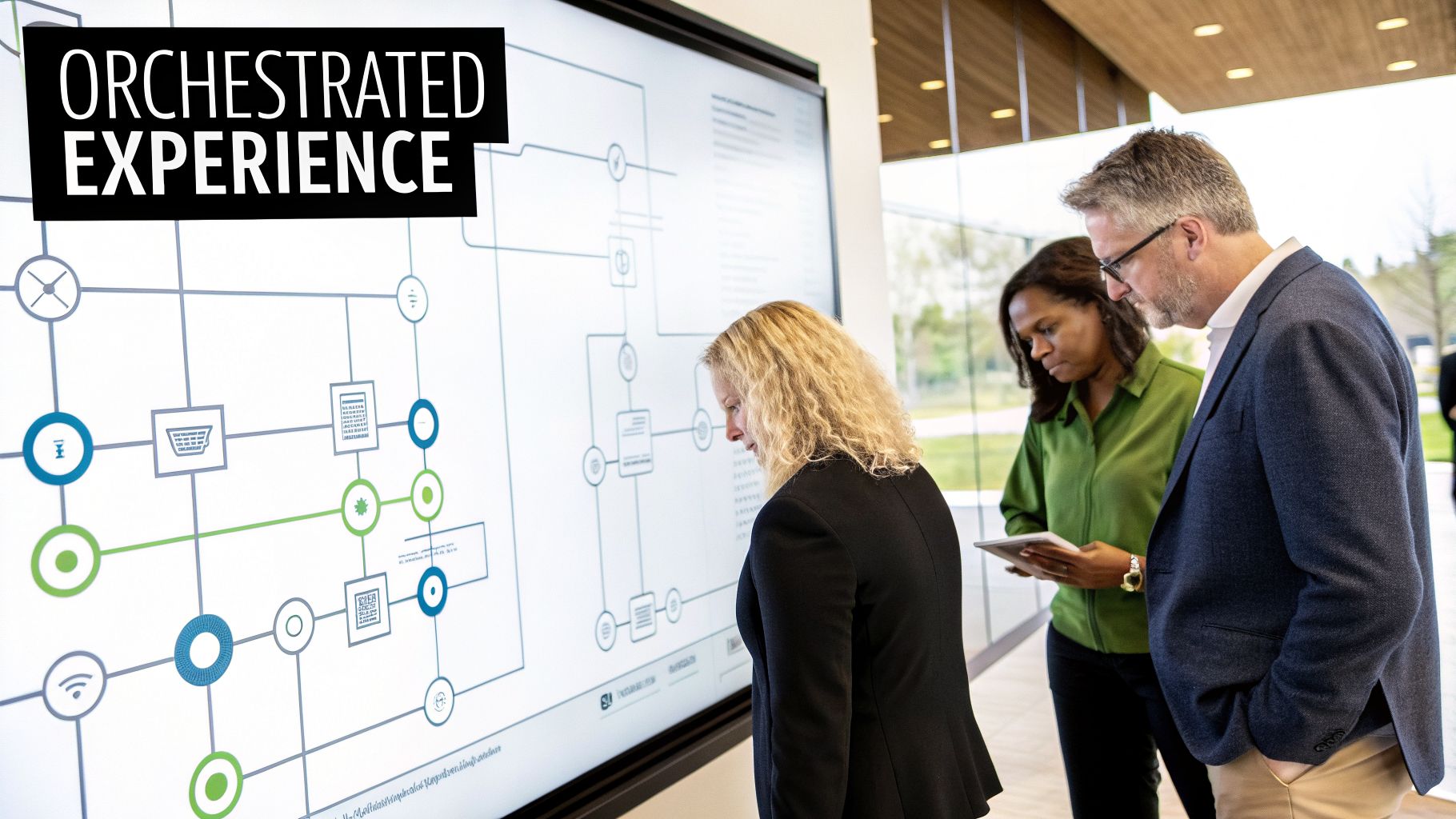
Orchestrating the Experience Across Teams
A unified strategy for branded customer communication is not just about buyer sentiment—it is about reducing the operational drag that constrains every department.
When communication is orchestrated, each team gains leverage, capacity, and clear visibility into the entire customer journey. The result is a more efficient, predictable, and profitable operation.
This approach transforms communication from a series of disconnected tasks into a strategic asset. As the connective tissue between your CRM, construction software, and ERP, it powers automated, on-brand workflows that make every team more effective. Instead of working from different playbooks, everyone aligns around a single, continuous customer conversation.
Unlocking Capacity for Your Sales Team
Your sales agents are your highest-value, customer-facing asset. Yet, they often spend a significant amount of time on low-value, post-contract administrative tasks, acting as the default point of contact for every buyer question. This directly limits their capacity to focus on selling homes.
A centralized communication platform flips this dynamic. By automating routine updates and progress notifications, you free your sales team from answering the same questions repeatedly.
This structured approach delivers immediate returns:
Reduced Inbound Volume: Proactive, automated updates anticipate buyer questions, dramatically cutting down on inbound calls and emails.
Increased Selling Time: Every hour saved on manual follow-up is an hour your team can reinvest into nurturing new leads and accelerating sales velocity.
Consistent Messaging: Sales can trust that buyers are receiving accurate, on-brand information, preventing miscommunications they would otherwise have to resolve.
This is not about replacing the personal touch; it is about reserving it for the moments that matter, allowing your sales team to function as strategic advisors, not support staff.
Creating a Single Source of Truth for Operations
For construction, closing, and admin teams, a lack of clear communication is a primary source of inefficiency. Conflicting information, missed updates, and endless internal follow-ups slow down operations and create frustration for both employees and homebuyers.
A unified system establishes a single, reliable source of truth.
When communication is centralized, construction and closing teams can focus on their core responsibilities instead of fielding constant "just checking in" calls. A central hub streamlines document sharing, task management, and milestone tracking, creating a transparent process for all stakeholders. This is the type of lifecycle gap modern customer experience platforms are designed to solve—connecting your systems to provide shared visibility.
An orchestrated experience ensures the right information reaches the right person at the right time, automatically. It replaces frantic phone calls and messy email chains with a calm, orderly, and measurable workflow.
Empowering Your Warranty and Service Teams
The warranty phase is where brand loyalty is either solidified or destroyed. A reactive service model quickly overwhelms even the best teams. Many inbound calls are not for urgent defects but are simple homeowner questions that could have been answered proactively.
A branded owner portal, powered by your central communication platform, transforms this dynamic. It proactively educates homeowners with maintenance guides, provides a searchable knowledge base for common questions, and offers a structured system for submitting and tracking service requests.
This shift from reactive to proactive service significantly reduces non-urgent inquiries and overall warranty volume. It empowers homeowners to find answers themselves while giving your team the tools to manage genuine service needs efficiently, lowering service friction and creating a more scalable service model.
Homebuilder marketing benchmarks show that well-branded email campaigns can achieve open rates of 21-23%, proving that homeowners will engage with communication that is timely, relevant, and consistent. You can discover more insights about digital benchmarks for homebuilders on astralcom.com.
Measuring the ROI of a Consistent Brand Experience
For any executive, strategic initiatives are measured by their outcomes. A systematic approach to branded customer communication is no different. While improved customer satisfaction is valuable, the real worth is found in the hard numbers that impact operational efficiency and profitability.
Investing in a consistent brand experience is an operational strategy that produces measurable returns. The key is to stop tracking fragmented departmental metrics and start measuring the health of the entire buyer-to-owner lifecycle. When you unify communication, you create a system that can be measured, managed, and optimized.
Key Performance Indicators to Track
To quantify the impact, leaders should focus on KPIs that connect communication quality directly to business performance. These metrics reveal the financial and operational benefits of abandoning a siloed approach.
Key indicators include:
Reduced Inbound Volume: Track the decrease in repetitive calls and emails to your sales, construction, and warranty teams. This directly translates to increased team capacity without adding headcount.
Shorter Time-to-Close: A smoother, more transparent closing process removes friction and delays, accelerating revenue recognition and improving cash flow.
Higher Net Promoter Score (NPS): Measure customer loyalty at key milestones, especially post-closing, to get a clear pulse on your brand's health and referral potential.
Increased Referral Rates: Monitor the number of leads generated from past buyers. A superior experience turns happy homeowners into your most effective—and lowest-cost—sales channel.
Lower Warranty Costs: Proactive, branded education delivered through an owner portal reduces preventable service requests, directly lowering service costs.
Tangible brand elements can also contribute to measurable returns. Items like effective promotional products can help keep your brand top-of-mind long after the sale, reinforcing brand loyalty.
From Brand Initiative to Competitive Advantage
Ultimately, branded customer communication creates a powerful competitive moat. While competitors contend with operational drag and inconsistent messaging, you build a scalable engine for customer satisfaction and long-term growth. To see how these metrics connect, you can learn more about how to measure customer engagement in our detailed guide.
This poses a critical question for leadership: Where does our customer experience break down today, and what is the cost in lost efficiency and future sales? Answering this honestly is the first step toward turning your brand promise into a durable, operational reality. This is exactly the kind of lifecycle gap that modern customer experience platforms are designed to solve.
Got Questions? We’ve Got Answers.
When we talk with homebuilder executives about creating a unified communication strategy, a few common questions always come up. Here are some pragmatic answers to get you started.
How Does This Fit With the Software We Already Use?
Think of a modern customer experience platform not as a replacement for your core systems, but as the connective tissue between them. It acts as an orchestration layer. It plugs into your construction management software and your CRM, pulling the right data at the right time to send out personalized, branded communications.
This approach ensures everyone is working from the same playbook without forcing your teams to ditch the tools they rely on every day.
Won't This Just Create More Work for Our Teams?
Quite the opposite. The goal is to reduce their workload and increase capacity.
By automating routine updates—like construction progress notifications, closing reminders, or document requests—you free up your sales, construction, and closing teams. Instead of answering the same questions repeatedly, they can focus on higher-value work and the customers who truly need their personal attention.
Can We Actually Measure the Impact of Better Communication?
Absolutely. This is about business results, not abstract sentiment.
Key metrics you can track include a measurable drop in inbound customer calls and emails, a noticeable lift in homeowner satisfaction scores (like NPS), and an increase in valuable referral leads. We even see builders shorten their closing cycles.
A centralized platform gives leadership a single dashboard to see what’s working across the entire journey, from first contact to years after move-in. It turns a chaotic, unmeasurable part of the business into a manageable, strategic asset.
Foundation is the customer experience layer that connects your systems, standardizes communication, and turns fragmented, offline interactions into a measurable, branded, and scalable experience. See how it works by visiting the Foundation website.
More from Foundation

Technology
What's New - September 2026
WarrantyOS, from work order to payment. September’s updates bring more of the day-to-day warranty workflow into one connected experience.
Sep 30, 2026

Marketing
New Home Portal: A Builder's Guide to the Buyer Journey
Learn what a new home portal is, the core features builders need, and how it shapes the buyer-to-owner experience across closing and early ownership.
Sep 16, 2026

Marketing
Home Warranty Software: A Practical Buyer's Guide
Compare home warranty software for homebuilders. Evaluate work orders, vendor coordination, customer communication, integrations, and implementation.
Sep 15, 2026