Feb 15, 2026

Reducing customer inbounds isn't just a customer service goal—it's a core operational strategy. The objective is to give buyers the information they need before they ask, freeing up your teams to focus on growth instead of answering repetitive questions.
This strategic shift directly impacts sales velocity, team capacity, and, ultimately, profitability over the next 6 to 18 months.
The Real Cost of High Inbound Volume
Most homebuilder executives see a flood of calls as a cost of doing business—a sign of an engaged customer. This view misses the massive operational drag and hidden financial tax that reactive communication imposes on the entire organization.
This isn't about ignoring customers. It's about engineering a more scalable and profitable way to operate.
When communication is fragmented across sales agents, construction managers, and warranty teams, buyers are forced to chase down answers. Every inbound call signals a breakdown in proactive communication. Each question—"What's the status of my countertops?" or "When is my pre-drywall walk?"—pulls a valuable team member away from their primary role.
The Hidden Tax on Growth and Profitability
This constant interruption creates a vicious cycle of inefficiency that directly hits your bottom line. High inbound volume is a symptom of deeper fragmentation.
Drained Team Capacity: Your skilled people—sales agents who should be closing deals or construction managers keeping projects on schedule—lose hours each week to administrative follow-ups. This is a colossal opportunity cost.
Increased Margin Erosion: Every minute spent on a reactive phone call is a direct labor cost that adds zero value to the home. This operational overhead quietly erodes project margins. Studies on the impact of chatbots on reducing customer support costs show how automation directly lifts this burden in other industries.
Stalled Sales Velocity: When your sales team gets bogged down with post-contract questions, their capacity to engage new prospects plummets. They become administrators instead of the revenue drivers you hired them to be.
The root of the problem? Most builders manage the customer journey with disconnected systems and personal inboxes. That approach doesn't scale. It creates the very friction that forces customers to pick up the phone.
Ultimately, strategically reducing customer inbounds is about regaining operational control. It means shifting from a reactive, high-touch service model to a proactive, high-value communication strategy.
When buyers have a single, reliable place to find answers, their confidence soars and their need to call plummets. This shift doesn't just improve the customer experience; it unlocks significant operational leverage. Your teams can build and sell more homes without a corresponding increase in headcount. Strong communication in the construction industry is the bedrock of this modern, profitable approach.
Shift From Reactive Support To Proactive Communication
The constant cycle of putting out fires is exhausting and unprofitable. When your team spends its days answering the same questions, you aren't just losing time—you're leaking margin. The solution isn't hiring more people to answer phones; it's fundamentally changing your communication model from reactive to proactive.
This means anticipating customer questions and delivering critical information before they think to ask.
A proactive approach to reducing customer inbounds hinges on creating a central, builder-branded hub where the buyer’s entire journey lives—a single source of truth. This isn't just another app; it's an authoritative portal for updates, documents, and milestones from contract to close.
When a buyer knows exactly where to look for an answer, the instinct to call three different people vanishes.
This process flow shows the hidden costs that a reactive, high-inbound model creates. Every repetitive call is a direct drain on profitability and a roadblock to growth.
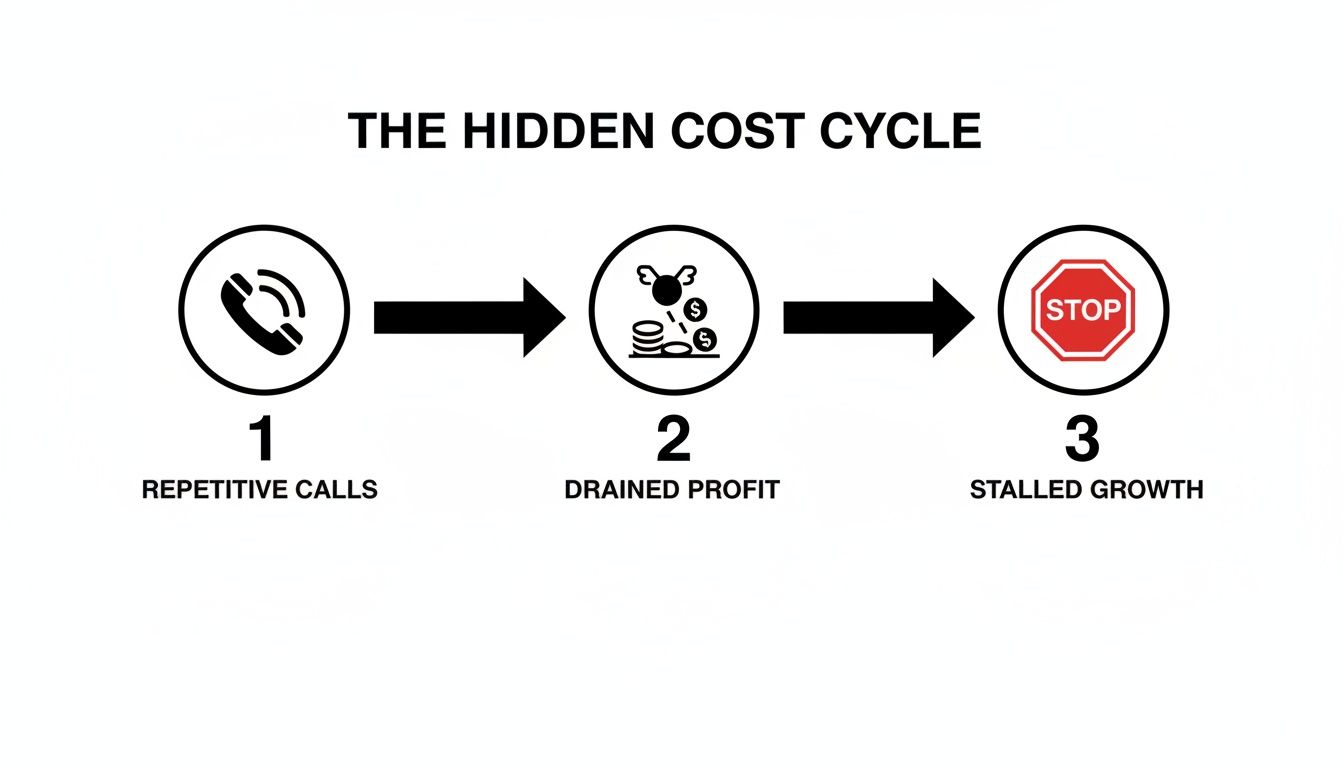
This visual gets to the heart of a critical operational reality: each inbound call is a symptom of a process breakdown. These breakdowns erode margins and consume resources that should be focused on scaling the business.
Automating The Post-Contract Journey
The period between contract and construction is often a communication black hole. This uncertainty breeds anxiety and triggers a flood of "what's next?" calls that overwhelm your sales team.
Automating key updates during this phase is one of the most effective ways to quiet the noise and build immediate trust. Instead of relying on individual team members to send updates, a modern customer experience platform can orchestrate these touchpoints automatically.
Welcome Sequence: Immediately after contract signing, an automated workflow sends a welcome message, introduces the construction team, and sets clear expectations.
Permitting Updates: The system pushes notifications when permits are submitted and approved, eliminating the need for buyers to call for status checks.
Pre-Construction Milestones: Buyers get automatic alerts for key events like lot clearing and foundation staking, keeping them engaged and informed.
This type of "lifecycle gap"—where communication falls through the cracks between disconnected teams and systems—is precisely what modern customer experience platforms are designed to solve. They provide the connective tissue needed to deliver a seamless, automated journey.
Automating post-contract updates dramatically slashes inbound calls. Platforms that digitize the homeowner journey reflect broader trends where automation has been shown to significantly reduce customer inquiries. For homebuilders, this translates directly into sales teams reclaiming weeks of their time annually to focus on the next sale.
A Tale of Two Builders
Consider a scenario for a builder closing 200 homes a year. The table below breaks down the difference between a reactive model and a proactive one, showing the direct impact on inbound volume and team efficiency.
From Reactive Chaos to Proactive Control
Operational Area | Reactive Model (High Inbounds) | Proactive Model (Reduced Inbounds) |
|---|---|---|
Buyer Communication | Fragmented across personal email, SMS, and phone calls. | Centralized in a single branded homeowner portal. |
Getting an Update | Buyer calls the sales agent, who chases the CM for information. | Buyer checks the portal; information is synced from the source. |
Team Efficiency | 3+ team members involved in answering one simple question. | 0 team members involved; information is self-service. |
Information Accuracy | High risk of conflicting information and delays. | Single source of truth ensures accuracy and consistency. |
Customer Experience | Anxious, uncertain, and frustrating for the buyer. | Confident, informed, and predictable for the buyer. |
As you can see, the proactive model doesn't just reduce calls; it transforms the entire operational flow.
Here’s what that looks like day-to-day:
With Builder A (Reactive Model), the sales agent, construction manager, and closing coordinator all communicate with the buyer separately. The buyer emails the sales agent for the foundation pour date, who has to track down the CM. This creates a 24-hour delay and eats up time for three people.
With Builder B (Proactive Model), the buyer logs into their branded portal. The project timeline, synced directly with the construction management system, shows the target foundation pour date. An automated notification is scheduled to go out the day before. The buyer has full visibility and never needs to pick up the phone.
Exploring specific use cases for digital tools makes it clear how they directly contribute to reducing inbound calls by keeping customers proactively engaged.
This shift is more than technology; it’s a new operating model. It reframes customer communication as a scalable, brand-owned asset rather than a series of manual tasks. To execute this, leaders need to understand the principles behind system integration and automation. You can learn more about structuring these systems in our guide on https://buildwithfoundation.com/blog/what-is-workflow-automation-software.
The result is a calmer, more predictable experience for the buyer and a more efficient, profitable operation for the builder.
Streamline the Closing Process with Digital Tools
The closing process is a notorious bottleneck and a massive source of inbound calls. As deadlines approach, buyer anxiety skyrockets, unleashing a flood of panicked questions about documents, timelines, and what comes next.
Every one of those calls pulls your closing coordinators and sales agents away from high-value work, creating a serious operational drag. This final stretch of the homebuying journey is where a proactive communication strategy proves its worth.
By creating a digital Closing Concierge, you centralize every task, document, and communication into a single, easy-to-use hub for the buyer. This approach is fundamental to reducing customer inbounds during this critical phase.
Creating a Digital Closing Concierge
A digital closing concierge is an orchestrated workflow that guides the buyer through every milestone, providing self-service visibility into the entire transaction—from final inspections to the transfer of funds.
This transparency replaces uncertainty with confidence, drastically cutting down on the need for buyers to call your team for reassurance.
This digital hub should give buyers clear, real-time answers to the most common closing questions:
What documents do I need to sign? A central library with e-signature capabilities eliminates confusion.
When is my final walkthrough scheduled? An integrated calendar puts all key dates in one place.
Have my funds been received? Automated notifications confirm when critical financial milestones are hit. No more "just checking in" calls.
Who do I contact with a specific question? A clear directory connects buyers to the right person at the mortgage, title, or insurance company.
Fragmented, offline interactions buried in emails and phone calls create a massive amount of inbound noise for closing teams.
In contrast, builders who switch to unified digital platforms have historically cut down these interactions, significantly. A good digital hub empowers buyers to track milestones and find documents themselves, slashing questions by automating routine updates. For a builder closing 500 homes a year, that can mean thousands of fewer calls annually—the workload of two full-time employees.
You can find more data on how market conditions impact builder operations by exploring the latest industry sentiment data from Eye on Housing.
The Impact on Team Efficiency and Customer Experience
Implementing a digital closing process is a win-win. Buyers get the modern, predictable experience they expect, and your internal teams get a significant operational lift. The chaos of last-minute fire drills is replaced by a smooth, scalable workflow.
This is where most builders see the experience break down. The transition from construction to closing often feels disjointed. Integrated, white-labeled platforms make this handoff seamless and scalable without adding complexity for your team.
For closing coordinators, the benefits are immediate. Instead of fielding the same questions repeatedly, they can focus on managing exceptions and ensuring every transaction closes on time. This shift allows them to handle a higher volume of closings without a corresponding increase in stress or headcount.
Ultimately, a streamlined closing process is the capstone of a great buyer journey. It reinforces the buyer's decision and sets the stage for a positive post-close relationship, which is critical for generating referrals and repeat business.
For executives looking to improve efficiency and customer satisfaction, optimizing this final phase is a strategic imperative. A well-designed digital Closing Concierge is the tool that makes it possible.
Transforming the Post-Close Experience
The customer relationship doesn't stop at closing. For too many homebuilders, the post-close period kicks off the most expensive and frustrating chapter of the journey: warranty claims.
This "warranty noise"—vague, repetitive, and often preventable questions—bogs down your service teams. Every call about a squeaky floorboard or an appliance manual pulls your team into a reactive, costly service cycle.
Let's be clear: reducing customer inbounds in the ownership phase isn't about dodging responsibility. It's about empowering homeowners to become more self-sufficient, which benefits everyone.
Building a Builder-Branded Homeowner Hub
The most effective way to manage the post-close experience is to create a builder-branded homeowner hub. This digital command center becomes the single source of truth for the entire ownership journey.
Think of it as a living, digital owner's manual—always on, accessible, and completely wrapped in your brand. The homeowner’s first instinct becomes checking their portal, not calling your warranty department.
This hub should pull all critical ownership information into one intuitive place:
Centralized Document Library: All closing docs, plot plans, and home specs are stored securely.
Warranty Details: Clear explanations of what is and isn't covered, along with instructions on how to submit a claim.
Appliance and Material Information: Easy access to model numbers, manufacturer manuals, and registration links.
Maintenance Guides: Proactive, seasonal checklists and how-to guides for common homeowner tasks.
This approach transforms the homeowner from a passive caller into an informed partner in maintaining their home.
This is exactly the kind of lifecycle gap that modern customer experience platforms are built to solve. They extend the seamless digital journey past closing, turning the ownership phase into a strategic asset for brand loyalty.
From Warranty Noise to Streamlined Service
A well-designed homeowner hub does more than share information—it creates a structured system for managing service requests. Vague phone calls are replaced with clear, data-rich digital submissions.
This structured process allows your team to triage issues more effectively. Homeowners can upload photos or videos, giving service coordinators the context needed to dispatch the right trade partner on the first visit.
The financial and operational impact is massive. Post-close ownership is plagued with warranty noise, but builders using branded digital hubs are significantly cutting those inbounds. In a market where every dollar of margin counts, automated hubs can handle much of the post-sale queries through self-service alone.
For an enterprise builder, that can translate to 15,000 fewer emails and calls every year. That's a 50% reduction in overall warranty noise, saving hundreds of thousands in labor costs. You can learn more about how builders are navigating current market affordability challenges from industry analyses.
A Strategic Lever for Trust and Referrals
The post-close experience is your brand's lasting impression. A chaotic warranty process destroys trust and kills any chance of a referral.
Conversely, an organized, empowering ownership experience reinforces the quality of your homes and the integrity of your brand.
By giving homeowners the tools they need to succeed, you build long-term confidence and loyalty. Satisfied homeowners don't just submit fewer trivial warranty claims; they become vocal advocates for your brand, driving valuable referral business for years.
This makes the investment in a dedicated Ownership Experience platform a strategic decision that pays dividends long after the final walkthrough. It’s a direct path to higher customer satisfaction, lower operational costs, and a stronger brand.
Integrating Systems for a Single Source of Truth
A standalone customer portal can feel like a step forward, but it often creates a new island of information. To achieve a lasting drop in customer calls, you need a connected internal ecosystem.
Without it, your teams are stuck manually updating multiple platforms, leading to data conflicts that kill buyer trust.
When a buyer sees one date in their portal but hears another from the construction manager, the portal’s value is destroyed. That failure sends confused customers straight back to the phone. A customer experience platform must be the connective tissue between your core systems, not another silo.
This integration layer ensures every automated update—from a selection deadline to a construction milestone—reflects the real-time truth from the field. It pulls data from where work actually happens, guaranteeing consistency.
Connecting Your Core Operational Systems
For homebuilder leadership, the goal isn't to rip and replace proven systems like your CRM or ERP. The goal is to orchestrate them. A modern customer experience platform sits on top of these core tools, pulling and pushing data to create one unified view for the customer and your internal teams.
This model creates a single source of truth that powers the entire customer journey.
CRM Integration: Syncs buyer information, selections, and communication history, giving sales a complete picture without leaving their primary tool.
Construction Software Integration: Automatically pulls key dates and project updates into the customer portal, freeing up construction managers from sending manual updates.
ERP Integration: Connects financial milestones and purchasing data, providing visibility into key transaction events that impact the closing timeline.
This connected framework is the only way to deliver a consistent experience at scale. It guarantees the message a buyer receives always aligns with operational reality. You can learn more about how these systems work together in our guide to construction enterprise resource planning.
This is exactly the kind of lifecycle gap that modern customer experience platforms are designed to solve. They don’t replace your core systems; they make them more powerful by orchestrating workflows and visibility across previously disconnected departments.
The Executive View: Unlocking Lifecycle Visibility
For a COO or CEO, this integrated approach provides something historically impossible: unprecedented lifecycle visibility. When customer engagement data is tied directly to operational milestones, leaders can finally see where friction exists in the buyer-to-owner journey.
You can start answering critical strategic questions with data, not anecdotes.
Which construction phases generate the most inbound questions?
Are buyers in a specific community more or less engaged with their portal?
How does portal engagement correlate with post-close customer satisfaction scores?
This level of insight allows you to shift from reactive to proactive management. You can spot potential bottlenecks before they escalate and refine your processes based on real customer behavior. It transforms the customer experience from disconnected touchpoints into a measurable, strategic part of the business.
Ultimately, integrating your systems is about building a more resilient and scalable operating model. It reduces manual work, minimizes human error, and delivers the seamless, trustworthy experience modern buyers expect.
Measuring Success and Fostering an Efficient Culture
A strategy for reducing customer inbounds is only as good as its adoption. For this operational shift to stick, you must define what success looks like and champion a culture that sees proactive communication as a competitive advantage.
It starts by moving beyond vague goals to concrete key performance indicators (KPIs) that directly measure the impact of your efforts.
Defining Your Key Metrics
Tracking the right numbers provides a clear picture of what’s working. It turns "better communication" into a measurable operational discipline.
Consider tracking these metrics:
Inbound Inquiries per Closing: Your north star metric. A steady drop proves your strategy is working by tying communication efficiency to production volume.
Customer Portal Engagement Rate: Tracks how often buyers and homeowners log in. High engagement is a leading indicator of reduced call volume.
First-Contact Resolution Rate (Warranty): The percentage of service issues resolved on the first visit. A higher rate indicates better information quality from portal submissions, saving your team from wasteful return trips.
Gaining Team Buy-In
For your sales, construction, and warranty teams, a new system can feel like a threat. The key to gaining their support is to frame these tools as something that makes their jobs easier and more effective.
The goal isn't to eliminate human interaction; it's to elevate it. When technology handles repetitive, low-value questions, your teams are freed up to manage complex issues, build stronger relationships, and focus on work that requires their expertise.
This is a change management challenge. Position your customer experience platform as a tool that crushes administrative burden—no more chasing down updates or answering the same question for the tenth time. It gives them back time to sell homes, manage projects, and deliver the service that builds your brand.
Building a more scalable, customer-centric operating model requires both the right technology and the right mindset. This is a leadership-driven shift that pays dividends in team capacity, customer loyalty, and long-term profitability.
Even with a clear plan, homebuilding leaders often have the same key questions about real-world implementation.
What is a realistic ROI on this kind of platform?
The return extends beyond a quieter phone line.
Lower labor costs in warranty and support are an obvious win. But the real financial impact comes from giving your teams their time back. When you automate routine "what's next?" updates, your sales team can reclaim weeks of time annually. That time goes directly into selling more homes—without increasing headcount.
Beyond that, a proactive customer experience builds brand reputation, drives referrals, and brings buyers back. This flips the script, turning customer experience from a cost center into a revenue driver.
How do we get our teams to actually use a new system?
Success here comes down to one thing: framing this as a tool that makes their day-to-day job less frustrating.
For your sales agents, it means they're not bogged down in post-contract hand-holding. For your construction managers, it means fewer on-site interruptions, letting them focus on build quality and schedules.
The goal is to show them how the platform automates the most repetitive parts of their job. When your team sees it as a way to get back to the high-value work they were hired for, adoption becomes a no-brainer.
Will this plug into our CRM and construction software?
It has to. This is non-negotiable for it to work.
A modern customer experience platform isn't another data silo. It must be the connective tissue linking your core systems.
Through pre-built integrations and APIs, it should pull real-time construction milestones from your ERP or scheduling software and sync all customer communications back to your CRM. This ensures the information you're sending buyers is always accurate—the bedrock of building trust and stopping inbound calls before they start.
A fragmented customer journey creates operational drag and eats into profit. Foundation provides the customer experience layer to connect your systems, automate communication, and deliver a scalable, brand-owned journey from contract to close and beyond. See how it works.
More from Foundation

Technology
What's New - September 2026
WarrantyOS, from work order to payment. September’s updates bring more of the day-to-day warranty workflow into one connected experience.
Sep 30, 2026

Marketing
New Home Portal: A Builder's Guide to the Buyer Journey
Learn what a new home portal is, the core features builders need, and how it shapes the buyer-to-owner experience across closing and early ownership.
Sep 16, 2026

Marketing
Home Warranty Software: A Practical Buyer's Guide
Compare home warranty software for homebuilders. Evaluate work orders, vendor coordination, customer communication, integrations, and implementation.
Sep 15, 2026