Feb 5, 2026
For most homebuilders, the moment the keys are handed over marks a dangerous transition. The post-close experience is where the promises made during the sales process meet the reality of homeownership, yet it’s often the most neglected part of the entire customer journey. This is where excitement fades, communication breaks down, and the long-term value of your brand erodes, one missed follow-up at a time.
This isn't just a customer service issue; it's a direct threat to referrals, brand reputation, and long-term revenue.
The Strategic Blind Spot in Homebuilding
After months of high-touch, personal engagement from your sales and construction teams, the relationship with your new homeowner changes overnight. The dedicated sales agent and construction manager they’ve come to trust are suddenly replaced by a generic warranty hotline or an unmonitored email inbox. This communication vacuum creates a significant gap, which is quickly filled by homeowner anxiety and frustration.
This isn’t a small hiccup; it’s a massive business risk we call the “satisfaction cliff.” All the momentum and goodwill you worked so hard to build during the sales process can vanish in an instant, and that directly hits your bottom line.
The Real Cost of Neglecting Homeowners
When the post-close experience is disconnected, it shows up in tangible, expensive ways that senior leaders simply can't afford to ignore. These aren't just one-off incidents—they're symptoms of a broken, fragmented process. The fallout looks like this:
Skyrocketing Warranty Volume: Without clear, proactive guidance, new homeowners submit tickets for everything. Many of these issues could be solved with a simple FAQ or video, but instead, they overwhelm your service teams.
Wasted Team Capacity: Your most skilled people end up answering the same repetitive questions about appliance registration or maintenance schedules instead of focusing on high-value construction and service issues.
Eroded Brand Trust: A homeowner who feels abandoned the second you have their money will never become an advocate for your brand. This directly damages the reputation you've spent millions to build.
Zero Referrals: Happy homeowners are a builder’s single most effective and highest-margin sales channel. A poor ownership experience slams that door shut.
Industry data confirms this breakdown. A landmark analysis of over 350,000 homebuyer surveys reveals customer satisfaction plummets from 92.8% during the sales phase to just 75.8% during the warranty phase. Even worse, the "Would Recommend" score—the engine of growth—drops from 97% at purchase to a dismal 71% after move-in. That’s a 26-point collapse that directly correlates to lost revenue.
This is exactly the kind of lifecycle gap a modern customer experience platform for homebuilders is designed to fix. By connecting your teams and automating crucial communications, you can turn this vulnerable period into a competitive advantage. The goal is to shift from a reactive, costly support model to a proactive, scalable ownership experience that drives long-term growth.
Mapping the Fragmented Homeowner Journey
For a new homeowner, the journey after closing should be a smooth handoff into a long-term relationship with their builder. In reality, it rarely is.
Instead, initial excitement often gives way to a chaotic scramble for information, turning their dream-come-true moment into a slow burn of anxiety. This breakdown isn't malicious; it's the natural result of siloed teams and disconnected systems managing what is a deeply personal journey for the customer.
Consider a scenario that plays out in builder divisions every day. A family moves in, finds a minor scuff on a baseboard, and can't figure out their new smart thermostat. For weeks, they had a single point of contact: their sales agent. That relationship is now over.
So, who do they call? Their first instinct is to text the sales agent or construction manager, pulling those team members back into post-close service and distracting them from their actual jobs of selling the next home or managing the next build. This is the first crack in the experience.
The Breakdown Across Teams and Systems
Next, the homeowner gets pointed to a generic warranty email address. They send a message and wait, wondering if anyone received it.
The warranty coordinator who opens that email has zero context. To find the right paint color or thermostat model, they must start digging—logging into a separate construction management system, hunting for closing docs in a different folder, or tracking down the original project manager.
This internal goose chase creates massive operational drag. Every step introduces another delay and a new opportunity for error, all while the homeowner's frustration builds. Their simple question has now turned into a multi-day, multi-team scavenger hunt.
This is where the experience almost always falls apart. The homeowner isn't just sending an email; they're trying to navigate an invisible maze of departmental handoffs, each with its own tools and priorities. The result is a slow, inconsistent, and deeply impersonal post-close experience.
This chart says it all. Homeowner satisfaction starts incredibly high at purchase but plummets once they enter the confusing world of move-in and warranty.
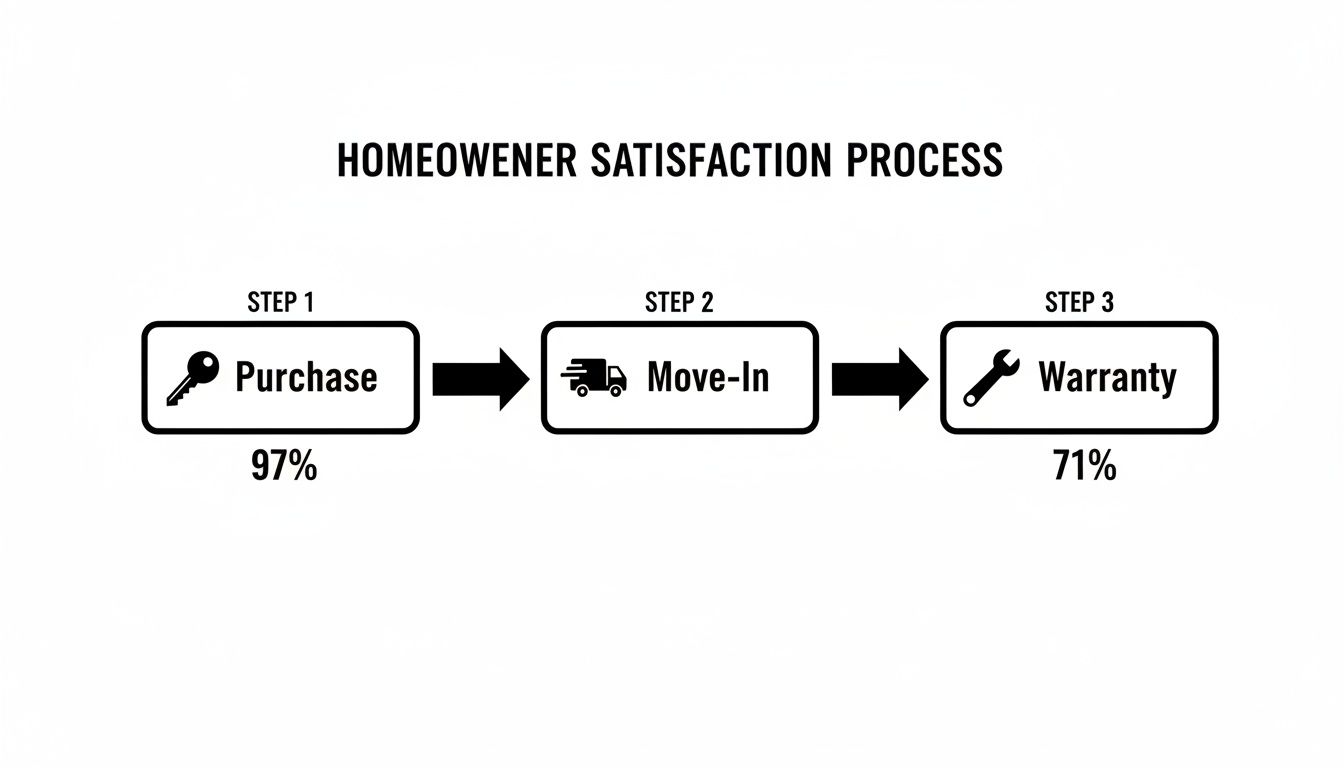
That steep drop from a 97% "Would Recommend" rating at purchase to just 71% during the warranty phase is a flashing red light. It shows exactly how this fragmented journey directly harms your brand's most powerful growth engine: referrals.
Symptoms of a Disconnected Journey
Trying to manage this with manual, reactive processes simply doesn't scale. It creates friction for your customers and your internal teams. The symptoms are probably all too familiar:
Repetitive Inbound Questions: Your teams are stuck answering the same questions about appliance registration, maintenance schedules, and utility contacts—information the homeowner should have at their fingertips.
Lack of Visibility: Leadership is flying blind with no clear view of homeowner engagement post-close. Problems only surface after they’ve escalated into angry phone calls or scathing online reviews.
Inconsistent Brand Experience: The polished, professional voice from the sales process is replaced by a disjointed, transactional tone during the warranty phase. That shift erodes trust fast. You can learn more by exploring how to measure customer engagement.
This fragmentation is the root cause of the satisfaction cliff. It’s a systemic problem that can only be fixed by connecting the people, processes, and platforms that touch the homeowner's journey. An integrated platform creates a single source of truth for both your team and your customer, making a seamless experience scalable.
The True Cost of a Disconnected Experience
The friction from a fragmented post-close experience isn't a minor headache; it’s a direct hit to your bottom line. It's easy to dismiss this phase as a cost center, but that thinking is a strategic liability. When inefficiencies go unchecked, they quietly eat away at margins, stunt growth, and damage the long-term value of your business.
When communication falls apart after closing, the financial consequences ripple through the entire company. These costs often get buried in departmental budgets, but when you add them all up, the impact is massive. To grasp the damage, you have to look past the obvious expenses to see the deeper, long-term harm.
The Financial Drain of Warranty Overload
A reactive warranty process is one of the most visible money pits. When new homeowners don't get proactive guidance, they call your warranty team for everything. This opens the floodgates for low-value, preventable service requests that drain your team's most valuable resource: time.
Every call about resetting a GFCI outlet or operating a new appliance has a real cost. It pulls skilled technicians away from legitimate construction issues, driving up labor costs and creating backlogs for critical repairs. This isn't just a customer service issue; it's a direct blow to operational efficiency.
Revenue Lost from Missed Opportunities
Perhaps the biggest hidden cost is the revenue you never earn. A frustrated homeowner isn't going to recommend you to their friends or family. Worse, they’re far more likely to leave negative reviews that scare away new prospects, forcing your marketing and sales teams to spend more just to keep the lead funnel full.
On the flip side, happy homeowners are your best, highest-margin sales channel. By engaging with homeowners after the sale, builders can dramatically increase customer lifetime value and turn a single transaction into a lasting, profitable relationship. Every missed referral is tens of thousands of dollars in lost revenue.
Contrasting Operational Models
The financial argument becomes crystal clear when you compare a reactive process with a modern, proactive approach. The difference in key business metrics tells a compelling story about where to invest. An integrated platform doesn't just make homeowners happier; it directly pads your bottom line.
Operational Impact Traditional vs. Modern Post-Close Experience
Metric | Traditional Post-Close (Fragmented) | Modern Post-Close (Integrated Platform) |
|---|---|---|
Warranty Volume | High volume of preventable, low-value tickets | Reduced by 20-30% through proactive information |
Team Capacity | Teams are bogged down by repetitive questions | Increased capacity for high-value tasks |
Referral Rate | Low to negligible due to poor experience | Consistently high, creating a reliable revenue stream |
Brand Reputation | At risk from negative reviews and word-of-mouth | Strengthened by positive homeowner advocacy |
Operating Costs | Inflated by manual follow-ups and inefficiencies | Lowered through automation and self-service tools |
The traditional model keeps your teams on the defensive, constantly putting out fires instead of building value. It’s a framework that actively holds back your growth.
For a deeper dive into optimizing this critical function, explore our guide on transforming your home builder warranty process. Shifting to a proactive, platform-driven model doesn't just cut costs—it unlocks new channels for sustainable, high-margin growth.
Building a Scalable Post-Close Operating Model
A great post-close experience doesn't just happen. It’s the result of a deliberate, scalable system. Moving beyond scattered emails and frantic phone calls requires a shift in how you view the homeowner relationship after you hand over the keys. The aim is to build a process that delivers consistent quality without scaling headcount.
This isn't about ripping and replacing your core systems like your CRM or construction management software. The solution is to add a dedicated customer experience layer that acts as the connective tissue between them all. This layer orchestrates communication, workflows, and data, creating a single source of truth for your team and the homeowner.
The Three Pillars of a Modern Model
A post-close framework that scales is built on three core pillars. Each is designed to eliminate friction, automate repetitive tasks, and keep the relationship tied to your brand.
A Centralized, Branded Homeowner Hub: This is the foundation. Instead of homeowners digging through emails, give them a single, white-labeled digital portal. This hub is their one-stop shop for everything: closing documents, home specs, appliance manuals, and maintenance guides.
Automated, Context-Aware Communication: Staying ahead of homeowner questions is critical. A modern model uses automation to send the right information at the right time, whether it's a seasonal maintenance reminder or a community update. This keeps your brand helpful long after closing.
Seamless System Integration: The homeowner hub must connect directly into your back-end systems. This enables automated warranty requests that route to the right person with all the necessary details, cutting out the manual data entry and internal phone tag that kills efficiency.
This is precisely the kind of problem that modern customer experience platforms are built to solve. For example, you can see how Foundation’s Operator platform provides this essential connective layer for homebuilders.
Orchestrating Workflows, Not Replacing Systems
It's critical for leadership to grasp that this approach is about orchestrating workflows, not replacing technology. The customer experience platform sits on top of your existing tech stack, pulling the right data from each system to give the homeowner one clean, unified view.
Think of it like this: your CRM knows who the customer is, your construction software knows what you built, and your ERP knows the financials. The customer experience layer is what stitches it all together to answer the homeowner’s questions and guide their journey—without your team manually connecting the dots.
This creates true end-to-end visibility. When a homeowner submits a warranty claim through their hub, it's automatically populated with data from the construction file. Your service team instantly sees the exact appliance model, installation date, and subcontractor, eliminating the back-and-forth and enabling a first-time fix.
Strengthening Your Brand and Customer Relationships
Ultimately, this model is about owning the customer relationship. By providing a builder-branded digital home base, every interaction reinforces your company’s identity and commitment. You control the narrative, the data, and the entire experience.
A key part of owning that journey is listening. Implementing actionable post-purchase surveys is a simple way to get direct feedback from homeowners. That data, captured within your branded ecosystem, offers priceless insights to spot trends, fix recurring problems, and continuously improve the ownership experience.
The result is a scalable, efficient model that doesn't just cut operational costs—it builds the brand loyalty that fuels referrals and drives long-term growth.
How a Unified Experience Transforms Your Teams

A broken post-close experience doesn’t just frustrate homeowners. It creates serious drag on every customer-facing team in your company. The friction from disjointed communication and manual follow-ups quietly drains resources, caps your team's capacity, and pulls your best people away from high-value work.
Implementing a unified platform isn't just a "customer service" project—it’s a strategic move that provides significant operating leverage across the business.
When your systems are connected and homeowners have one place to get information, the benefits ripple through every department. Your teams can finally stop putting out fires and wasting time on repetitive tasks, and start focusing on the work that actually drives growth.
Transforming Warranty from Reactive to Proactive
For most warranty teams, a fragmented process means they're constantly on the defensive. They are buried under inbound calls and emails, a huge portion of which are simple questions, not actual defects. It's an inefficient and demoralizing way to work.
A unified platform completely flips that dynamic.
By giving homeowners a central hub with guides, maintenance reminders, and FAQs, you can deflect up to 30% of routine questions. When a real issue arises, homeowners submit structured requests through a portal—complete with photos and necessary details. This lets your team diagnose problems faster and dispatch the right trade partner the first time.
The goal is to turn your warranty department from a cost center into a customer retention engine. When service is fast, transparent, and easy, it reinforces the quality of your brand and builds real trust.
Empowering Sales with a Referral Engine
Your sales team’s job is selling the next home, not hand-holding past buyers through service issues. Too often, they become the first line of defense for frustrated homeowners, pulling them away from activities that generate revenue. Every hour spent on post-close problems is an hour they’re not selling.
An integrated post-close journey creates a powerful, automated referral engine. Here’s how:
Proactive Engagement: Automated check-ins and helpful content keep the relationship warm long after closing, making homeowners feel valued.
Satisfaction Monitoring: The platform provides a direct line of sight into homeowner happiness, making it easy to spot your biggest fans—the perfect candidates for referrals.
Seamless Referral Requests: You can automatically prompt delighted homeowners for referrals and testimonials when they're happiest with their new home.
This creates a steady pipeline of high-quality, low-cost leads, turning your existing customer base into your most effective sales channel. To learn more about getting your teams on the same page, check out our guide on improving communication in the construction industry.
Arming Marketing with Actionable Data
For most marketing leaders, visibility drops off a cliff the moment a contract is signed. Without a connected post-close experience, they have no real way to measure long-term satisfaction, identify brand advocates, or understand what drives loyalty. They are left guessing about the real ROI of their brand-building efforts.
A unified platform is a goldmine of first-party data.
Your marketing team can finally track Net Promoter Score (NPS) through the entire ownership journey, not just in a one-off survey. They get direct insight into which features and experiences are creating satisfaction. This data is pure gold for refining marketing messages, creating authentic testimonial campaigns, and proving the long-term value of a great customer experience.
Shifting from Closing Deals to Owning the Lifecycle
Most conversations about the post-close experience get stuck on tactics—how to fix a clunky warranty workflow or reduce inbound calls. While important, focusing only on operational fixes misses the massive strategic opportunity.
The real goal isn’t just to manage the first year of homeownership more efficiently. It’s to completely shift your business model from just closing deals to owning the entire customer lifecycle.
This changes everything. Instead of a transaction that ends when you hand over the keys, you start building a durable, long-term connection that lasts for years. This is how you stop being just another builder and become a trusted, lifelong partner in their homeownership journey.
Building Your Competitive Moat
In a market where land, labor, and materials are commodities, a superior customer lifecycle becomes your competitive moat. It’s powerful, defensible, and something your competitors can't easily copy.
When you own the relationship, you own the data. You own the communication. You own the brand narrative from the first website inquiry through years of happy ownership.
This kicks off a powerful growth loop fueled by the customers you already have:
High-Margin Referral Revenue: Homeowners who feel genuinely supported become your most credible and effective sales force. Their referrals are warm leads that close faster and at a fraction of traditional marketing costs.
Predictable Repeat Business: A stellar ownership experience means you're the first—and only—call when that family is ready for their next home, whether they're upsizing, downsizing, or buying a second property.
Increased Enterprise Value: A business with a predictable stream of high-margin revenue from referrals and repeat buyers is fundamentally more valuable. It proves you have the brand loyalty and long-term stability that investors seek.
The most forward-thinking builders understand: the home is the product, but the homeowner relationship is the asset. Cultivating that asset is the key to creating sustainable, high-margin growth that doesn’t depend on market cycles.
This is exactly the kind of lifecycle gap that a modern customer experience platform like Foundation is designed to close. An integrated, white-labeled platform makes this long-term engagement scalable without bogging down your teams. It gives you the tools to perfect the post-close experience and turn it into the foundation of your brand’s future.
The question is no longer if you can afford to invest in the ownership journey, but whether you can afford not to.
Common Questions
Even with a solid plan, it's natural to have questions about rethinking your post-close experience. Here are some of the most common ones we hear from homebuilding leaders.
What Is the Biggest Failure Point in a Typical Post-Close Experience?
The single biggest breakdown is the jarring transition from the high-touch, constant-contact sales process to a fragmented warranty phase.
Buyers go from feeling like the center of attention to feeling abandoned, left to navigate a confusing web of contacts for the simplest questions. This is where satisfaction nosedives and brand trust erodes, all because they’re forced to chase down information through a messy mix of emails and phone calls.
Can We Improve Our Post-Close Experience Without Replacing Our CRM?
Absolutely. In fact, replacing a core system like a CRM is usually the wrong move. The smartest approach is to add a dedicated customer experience layer that integrates with the systems you already have.
Think of this layer as the connective tissue that links your CRM, construction software, and warranty platforms. It creates a unified, branded portal for the homeowner without the massive disruption of tearing out your core software. It fills the communication and visibility gaps your current tech stack wasn't built to solve.
What Are the First Steps to Evaluate Our Current Post-Close Process?
Start by mapping the journey from the homeowner's perspective, from contract through their first year of ownership. Pinpoint every touchpoint, system interaction, and team handoff. You’ll quickly see where the process gets messy.
Next, audit the questions your teams are fielding from recent buyers. What are they asking about most? Combine that with homeowner surveys. This data will highlight the biggest points of friction and give you a rock-solid business case for making a change.
Foundation is the customer experience platform built for homebuilders, connecting your systems and teams to deliver a scalable, branded journey from contract through ownership. See how it works.
More from Foundation

Technology
What's New - September 2026
WarrantyOS, from work order to payment. September’s updates bring more of the day-to-day warranty workflow into one connected experience.
Sep 30, 2026

Marketing
New Home Portal: A Builder's Guide to the Buyer Journey
Learn what a new home portal is, the core features builders need, and how it shapes the buyer-to-owner experience across closing and early ownership.
Sep 16, 2026

Marketing
Home Warranty Software: A Practical Buyer's Guide
Compare home warranty software for homebuilders. Evaluate work orders, vendor coordination, customer communication, integrations, and implementation.
Sep 15, 2026