Feb 12, 2026
For homebuilder executives, operational efficiency isn't a buzzword—it's the engine of profitability and the key to scaling growth. It’s about building and selling more homes, better and faster, without overhead costs growing at the same pace. True operational efficiency delivers more operating leverage from the people and resources you already have.
The goal is to eliminate the friction that quietly eats away at margins, slows down sales velocity, and caps your team's capacity.
What Operational Efficiency Really Means for Homebuilders
In homebuilding, operational efficiency is a strategic approach to every step in your process, from the first buyer inquiry to the final warranty claim years later. It's about finding and fixing the fragmentation that causes drag on your business.
Most builders are wrestling with the same core frustrations: systems that don't talk to each other, endless manual follow-ups, and teams working in silos. This isn't just an internal IT problem. This operational drag directly hurts the customer experience, leading to missed updates, chaotic closings, and a reactive warranty process that feels like constantly putting out fires.
These small points of friction stack up, damaging your brand's reputation and limiting what your best people can actually accomplish.
From Common Bottlenecks to Modern Solutions
Every builder faces operational hurdles that seem baked into the business. Recognizing these common pain points is the first step toward solving them. The table below contrasts frequent bottlenecks with the modern, strategic solutions that turn them into opportunities for scalable growth.
Common Bottleneck | Impact on Business | Modern Solution |
|---|---|---|
Manual, repetitive tasks | Wastes team time, leads to burnout, and increases the risk of human error. | Automate routine communications and task management to free up your team for high-value work. |
Fragmented systems (CRM, ERP, etc.) | No single source of truth; data is inconsistent, and teams can't see the full picture. | Integrate core systems with a customer experience layer that provides lifecycle visibility. |
Reactive customer communication | Anxious buyers, constant inbound questions for your sales team, and a chaotic closing process. | Implement a proactive, self-service platform like a Closing Concierge for buyers. |
Siloed departments | Gaps in handoffs between sales, construction, and warranty create a broken customer journey. | Orchestrate workflows across the entire lifecycle to create a unified customer experience. |
Post-closing relationship drop-off | Lost opportunities for referrals, repeat business, and positive reviews. | Develop an Ownership Experience to maintain engagement and build brand trust. |
Moving past these challenges isn't about finding a single silver bullet. It's about adopting a new operating model—one that connects your teams, technology, and customers in a cohesive way.
The Three Pillars of Modern Efficiency
To shift from a reactive mode to a proactive, scalable model, leaders should focus on three interconnected pillars. Think of them as the foundation for a resilient operation that can handle growth without cracking.
Standardized Processes: Create consistent, repeatable playbooks for every key stage of the customer journey. When everyone follows the same process, every buyer gets the same high-quality brand experience.
Integrated Technology: Connect your core systems of record—like your CRM, ERP, and construction software. This eliminates duplicate data entry and creates a single source of truth, enabling smarter automation and better decision-making.
A Unified Customer Experience: This is the connective tissue that holds it all together. By implementing a dedicated layer to orchestrate communication, you give everyone—your team and your buyers—total visibility across the entire journey.
The biggest breakthroughs happen when you stop thinking about sales, construction, and warranty as separate departments. Instead, see them as a single, continuous journey for the customer. The real gains are found when you close the gaps between those stages.
This approach turns efficiency from an internal cost-cutting exercise into a powerful strategic advantage. It lets you protect margins, increase team capacity without new headcount, and build a brand that people trust for its consistency.
Pinpointing Inefficiency Across the Homebuyer Journey
To improve operational efficiency, leaders must first diagnose exactly where—and why—things are getting bogged down. Before evaluating solutions, you have to map the entire buyer journey, from the initial sales consultation all the way to a one-year warranty request.
This isn't about pointing fingers. It’s about seeing your operation through your customer’s eyes and identifying the specific moments where manual tasks, fragmented communication, and siloed data create friction.
For time-constrained executives, this means looking at the handoffs between departments. Inefficiency loves to hide in the gaps—the space between sales and pre-construction, the jump from construction to closing, and the often-ignored phase after you hand over the keys. Every one of those gaps is a direct threat to your margins, timelines, and brand reputation.
The entire system boils down to three core pillars that must work in concert: your processes, your technology, and the final experience you deliver to the customer.
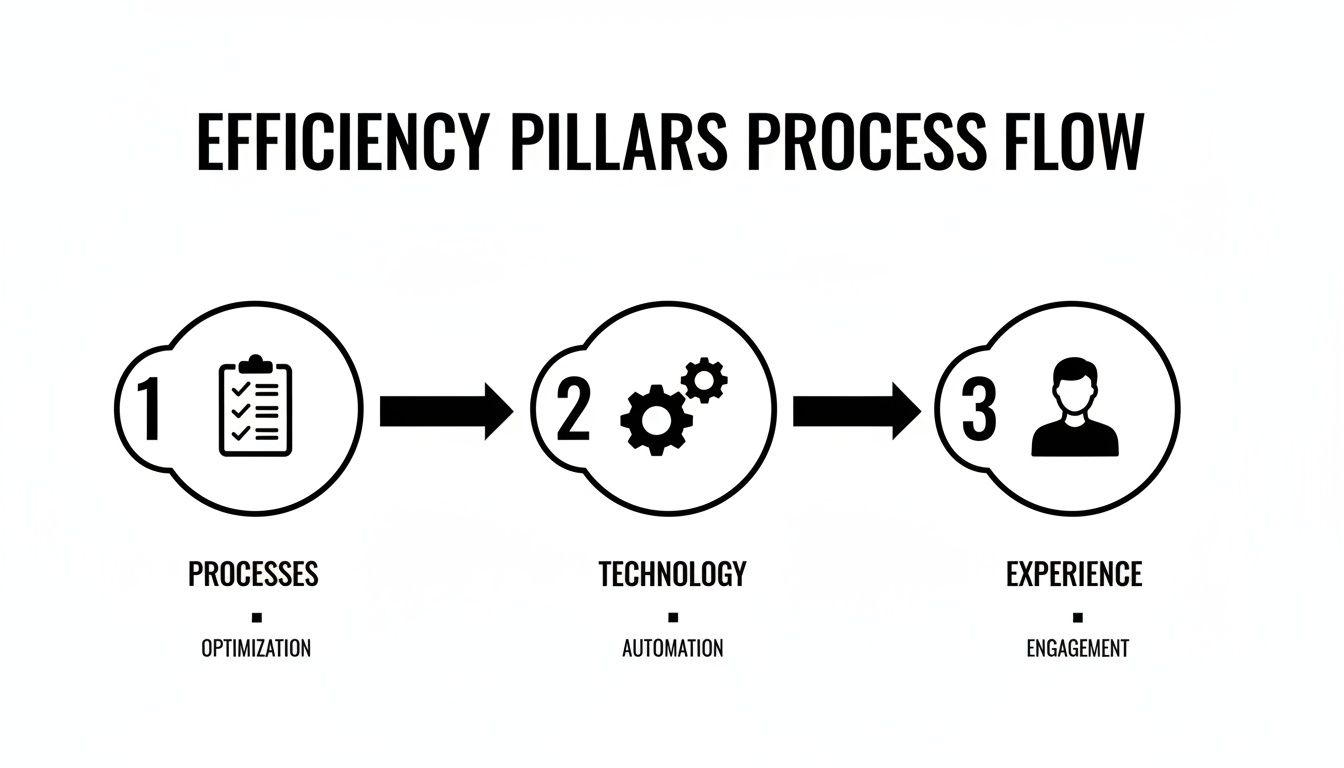
As you can see, a great customer experience isn't an accident. It's the natural result of solid, repeatable processes powered by integrated technology. When one piece is out of sync, the whole machine starts to drag.
Sales and Pre-Construction Friction
The first cracks usually appear right after the ink dries on the purchase agreement.
Your sales team, fresh off building a great relationship with the buyer, is suddenly hit with questions they can't answer. What’s the deadline for design selections? Has my financing been approved? Where are we on permitting? This happens because information in your CRM isn't flowing seamlessly to the pre-construction team.
The result? Your sales team spends its time chasing down internal information instead of generating new leads. Every minute they’re tracking down a document is a minute they’re not selling. It's a classic symptom of a disconnected process, and it always leads to shaky buyer communication and a slow start to the build.
Construction Communication Breakdowns
Once the build starts, the communication problems often multiply. Homebuyers are hungry for updates, but making your site superintendents the primary point of contact is a recipe for inefficiency and inconsistency.
This is where the constant stream of "just checking in" calls and emails begins, pulling your sales and construction teams away from their core responsibilities. Without a central hub for sharing progress photos, key milestones, and residential construction project scheduling updates, your team is stuck in reactive mode. This not only burns out your people but also creates anxiety for the buyer, who feels completely out of the loop.
The biggest operational wins come when you give buyers proactive, self-service information. It flips the relationship from one of constant questioning to one of confident oversight, which frees up your team's bandwidth immediately.
Closing Delays and Document Chaos
The final stretch to the closing table is where small hiccups can turn into major delays. Coordinating with lenders, title companies, and attorneys while keeping the buyer informed is a massive manual lift.
A single missing document or a last-minute change can easily derail a closing date. Every delay hits your bottom line, impacting revenue recognition and adding to carrying costs.
A smooth closing depends on having a single source of truth—a place where all stakeholders can see milestones, track tasks, and access the documents they need. This is precisely the type of lifecycle gap modern customer experience platforms are designed to solve, and improving communication here is directly tied to how you measure customer engagement.
Post-Closing Warranty Overload
The operational drag doesn't stop at closing. A rushed or inconsistent homeowner orientation is a direct pipeline to a flood of preventable warranty calls.
When new owners don’t understand how to operate their HVAC system or what constitutes a real warranty issue versus simple home maintenance, your service team becomes an expensive help desk.
This reactive service model eats up resources and erodes the goodwill you worked so hard to build. A frustrating warranty experience is one of the fastest ways to kill any chance of a future referral. The solution is to provide a comprehensive digital ownership hub from day one, giving homeowners the answers they need while structuring the service request process for total efficiency.
Using Technology and Process to Protect Your Margins
Once you've pinpointed the friction slowing you down, it's time to shift from diagnosis to cure. Protecting margins in a volatile market isn't about cutting corners; it's about making smart investments in technology and processes that create lasting operational efficiency for homebuilders. It’s about getting more from the people and systems you already have.
The root of the problem for most builders is that their core systems—the CRM for sales, the ERP for finance, and the construction software for the build—all live in separate universes. This disconnect is a primary driver of costly mistakes, endless manual data entry, and communication breakdowns that chip away at your bottom line.
Bridging the Gaps with a Customer Experience Layer
The answer isn't to rip and replace your core systems. Your CRM and ERP are critical systems of record. The strategic move is to connect them with a dedicated customer experience layer—a platform that acts as the connective tissue for your entire operation.
This system doesn't replace your master data; it orchestrates the workflow and visibility across your existing tech stack. Think of it as a central nervous system, ensuring information flows smoothly from sales to construction, through closing, and into ownership. It pulls data from each system to create one unified view of the customer journey, both for your internal teams and for the homebuyer.
This integrated approach solves several critical problems at once:
It eliminates duplicate work: Data entered once automatically populates everywhere else it's needed, slashing manual tasks and the risk of human error.
It creates a single source of truth: From the sales agent to the warranty manager, everyone is looking at the same real-time information.
It enables powerful automation: With connected systems, you can trigger automatic updates, tasks, and notifications based on milestones in your CRM or construction software.
The big shift happens when technology stops being a collection of siloed tools and becomes an integrated operating model. This is where you find scalable consistency and protect your margins without adding complexity for your teams.
From Disconnected Systems to an Orchestrated Workflow
Your ERP is the financial brain of your company—it manages budgets, procurement, and costs. It’s absolutely essential for fiscal control, but it was never built for customer interaction. For a deeper look at getting the most from your core financial systems, check out our guide on the role of construction enterprise resource planning.
A dedicated customer experience platform bridges that gap. When a buyer makes a selection in their online portal, that choice can instantly trigger a purchase order in your ERP. When a superintendent updates a construction milestone on their tablet, the buyer immediately gets a branded, professional update on their phone. That's the power of an orchestrated workflow.
This approach transforms technology from a necessary expense into a strategic advantage. It lets you deliver the premium, modern experience buyers now demand, all while making your internal operations leaner and more effective. This connected ecosystem is what allows you to build and sell more homes with greater predictability and profit.
How to Scale Consistency Without Scaling Your Headcount
For growing homebuilders, there’s a constant tension between expansion and brand consistency. As you build more homes, the risk of a fragmented, inconsistent buyer experience grows. The current labor market only exacerbates this challenge—simply hiring more people isn't a realistic or profitable solution.
The way out of this cycle is to get strategic with automation and standardized communication, which is the heart of real operational efficiency for homebuilders.
This isn't about replacing your talented team; it's about increasing their capacity. Think about the routine, predictable communications that fill the buyer journey: construction updates, task reminders, document requests. By automating these, you can reclaim hundreds of hours for your people. That time gets reinvested into high-value, relationship-building activities that drive sales and create loyal customers.
The labor crunch has turned this from a 'nice-to-have' into a strategic imperative. Labor shortages are hitting homebuilder efficiency hard, with over 60% of projects worldwide slowed by the intense 'battle for labor'. Getting the most out of the team you already have is critical for growth.
Reclaiming Time Through Automated Workflows
Consider a common scenario: a sales team is managing 20 active buyers under contract. Without automation, a huge chunk of their week is spent on reactive communication—answering calls about construction progress, sending one-off milestone updates, and manually hunting down documents for the closing coordinator. This is operational drag in its purest form.
Now, picture that same scenario with an automated workflow. The construction team updates a milestone in their system—let's say "framing complete." A customer experience platform instantly orchestrates a series of actions:
A Branded Email Update: A professional, pre-approved email with photos of the home is automatically sent to the buyer, celebrating the progress.
A Portal Notification: The buyer’s personal online portal is updated with the new milestone, keeping them in the loop 24/7.
An Internal Task: A task is created for the closing coordinator to start prepping related documents, ensuring a smooth handoff between teams.
This single automated event eliminated a handful of phone calls and emails for both the sales and construction teams. When you scale this across dozens of buyers and hundreds of construction milestones, the time saved is massive. Your sales team is freed from being project managers and can get back to what they do best: selling.
To see how these systems work under the hood, check out our guide on what is workflow automation software.
From Manual Effort to Strategic Advantage
This shift directly impacts your bottom line. When your existing team can handle a larger pipeline of buyers without service quality declining, you achieve greater operating leverage. You can grow your business and protect your margins without your payroll expenses growing in lockstep.
Automation is not about removing the human element. It's about directing human energy where it matters most—building relationships, solving complex problems, and creating delighted customers who become your best source of referrals.
This approach changes your entire operational model. Instead of relying on individual heroics to deliver a great experience, you're building a system that guarantees a consistent, high-quality journey for every single buyer. This is exactly the kind of lifecycle gap that modern customer experience platforms are designed to solve.
Turning Your Post-Close Experience into a Profit Center
For most homebuilders, the relationship effectively ends at closing. The post-close phase, especially warranty service, is often treated as a cost center to be managed as leanly as possible. This perspective is a massive missed opportunity.
True operational efficiency for homebuilders doesn't stop at the closing table. The ownership experience is one of your most strategic assets for building long-term brand value, reducing service friction, and sparking future sales. By rethinking this final phase, you can flip a cost center into a powerful profit driver.
The entire dynamic changes when you move from a reactive, fire-fighting service model to a proactive, digitally-enabled ownership experience.
From Reactive Service to a Digital Ownership Hub
The traditional warranty process is often fragmented. A rushed homeowner orientation almost guarantees a flood of preventable service calls, bogging down your team with basic questions that should have been answered on day one. Your warranty department quickly becomes an expensive help desk, and customer goodwill evaporates with every frustrating phone call.
A modern solution is a builder-branded digital Ownership Hub—a single, online portal for the homeowner. Instead of a dusty binder, it provides immediate, self-service access to everything they need:
Key Documents: All contracts, closing papers, and community info are in one secure, easy-to-find location.
Home Details: Appliance models, paint codes, and maintenance reminders are available 24/7, reducing simple "how-to" questions.
Warranty Information: Homeowners can clearly see what's covered and for how long, setting clear expectations from the start.
Streamlined Service Requests: When a real issue arises, they can submit a request with photos and details through a simple online form, ending chaotic email chains for good.
This approach dramatically reduces inbound call and email volume. It frees up your warranty team to focus on legitimate issues, not just answer repetitive questions. You get more operating leverage by managing the post-close experience with precision instead of excess manpower.
Connecting a Great Experience to Future Revenue
The payoff for a seamless ownership experience goes far beyond cost savings. When homeowners feel supported and have the tools to confidently manage their new home, you build deep, lasting brand trust. That positive feeling is the fuel for your most powerful marketing engine: word-of-mouth referrals.
A frictionless warranty process and a helpful ownership hub aren't just operational wins. They are strategic assets that directly generate high-quality, low-cost leads from your happiest customers.
This is where the post-close experience becomes a true competitive advantage. While other builders are burning cash on reactive service calls, you're building a network of brand advocates. These are the homeowners who leave glowing reviews, refer friends and family, and come back to you for their next home.
By investing in the ownership journey, you close the loop. You turn the end of one transaction into the beginning of the next, creating a sustainable growth engine built on reputation and exceptional service.
Your Roadmap for Implementing Operational Excellence
Achieving operational excellence is a strategic journey, not a quick fix. For leadership, this means moving from spotting friction to executing a clear, phased plan that creates lasting change. It requires a mindset shift—treating operational efficiency as a core business strategy that connects your processes, technology, and customer experience.
Here’s a practical framework for homebuilder executives.
Phase 1: Audit and Define
You cannot improve what you do not measure. The first step is an honest assessment of your current state.
Map the entire buyer-to-owner journey as it actually happens today, not as it's designed in a manual. Sit down with your sales, construction, and warranty teams to pinpoint real-world bottlenecks, manual workarounds, and communication black holes. Where are your people spending time chasing information? Where are buyers becoming the most frustrated?
With this audit, define your Key Performance Indicators (KPIs). These should blend internal metrics with customer outcomes:
Cycle Time: How long does it take from contract sign to closing day?
Team Capacity: How many homes can a team member manage before service quality degrades?
Warranty Volume: What is the number and type of first-year service requests? Are there patterns?
Customer Satisfaction (CSAT/NPS): What are buyers saying at key milestones, such as closing and 90 days post-move-in?
Phase 2: Standardize and Connect
Once you have your KPIs, it's time to build the operational backbone for improvement. This phase is about standardizing processes and connecting your technology stack.
First, document a single, consistent workflow for key moments like the pre-construction handoff, buyer communication touchpoints, and the entire closing process. This playbook becomes the source of truth for your organization, ensuring every customer gets the same high-quality, predictable experience.
Simultaneously, evaluate technology partners that can act as the connective tissue for your existing systems. The goal isn't to rip and replace the CRM or ERP you already trust. Instead, find a customer experience layer that integrates with them to create a single, unified flow of data. For a deeper analysis of this critical decision, see our guide on the build vs buy dilemma for homebuilders.
Phase 3: Automate and Optimize
With standard processes and connected systems in place, you can finally leverage automation effectively.
Start with high-volume, low-complexity tasks: routine construction updates, document reminders, and post-closing check-ins. Automating these frees your teams to focus on high-value work—building relationships and solving complex problems—which directly boosts their capacity and job satisfaction.
This is also where innovation in building methods can supercharge efficiency. For instance, adopting panelized off-site construction has been shown to slash production cycles by 30–40% and cut material waste by an incredible 83%. That’s a massive jump in operational efficiency for homebuilders.
By focusing on incremental, high-impact changes, you build momentum. This approach de-risks the transformation and allows your organization to adapt, ensuring that operational excellence becomes embedded in your company culture, not just a fleeting project.
Your Top Questions Answered
Before committing time and resources to any strategic initiative, it’s critical to address the tough questions. Here are the most common concerns we hear from homebuilding executives.
How Do We Measure the ROI on This?
The return on investment has both quantitative and strategic components.
Hard ROI is measured through KPIs you likely already track: shorter construction cycle times, reduced warranty spend per home, and lower overhead costs due to decreased administrative work. These metrics directly impact your profit margins.
Strategic ROI is just as critical for long-term growth. This includes higher customer satisfaction scores (CSAT/NPS), increased referral rates from satisfied homeowners, and a stronger brand reputation for reliability and professionalism. Together, they paint a complete picture of the business impact.
Our Teams Are Swamped. Won't This Just Add More Work?
This is a valid concern, especially for lean teams. The last thing anyone needs is another piece of software to learn and manage.
The right technology should not be another siloed tool; it should be the connective tissue that makes work disappear. An effective customer experience platform doesn't replace your existing CRM, ERP, or construction software—it integrates with them.
It automates routine communication and pulls scattered information into one place. The entire purpose is to free up your people from the repetitive tasks that cause burnout, giving them back time to focus on the high-value work that drives the business forward.
Will This Actually Work for a Builder Our Size?
Yes. Whether you’re a large national builder or a growing regional player, the fundamental challenges are the same: reducing system fragmentation, standardizing customer communication, and providing the transparency buyers now expect.
Modern platforms are designed to scale. For a smaller builder, they provide the operational framework needed to grow without chaos. For a larger enterprise wrestling with complexity across divisions, they bring much-needed consistency and visibility. The strategy molds to fit your specific operation, not the other way around.
Ready to turn operational drag into a competitive advantage? Foundation is the customer experience platform designed to connect your systems, automate your workflows, and deliver a seamless journey from contract to ownership. See how Foundation can help you build more efficiently.
More from Foundation

Technology
What's New - September 2026
WarrantyOS, from work order to payment. September’s updates bring more of the day-to-day warranty workflow into one connected experience.
Sep 30, 2026

Marketing
New Home Portal: A Builder's Guide to the Buyer Journey
Learn what a new home portal is, the core features builders need, and how it shapes the buyer-to-owner experience across closing and early ownership.
Sep 16, 2026

Marketing
Home Warranty Software: A Practical Buyer's Guide
Compare home warranty software for homebuilders. Evaluate work orders, vendor coordination, customer communication, integrations, and implementation.
Sep 15, 2026