Jun 25, 2026

A familiar pattern shows up in homebuilding leadership meetings. Closing surveys look healthy. Buyers praise the sales team, the design process, and the excitement of move-in. Then the next wave of feedback arrives months later, and the score drops. Warranty complaints rise, communication feels fragmented, and nobody can point to one department that owns the problem.
That's why generic advice on how to improve NPS scores usually falls apart in this industry. It assumes a short customer journey, one support team, and a clean system of record. Homebuilders operate in a different reality. The buyer-to-owner lifecycle stretches across contract, construction, closing, warranty, and long-term ownership. Feedback gets shaped by handoffs, delays, unclear next steps, and information trapped across multiple systems.
The builders that improve NPS sustainably don't treat it like a survey project. They treat it like an operating model for the customer relationship.
Why Your NPS Score Is a Leading Indicator of Profitability
A division president reviews the quarterly dashboard and sees two truths at once. The closing team is getting strong marks. The owner experience team is absorbing frustration a few months later. On paper, the business looks like it's delivering a good experience and a bad one at the same time.
That contradiction matters because NPS isn't just a sentiment metric. It's an early read on whether the business is building loyalty or eroding it after the sale. In homebuilding, that affects referrals, online reputation, repeat purchase potential, warranty workload, and the amount of manual recovery work teams have to do to keep homeowners calm.

A 2023 CustomerGauge study found that a tenfold increase in a company's NPS score correlates with a 3.2% increase in annual revenue growth, as summarized in Survicate's review of NPS statistics. For homebuilders, even a modest lift in revenue growth changes the economics quickly because every improvement flows through a business with large transaction values and tight coordination demands.
The homebuilder problem starts after the celebration
The hardest part of the experience often begins after the home is sold. Buyers move from excitement to expectation. They want proactive updates, clear timelines, document access, and fast answers when something goes wrong. If they get bounced between sales, construction, closing, and warranty, the score drops even when the house itself eventually gets fixed.
This is the post-closing gap. It's where builders lose goodwill they thought they had already earned.
The most dangerous NPS pattern in homebuilding is a strong score at closing that hides weak ownership experience.
Most off-the-shelf NPS advice ignores this. It focuses on quick transactional surveys and support-team responsiveness. That's too narrow for a builder managing a years-long relationship. A homeowner may judge the brand by a warranty delay, a missing document, or three conflicting updates from different teams.
Why executives should treat NPS as a business signal
Leaders don't need another vanity score. They need a way to see where customer friction is slowing growth and consuming labor. NPS can do that when it's tied to operations.
Here's a practical approach:
What the score is showing | What it often means operationally |
|---|---|
Strong closing feedback, weak post-close feedback | Handoff gaps, unclear ownership, fragmented communication |
Low scores clustered by community | Local process inconsistency or staffing issues |
High volume of neutral responses | Buyers got the home, but not a memorable experience |
Sudden drop after service interactions | Warranty intake and update workflows need work |
Builders that connect customer feedback across the full lifecycle get a more useful view of the business. That's the difference between collecting survey data and building a unified customer experience for homebuilders.
Diagnose the Real Drivers Behind Your NPS Score
An aggregate NPS number can't tell a COO what to fix on Monday morning. It only tells leadership that loyalty is moving. The operational value comes from identifying why it's moving, where it's moving, and which team interaction is creating the response.
That diagnostic work is harder in homebuilding because no single platform usually holds the full story.
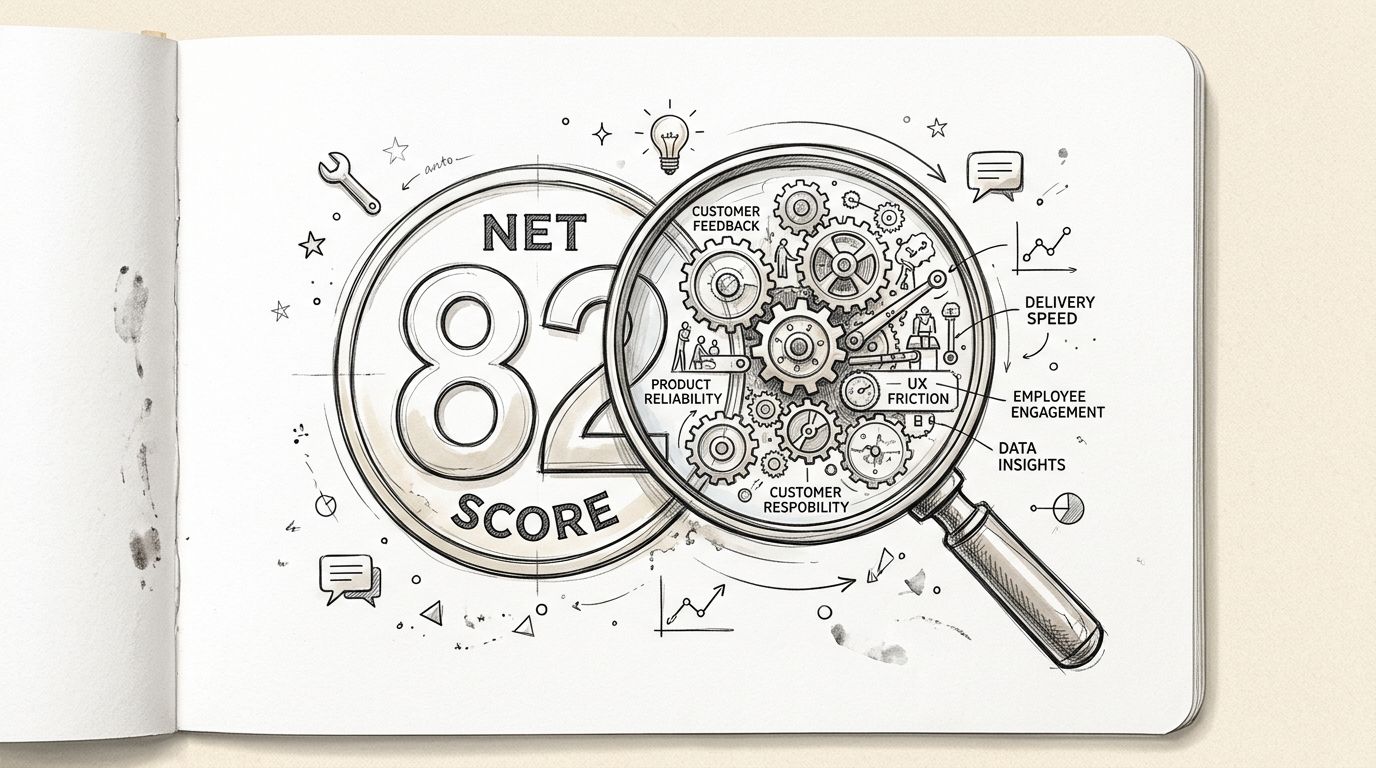
According to a 2025 report by the Software and Information Industry Association, 68% of enterprise homebuilders lose NPS score visibility because customer data is trapped in 4+ separate platforms, making it impossible to link a warranty delay to a closing delay or a construction defect.
Segment by lifecycle, not just by region
Many builders segment by division or market and stop there. That's useful, but it misses the bigger issue. The same community can produce very different scores depending on where the homeowner is in the journey.
A stronger diagnostic view separates feedback into stages such as:
Post-contract buyers: Are they getting clear next steps, milestone visibility, and one source of truth?
Active construction customers: Are updates proactive, understandable, and consistent across teams?
Closing-stage buyers: Are documents, appointments, and responsibilities clear?
New homeowners: Do they know where to go for maintenance, documents, and service requests?
Warranty customers: Are they getting acknowledgment, status visibility, and resolution ownership?
When leaders ask how to improve NPS scores, this is usually the first missing piece. They're looking at one blended metric for a journey that contains very different experiences.
Use a root-cause checklist that reflects real builder friction
A useful diagnosis starts with the comments behind the score, but it can't stop there. Teams need a structured review of common failure points.
Check handoffs first: Sales may promise visibility that construction doesn't provide. Closing may assume documents were already shared. Warranty may inherit homeowner frustration without the full history.
Review communication consistency: Buyers often tolerate delays better than silence. They react badly when updates arrive late, from different people, or in conflicting formats.
Trace service intake paths: If service requests are coming in through phone calls, texts, emails, and spreadsheets, leaders won't get a clean read on root causes. They'll only see noise.
Look for repeat questions: Repetitive inbound questions are an operational signal. They usually mean the builder hasn't made the next step obvious.
Practical rule: If customers keep asking for status, the problem usually isn't the customer. It's the visibility model.
A simple diagnostic framework
The most effective review process uses a tight loop instead of a long post-mortem.
Measure with context
Collect the score with an open-ended reason and one or two driver questions tied to the stage of the journey.Diagnose by segment
Break results down by division, community, product line, lifecycle stage, and service event.Assign one owner per issue
Don't send the same comment to five departments. Route it to the team that can remove the friction.Review trends on a regular cadence
Patterns matter more than isolated comments. A recurring complaint about update frequency tells leaders more than one angry survey.
A separate but related discipline is engagement tracking. Builders that combine sentiment with behavior can see whether low-scoring homeowners also missed updates, reopened service requests, or failed to complete key tasks. That's where measuring customer engagement in homebuilding becomes useful. It turns feedback into a clearer operating signal.
Implement Fixes Across the Homeowner Lifecycle
Once the drivers are visible, the work shifts from reporting to redesign. Most NPS gains in homebuilding come from fixing a handful of recurring breakdowns across the lifecycle, not from rewriting survey language or asking teams to “care more.”
The strongest improvements usually show up when builders standardize communication at the exact moments customers feel uncertainty.
Tighten the sales-to-construction handoff
The first avoidable drop in trust often happens right after contract. Sales knows the customer. Construction owns the process. The buyer suddenly loses continuity.
A workable fix includes:
One shared handoff record: Key promises, upgrade context, lot details, and known homeowner concerns need to move with the file.
Clear milestone definitions: “Framing complete” or “closing ready” should mean the same thing to the team and the buyer.
Standard next-step communication: Every buyer should know what happens next, who owns it, and where updates will appear.
If that handoff is inconsistent, the builder creates confusion before construction even starts.
Make construction updates proactive and predictable
Many teams still manage updates manually. Superintendents text one buyer, email another, and forget a third when the schedule gets tight. That inconsistency hurts trust and creates avoidable inbound traffic.
A better model uses event-driven updates. Buyers don't need constant messaging. They need timely communication when a milestone changes, a task is due, or a decision is required.
A comparison makes the trade-off clear:
Approach | What customers experience | What teams experience |
|---|---|---|
Manual status chasing | Unclear timing, inconsistent messages, repeated follow-up | More calls, more emails, more one-off explanations |
Standardized proactive updates | Clear expectations and fewer surprises | Less repetitive communication and better capacity |
Reduce closing chaos before it reaches the customer
Closing teams often carry hidden NPS risk. They're managing documents, dates, lender coordination, and last-minute changes under pressure. When buyers don't know what's outstanding, they assume the builder is disorganized.
The operational fix is simple in concept and difficult in practice. Put tasks, required documents, milestone status, and buyer responsibilities in one visible workflow. That reduces the scramble across inboxes and helps the customer prepare without repeated outreach.
A smoother closing doesn't just improve satisfaction. It protects team capacity during one of the most deadline-sensitive parts of the journey.
Treat warranty as a loyalty moment, not a back-office function
Builders often lose the score they earned earlier during the issue resolution process. Homeowners submit issues through whatever channel is easiest. The care team spends time sorting, re-entering, clarifying, and updating status instead of moving work to resolution.
That's why centralizing intake matters so much. One intake path, visible status, and coordinated follow-up create a very different experience than scattered messages across teams and vendors.
The response standard matters too. The expert benchmark for success is a 60-minute response SLA for unhappy customers, which increases the probability of converting a detractor to a passive by 45%. In practice, that doesn't mean every issue gets solved in an hour. It means the homeowner gets fast acknowledgment, clear ownership, and a visible next step.
Match the fix to the stage
Builders don't need one generic playbook. They need targeted corrections across the journey.
Contract to pre-construction: Clarify expectations and ownership.
Build phase: Automate milestone communication and reduce customer guesswork.
Pre-close: Centralize documents, tasks, and readiness.
Post-close ownership: Provide home information, maintenance guidance, and clear service channels.
Warranty and customer care: Route requests consistently, update proactively, and close the loop visibly.
Builders that want stronger post-close loyalty should also examine the design of the post-close experience in homebuilding, because that period shapes reviews, referrals, and future advocacy more than many teams realize.
Build a Modern NPS Measurement System
A weak measurement system creates false confidence. It asks for a score at one moment, from one channel, with no context around what the customer is reacting to. That's how builders end up debating whether the score is “fair” instead of using it to improve operations.
A stronger system measures the relationship across the lifecycle and pairs NPS with the operational signals that shape it.

Ask at moments that reveal the journey
For homebuilders, timing matters more than survey volume. A useful program usually captures feedback at a few key points rather than spamming homeowners after every interaction.
A practical cadence looks like this:
After contract: Did the customer understand what happens next?
Near closing: Was the preparation process clear and organized?
After move-in: Did the transition into ownership feel supported?
After meaningful service interactions: Did the homeowner feel heard, informed, and confident in the resolution path?
The survey itself should stay lean. The most useful version includes the NPS question, one open-ended prompt about the main reason for the score, and one or two driver questions tied to the current stage.
Track the drivers, not just the headline number
Many builder teams go wrong by putting NPS on the executive dashboard as the main KPI and then trying to push the number up directly. That almost never creates discipline at the workflow level.
Instead of setting NPS as the primary KPI, builders should define and measure specific KPIs for the underlying factors that drive NPS, such as first-call resolution rates, call handling times, and response visibility, as discussed in NovelVox's guidance on improving contact center NPS.
For homebuilders, those driver KPIs often look like this:
Lifecycle stage | Better KPI than raw NPS |
|---|---|
Pre-close | Task completion visibility |
Construction | Proactive update frequency |
Closing | Document readiness and status transparency |
Warranty | Time to first response and resolution visibility |
Ownership | Ease of finding documents and service information |
The score tells leadership where loyalty stands. Driver KPIs tell teams what to change tomorrow.
Build one feedback loop, not five disconnected ones
The measurement system should connect comments, events, and accountability. If NPS feedback lives in one tool, warranty history in another, and closing milestones in a third, the builder gets reporting without action.
That's why the platform decision matters less than the operating model. The business needs one place to review sentiment by lifecycle stage, identify recurring friction, and assign fixes across departments. A homebuilder customer engagement platform becomes useful when it supports that connected view instead of adding another isolated dashboard.
Turn Promoters and Passives into a Growth Engine
Most NPS programs over-focus on detractors because the pain is loud. That's necessary, but incomplete. Builders leave growth on the table when they ignore the quiet middle and the people already willing to advocate for the brand.
The opportunity is straightforward. Segment the homeowner base and treat each group differently.
Builders should segment customers into three distinct NPS categories, Promoters (scores 9–10), Passives (scores 7–8), and Detractors (scores 0–6), as outlined in RUI's overview of improving Net Promoter Score. That segmentation isn't a reporting exercise. It's the basis for different outreach motions.
What to do with promoters
Promoters shouldn't disappear into a spreadsheet after they submit a score. They're the customers most likely to strengthen reputation and referral flow if the builder gives them a clean path to act.
Useful actions include:
Ask for reviews at the right moment: Request them when satisfaction is current, not months later after the emotional peak has passed.
Offer referral pathways: Make it easy for homeowners to introduce friends, family, or neighbors without awkward manual follow-up.
Keep the relationship active: Share relevant homeowner content, community updates, and ownership guidance under the builder's brand.
Promoters are often willing to help. The issue is usually that no one has built a repeatable process around them.
Why passives deserve more attention than they get
Passives are often treated as acceptable because they aren't complaining. In reality, they represent unrealized brand value. They completed the transaction, but the experience didn't create enough confidence or enthusiasm to make them advocates.
That group responds well to useful, non-promotional engagement. Educational content, homeowner webinars, maintenance reminders, and thoughtful check-ins can reinforce value and move the relationship from neutral to positive. Teams looking for broader perspective can compare this approach with CallZent's guide to boosting Net Promoter Score, which is helpful as a general reference even though builders need a more lifecycle-specific model.
Passives don't usually need recovery. They need a reason to remember the builder positively.
Build advocacy into retention strategy
A good NPS program should support retention, not sit beside it. The relationship after closing is where referrals, repeat purchase potential, and long-term homeowner value either compound or fade.
That's why promoter and passive programs should sit alongside broader retention work. Builders that want to strengthen that side of the business should think in terms of advocacy, not only satisfaction, and connect it to customer retention strategies for homebuilders.
The practical shift is simple. Stop treating NPS as a score to defend. Start treating it as a map of who needs recovery, who needs nurturing, and who is ready to advocate.
Conclusion From Score to a Strategic Advantage
Builders don't improve NPS by asking for more feedback. They improve it by removing the operational friction that customers experience after the contract is signed. That means fixing handoffs, standardizing communication, creating visibility across construction and closing, and modernizing warranty response.
It also means accepting that homebuilding has a different loyalty pattern than most industries. The score can look healthy at one stage and weak at another because the journey is long, emotional, and fragmented. A modern approach to how to improve NPS scores has to follow that reality.
The business case is strong. CustomerGauge research from 2022 found that companies with the highest Net Promoter Scores experienced a 5.2% increase in customer retention compared to those with lower scores, as noted in CustomerGauge's discussion of improving NPS. In homebuilding, retention doesn't just mean repeat purchase. It includes referrals, reputation, willingness to engage, and long-term homeowner value.
What separates builders that improve from builders that stall
The difference usually isn't effort. It's architecture.
Builders that stall often have:
Disconnected systems: CRM, ERP, construction, and warranty each tell part of the story
Manual customer communication: Teams fill gaps with calls, texts, and spreadsheets
No lifecycle view: Feedback gets reviewed by department, not by customer journey stage
Builders that improve tend to create:
Shared visibility: Teams can see what the homeowner has experienced
Consistent workflows: Updates, tasks, and service requests follow a standard path
Builder-branded continuity: The customer relationship feels connected from contract through ownership
The strategic takeaway
NPS should sit closer to operations than to marketing. It reflects how well the company manages uncertainty, expectation, and trust across the buyer-to-owner lifecycle.
When leaders use it that way, the score becomes more than a CX number. It becomes a signal for where the business is creating drag, where teams need support, and where homeowners can become advocates. In modern homebuilding, customer experience isn't separate from the brand. It is the brand.
Foundation helps homebuilders connect the customer experience across contract, closing, warranty, ownership, referrals, and repeat purchase without replacing the systems already running the business. For teams that want to reduce manual communication, improve lifecycle visibility, and create a builder-branded experience from buyer to homeowner, Foundation is the customer experience platform built for that job.
More from Foundation

Marketing
New Home Portal: A Builder's Guide to the Buyer Journey
Learn what a new home portal is, the core features builders need, and how it shapes the buyer-to-owner experience across closing and early ownership.
Sep 16, 2026

Marketing
Home Warranty Software: A Practical Buyer's Guide
Compare home warranty software for homebuilders. Evaluate work orders, vendor coordination, customer communication, integrations, and implementation.
Sep 15, 2026

Marketing
How to Improve Team Accountability in Homebuilding
Improve team accountability in homebuilding with clear owners, reliable handoffs, practical metrics, and less manual follow-up from contract through warranty.
Sep 14, 2026