Jun 29, 2026

The typical home closing timeline is 30 to 60 days, according to Redfin's overview of the closing process, but for homebuilders, it can take many more months. That window isn't just a countdown to keys. It's one of the biggest sources of hidden operational cost, team friction, and customer anxiety in the entire buyer journey.
Most executive teams already know the symptoms. Closing coordinators are chasing signatures across inboxes. Construction managers are fielding buyer questions they thought sales had already answered. Title partners are asking for documents that exist somewhere, but no one is sure who has the latest version. Buyers are texting for updates because the formal update process has broken down.
None of that shows up neatly on a standard schedule report.
A disjointed home closing timeline creates drag in the final stretch of a sale, right when the customer is forming the memory that will shape reviews, referrals, and the first months of ownership. For builders trying to grow without adding unnecessary headcount, closing is no longer just an administrative checkpoint. It's an operational system test.
The Unseen Costs of a Chaotic Closing Timeline
Closing week often looks stable from the outside. Internally, it can be one of the noisiest phases in the business.
A buyer hears one date from the sales counselor, another from a lender, and a softer answer from construction. The home is nearly done, but punch items are still moving. Utility coordination is in flight. Insurance verification is pending. Someone at title needs a corrected name on a document. The coordinator starts sending updates manually because that feels faster than fixing the process.
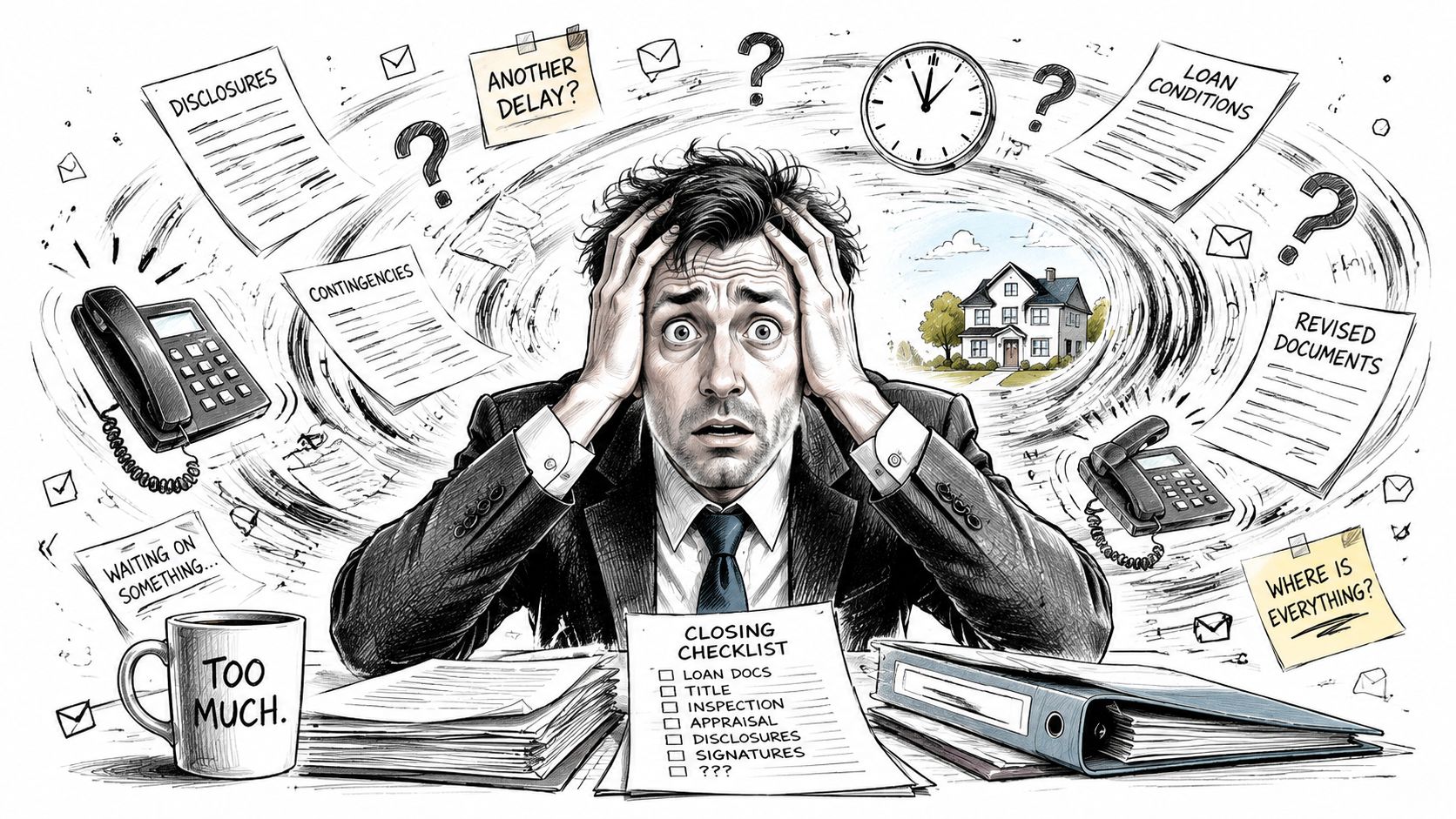
The result is familiar. Buyers don't see a managed process. They see uncertainty. Teams don't experience a controlled handoff. They experience interruption.
What looks like customer anxiety is often process failure
When buyers repeatedly ask what happens next, that usually isn't because they're unusually demanding. It's because the builder hasn't created a reliable source of truth for milestones, tasks, documents, and schedule changes.
That gap drives three forms of waste:
Manual communication waste: Coordinators, sales teams, and construction leaders spend time answering the same question in slightly different ways.
Escalation waste: Normal closing tasks turn into management issues because no one has confidence in the latest status.
Brand waste: The final impression before move-in feels reactive instead of professional.
Practical rule: If a buyer has to ask for status repeatedly, the builder is paying twice. Once in labor, and again in trust.
The closing period is where operational efficiency and customer experience stop being separate conversations. They become the same conversation.
Why this moment matters more than many teams treat it
Builders often invest heavily in lead generation, model experience, and sales conversion. Then the process becomes fragmented after contract. That creates a mismatch between the promise made during the sale and the experience delivered before keys.
For an executive team, that should be treated as a profit issue, not a hospitality issue.
A chaotic close ties up skilled employees in administrative follow-up instead of exception management. It increases the odds of avoidable delays. It weakens the handoff into ownership and warranty. It also undermines the exact post-close relationship that drives reviews and referrals, which is why many builders are rethinking the post-close experience as part of a connected operating model rather than a separate customer care concern.
A messy close doesn't end on closing day. It spills into move-in, warranty intake, and the homeowner's willingness to recommend the builder.
Anatomy of the Builder-Centric Closing Process
From a buyer's perspective, closing can feel like a list of tasks. From a builder's perspective, it's a chain of dependencies across sales, construction, lenders, title, and customer-facing teams. If one stage slips subtly, the downstream teams inherit the disruption.
The clearest way to manage the home closing timeline is to treat it as a staged operating model with visible ownership.
Home Closing Timeline Stages and Responsibilities
Stage | Typical Duration | Primary Builder Responsibility | Common Friction Point |
|---|---|---|---|
Contract and handoff | Early in the closing period | Transfer complete buyer, options, and schedule details from sales into downstream workflows | Incomplete handoff notes, conflicting expectations, missing selections |
Financing and appraisal coordination | Early to middle of the process | Keep communication aligned with lender-driven milestones and buyer readiness | Buyers unsure what documents are outstanding, appraisal timing uncertainty |
Title and insurance verification | Middle to late process | Confirm title coordination, required paperwork, and homeowner insurance readiness | Document chasing across email, unclear ownership of last-mile tasks |
Pre-closing construction milestones | Late process | Align home readiness, punch completion, municipal or internal signoffs, and expected close date | Construction changes not communicated early enough to customer-facing teams |
New home orientation and walkthrough | Final days before close | Prepare home presentation, educate buyer, capture open items, set expectations for move-in | Walkthrough issues logged inconsistently, unclear follow-up ownership |
Closing day execution | Closing day | Coordinate final documents, attendance, timing, and customer communication | Last-minute corrections, duplicate outreach, avoidable confusion |
The handoff sets the tone
The first operational risk appears right after contract. Sales may have the customer relationship. Construction and closing inherit the execution burden. If the handoff is light, informal, or inconsistent by community, teams spend the rest of the home closing timeline correcting avoidable misunderstandings.
Leaders should look for hidden process debt. For instance, if a buyer's financing assumptions, options status, promised communications, or target milestones aren't captured cleanly, every downstream team fills in the blanks differently.
Mid-process coordination exposes system gaps
The financing and title portions of closing often don't fail dramatically. They fail in subtle ways. A missing item sits in an inbox. An insurance document is requested but not visible to the broader team. A lender has one view of readiness and the builder has another.
That's why many builders need more than a shared spreadsheet or a portal with limited visibility. They need a structured post-contract workflow that keeps customer communication and internal coordination in sync, which is the gap a purpose-built solution like Closing Concierge is designed to address.
The strongest closing teams don't rely on heroics. They reduce the number of moments where one person has to remember, chase, clarify, and reassure manually.
The final stretch is where discipline matters most
The last phase combines construction readiness, buyer education, final walkthrough activity, and legal closing execution. This is also where trust is most fragile. A buyer can tolerate complexity if the next step is clear. A buyer loses confidence when updates arrive late, conflict with each other, or require repeated follow-up.
What good looks like is straightforward:
Every milestone is owned: Sales, closing, construction, and external partners know who moves each item forward.
Buyer-facing communication is consistent: The message matches internal reality.
Exceptions are visible early: Teams address real risks before they become closing-week emergencies.
Walkthrough and close are connected: Open items from orientation don't disappear into side conversations.
Builders that manage these stages deliberately create predictability. Builders that don't usually end up staffing around process weaknesses.
Where the Timeline Breaks Common Bottlenecks and Delays
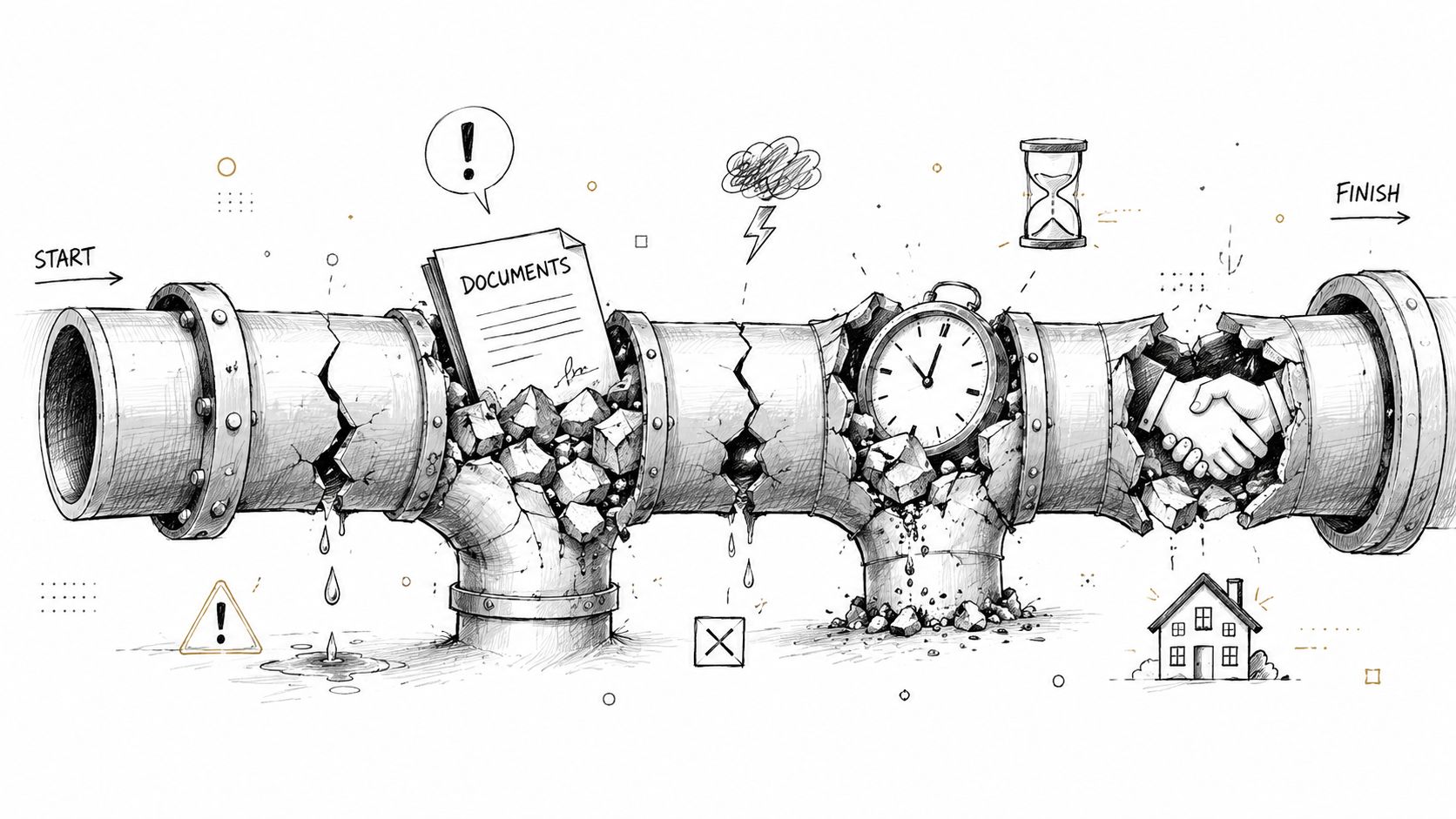
Most closing delays aren't caused by one dramatic failure. They come from recurring operational weak points that leaders have learned to tolerate because they happen in different departments. Viewed together, they form a pattern.
Handoff gaps between teams
The first break usually happens when the deal moves from sales into execution. Sales may capture important context in notes, personal messages, or local practices that don't flow into construction and closing in a reliable format.
That creates predictable problems:
Promise drift: A buyer remembers one commitment. The downstream team sees another reality.
Schedule ambiguity: Internal dates exist, but they aren't aligned well enough to communicate confidently.
Ownership confusion: Teams assume someone else has already explained the next step.
The issue isn't effort. It's fragmentation.
Repetitive communication loops
When buyers don't have a dependable place to see progress, they ask for updates through the path of least resistance. That usually means text, email, phone, or the sales contact they trust most.
Those questions are reasonable. The operational problem is repetition.
Status questions multiply: “Are we still on track?” gets answered by several people.
Task reminders become manual: Teams keep sending nudges for insurance, funds, documents, or appointments.
Construction updates become one-off explanations: Instead of structured communication, staff members improvise.
If the same closing question shows up repeatedly, the builder doesn't have a customer problem. The builder has a communication design problem.
A connected workflow matters here. Builders that have invested in homebuilder integrations are usually trying to solve this exact issue. Existing systems hold pieces of the truth, but the customer experience across those systems still breaks.
Decentralized document management
The document side of closing creates more drag than many leaders realize because the friction feels administrative, not strategic. But documents drive confidence, timing, and legal readiness.
Teams get into trouble when:
Files live in too many places: email threads, shared drives, title portals, personal folders, and texts
Version control breaks: people work from the wrong form or resend outdated copies
Buyers don't know what's complete: they submit items, then ask whether anyone received them
This slows the process even when nothing is technically “wrong.”
Reactive problem solving near the finish line
Construction schedules change. Municipal approvals move. Punch items take longer than expected. None of that is unusual. The damage happens when those changes aren't communicated proactively.
A reactive model creates last-minute fire drills. A date softens internally, but the buyer doesn't hear it until they've already arranged movers, time off, or utility changes. Then the closing team becomes a shock absorber for information that should have moved earlier.
Buyers can handle change better than silence. Silence turns a schedule adjustment into a trust issue.
The common thread across all four bottlenecks is simple. Teams are working hard, but the home closing timeline depends on disconnected workflows, tribal knowledge, and manual follow-up. That's why these delays keep recurring even in well-run organizations.
Calculating the Real Cost of a Disconnected Closing
Leaders usually see closing friction as an annoyance because the costs are scattered. Some show up in payroll. Others show up in delayed receipts, internal rework, online reviews, or strained customer care teams after move-in. That fragmentation hides the true business impact.
Operational drag consumes skilled capacity
A disconnected home closing timeline forces salaried employees to spend time on low-value coordination work. Closing coordinators chase signatures. Sales teams answer status questions that should never have reached them. Construction leaders clarify dates one buyer at a time. Managers get pulled into issues that are mostly visibility problems.
None of that increases throughput. It merely preserves motion.
A useful executive question is whether the team is spending its time on exceptions or on routine status management. Strong operators want people handling edge cases, customer concerns, and judgment calls. Weak systems push those same people into repetitive follow-up.
Closing friction carries financial consequences
Some costs are direct. When a close slips, the builder can face extended carrying exposure, scheduling inefficiency, and revenue timing pressure. Even when the delay is small, the internal work to reschedule meetings, confirm documents, reset expectations, and coordinate partners creates real overhead.
Some costs are softer, but no less serious:
Customer confidence falls when the process feels improvised
Reviews become more negative when the final stretch feels harder than the sale
Referrals weaken because buyers hesitate to recommend an experience they had to manage themselves
Those effects matter because the relationship doesn't end at the closing table. The tone set here follows the builder into move-in and service.
Leadership blindness is an enterprise problem
The most underappreciated cost is lack of visibility. Executives often have reports on starts, cycle times, backlog, and financial performance. They have far less visibility into where customer-facing closing friction sits across communities and divisions.
That creates blind spots:
Leadership Question | What a disconnected process usually produces |
|---|---|
Where are buyers getting stuck most often | Anecdotes instead of a pattern |
Which teams are overloaded by manual follow-up | Individual complaints instead of visible workflow data |
What recurring issues threaten close readiness | Late escalation instead of early intervention |
A builder can't improve what it can't see across handoffs, communications, and customer-facing tasks.
When leaders don't have a clean view of the customer side of closing, they manage through escalation. That works in the short term. It doesn't scale.
A Modern Framework for a Predictable Closing Experience
A predictable closing process doesn't require replacing the builder's operational backbone. It requires connecting the customer-facing workflow across the systems already in place. The builders making progress here usually standardize four disciplines at once.
For a buyer-side view of the broader journey, this guide to the 18-week property process offers helpful context on how milestones accumulate across financing, inspections, and closing. For builders, the operational challenge is making those milestones visible and coordinated internally.
Centralized communication and one source of truth
The first requirement is a single place where buyers and internal teams can understand what's happening, what's next, and what's still needed. That doesn't mean every department uses the same core system for its own work. It means the customer relationship is managed through a connected layer rather than scattered outreach.
When that layer exists, teams stop rebuilding context in every email chain.
Automation and shared visibility
Manual reminders are one of the biggest drains in the home closing timeline. The process improves quickly when routine communications and task triggers happen automatically based on milestone movement.
That should include:
Milestone-based updates: Buyers receive timely communication when the process moves, not after they ask.
Task prompts tied to real events: Insurance, documents, walkthrough scheduling, and final readiness don't rely on memory.
Internal visibility across roles: Sales, closing, and construction can see the same customer-facing progress.
Automation works best when it removes repetitive work and leaves judgment to people. That's the right use of technology in closing.
Connected systems and a buyer-ready experience
Builders already have CRM, construction management, ERP, and often warranty tooling. The gap is usually the experience between those systems. Existing platforms optimize for departments. Closing requires orchestration across departments.
A customer experience platform proves essential. The stronger model is a connected, builder-branded environment that bridges those systems and gives buyers a clear path from contract to keys, which is also why many builders are evaluating a broader homeownership experience platform rather than another isolated portal.
The operational difference is significant. Teams work from shared workflow visibility instead of fragmented updates. Buyers gain clarity without needing constant reassurance.

The goal isn't to digitize confusion. The goal is to make the process legible for both the buyer and the builder.
A modern closing framework should make it easier to answer four questions at any moment:
What has been completed
What's still outstanding
Who owns the next action
What the buyer should expect next
If those answers are easy to find, inbound volume drops, coordination improves, and closing becomes more predictable.
From Closing Day to Customer for Life
Closing day is not the end of the customer relationship. It's the handoff into ownership. Builders that treat it as a finish line often create avoidable warranty friction within the first weeks after move-in.
A buyer who experiences a transparent, well-managed home closing timeline enters ownership with more confidence. They know where documents live. They understand what was completed, what to expect next, and how to get help. That lowers confusion and reduces the flood of preventable post-close questions.
The closing experience shapes the warranty experience
When the close is rushed or disjointed, the service team inherits the consequences. Homeowners reach out through any channel available. Expectations are vague. Important home information is hard to find. Customer care teams spend too much time re-establishing context instead of resolving issues.
A connected builder-branded experience changes that transition. The buyer doesn't disappear into a service void after keys. The relationship continues with structure.
Long-term value comes from continuity
Executives should look beyond immediate efficiency. A disciplined closing process supports more than cleaner operations.
Stronger homeowner trust: Buyers feel guided rather than processed.
Lower post-close noise: Teams spend less time answering avoidable questions.
Better advocacy potential: Positive final impressions make referrals more likely.
Greater scalability: Standardized workflows are easier to manage across divisions and communities.
Builders focused on long-term growth are increasingly connecting closing to the broader ownership and loyalty journey, including strategies for engaging repeat homebuyers rather than treating each transaction as a one-time event.
The builders that win long term don't just complete homes well. They manage the relationship between milestones well.
The operational lesson is straightforward. If the closing process is fragmented, the business pays for that fragmentation again after move-in. If the process is connected, the builder carries trust forward into warranty, referrals, and future sales.
Builders already have systems for leads, jobs, and financials. What they often lack is a connected platform for the customer relationship after the sale begins. Foundation helps homebuilders connect communication, workflows, and visibility from contract through closing, ownership, warranty, referrals, and repeat purchase so teams can reduce manual follow-up, protect the builder-branded experience, and scale without adding unnecessary complexity.
More from Foundation

Marketing
New Home Portal: A Builder's Guide to the Buyer Journey
Learn what a new home portal is, the core features builders need, and how it shapes the buyer-to-owner experience across closing and early ownership.
Sep 16, 2026

Marketing
Home Warranty Software: A Practical Buyer's Guide
Compare home warranty software for homebuilders. Evaluate work orders, vendor coordination, customer communication, integrations, and implementation.
Sep 15, 2026

Marketing
How to Improve Team Accountability in Homebuilding
Improve team accountability in homebuilding with clear owners, reliable handoffs, practical metrics, and less manual follow-up from contract through warranty.
Sep 14, 2026