Feb 11, 2026

When market volatility increases, buyer confidence in home sales drops. This hesitation isn't just a headline—it's a direct drag on your business, showing up as longer sales cycles, higher cancellation rates, and buyers who are suddenly hyper-sensitive about price. Your teams end up working twice as hard for every signature.
The Confidence Crisis Slowing Down Your Sales

For homebuilder executives, this is not an abstract economic theory; it is a daily operational reality. When buyers get nervous, your entire sales pipeline becomes unpredictable. Deals that felt certain suddenly grind to a halt. Prospects who were excited a week ago now demand more concessions and constant reassurance.
This is not a marketing problem you can solve with a new campaign. It is a direct threat to your sales velocity and revenue targets.
The core issue is how external economic noise creates internal operational friction. Anxious buyers flood your sales and construction teams with repetitive questions, seeking clarity your fragmented systems cannot deliver. This traps your staff in a reactive loop of manual follow-ups, pulling them away from nurturing new leads and closing deals.
The Real Impact on Your Operations
This erosion of confidence manifests in measurable ways that hit your bottom line and stretch your teams thin. The pain points are likely familiar:
Prolonged Decision-Making: Buyers delay commitments, extending sales cycles and pushing out revenue recognition.
Increased Cancellation Rates: "Buyer's remorse" becomes more common, and even a flicker of doubt can be enough to terminate a contract.
Higher Customer Service Load: Jittery buyers require more hand-holding, which means more calls, texts, and emails for every department to handle.
Price and Incentive Pressure: A hesitant buyer is far more likely to negotiate aggressively on price or demand incentives, squeezing your margins.
This is not anecdotal. Recent industry data shows that consumer confidence is now the primary factor holding buyers back—and has been for four consecutive months.
Even as mortgage rates begin to stabilize, a quarter of builders report that buyers are still spooked by the overall market. Many point to job market jitters and broader economic worries as key factors keeping them on the sidelines.
Below is a breakdown of how these drivers translate directly into buyer behavior and sales metrics.
Key Drivers of Low Buyer Confidence
Confidence Driver | Impact on Buyer Behavior | Effect on Sales Metrics |
|---|---|---|
Economic Uncertainty | Delays purchase decisions, seeks more reassurance before committing. | Longer sales cycles, lower lead-to-sale conversion rates. |
Interest Rate Volatility | Increases price sensitivity, focuses heavily on monthly payment affordability. | Higher demand for incentives, increased negotiation pressure. |
Negative Media Headlines | Creates fear of "buying at the peak," leading to hesitation and analysis paralysis. | Higher rate of abandoned leads, increased contract cancellations. |
Lack of Process Transparency | Feels out of control and anxious, bombards teams with repetitive questions. | Increased customer service workload, lower team efficiency. |
Viewing the data this way makes it clear: these are not isolated issues but interconnected challenges stemming from a single root cause.
Rebuilding buyer trust is not about timing the market. It’s about creating an internal operating model so transparent and consistent that it overrides external uncertainty.
Ultimately, navigating this environment demands a strategic focus on the customer experience itself. By standardizing your processes and providing the visibility buyers crave, you create a sense of stability and control that directly counters market anxiety.
A smart approach to communication in the construction industry is the bedrock of this effort. Your ability to deliver a predictable, reassuring journey is the most powerful tool you have to protect your sales pipeline.
Why Builder Sentiment Mirrors Homebuyer Hesitation
The hesitation buyers feel does not happen in a vacuum. It is a direct reflection of the uncertainty rippling across the industry—a sentiment you can track and measure. When builders become cautious, that caution is contagious.
Key industry metrics are a market-wide forecast. Savvy buyers, agents, and lenders watch them closely. For a homebuilding executive, understanding this link is critical: low builder confidence signals a bumpy road ahead, which in turn makes buyers demand more proof that you are a safe bet before signing.
The Index That Predicts Buyer Anxiety
One of the best gauges of this sentiment is the NAHB/Wells Fargo Housing Market Index (HMI). It is not an abstract number; it is a real-time snapshot of the collective confidence of your peers.
Lately, the data shows builder confidence has fallen to historically low levels. The HMI dropped to just 37 in January 2026, a clear sign of persistent headwinds. For perspective, this index hit an all-time high of 90 in November 2020. Current numbers reveal sharp declines across current sales, future sales expectations, and—most critically—prospective buyer traffic, which plummeted to 23.
This data confirms what leaders are already feeling. When builders brace for a tougher market, buyers instinctively pull back. They become more cautious, ask harder questions, and are far quicker to walk away from a deal if they sense instability.
This is where your internal operations become either your greatest strategic advantage or your biggest liability. In a high-confidence market, buyers might overlook minor communication gaps. In today's risk-averse environment, those same small friction points are magnified and feed directly into a buyer’s worst fears.
How Internal Friction Amplifies Market Fears
When uncertainty is high, any hint of disorganization on your end can shatter buyer confidence in home sales. A buyer who receives conflicting timelines from your sales and construction teams does not just see confusion—they see a red flag that you might not be in control.
That perception has immediate, expensive consequences:
Increased Scrutiny: Buyers will comb through every detail, demanding more time and energy from your team to keep them comfortable.
Delayed Decisions: Any inconsistency gives a nervous buyer a reason to pause, stretching out sales cycles and pushing back revenue.
Contract Cancellations: A few fragmented emails or missed calls can be the final straw that turns a hesitant buyer into a canceled contract.
The takeaway is clear. You cannot control macroeconomic trends or national sentiment. You can control the experience you deliver.
By demonstrating rock-solid operational stability and a radically transparent customer experience, you create a powerful counter-narrative. It is a proactive approach that reassures individual buyers and builds a brand reputation for reliability that insulates your business from market volatility.
How Operational Gaps Erode Buyer Trust
To see how fast buyer confidence can unravel, consider a realistic builder scenario. A young couple just put a deposit on a new home. They are excited but also nervous, having stretched their budget in a volatile market. Their entire view of your brand now rests on the journey ahead.
This is where abstract operational problems become very real, confidence-killing failures. For this couple, the trouble starts almost immediately.
Communication Breakdowns Create Early Doubts
Two weeks after signing, the couple gets a call from their sales agent with an updated timeline for the foundation pour. The next day, an automated email from the construction portal arrives with a different date.
It's a minor discrepancy, but that inconsistency plants the first seed of doubt. Who is running the show? Do these teams talk to each other?
This small issue kicks off a string of emails and voicemails. The sales agent lacks direct access to the construction schedule and must hunt down the project manager. For 48 hours, the buyers are left in limbo, wondering if this is a sign of bigger problems.
This is where most builders see the experience break down. Trust is not lost in one catastrophe, but in a series of small, preventable friction points caused by disconnected systems and manual follow-ups.
These inconsistencies are symptoms of a fragmented operating model. When your sales, construction, and closing teams all work out of different systems with nothing connecting them, the customer feels the chaos.
Radio Silence During Critical Phases
As construction moves forward, the couple feels like they have fallen into a black hole. Weeks go by without a proactive update. Their scheduled weekly email never arrives. Is work still happening? Did they hit a supply chain snag?
The lack of proactive updates forces them to start chasing people down, turning them from excited future homeowners into anxious project managers.
This radio silence is a classic failure of manual processes. Responsibility for that update probably falls on a busy project manager. Without automated systems to keep communication consistent, updates depend on one person's bandwidth, meaning gaps are inevitable. In these moments of silence, buyer anxiety grows, gutting their buyer confidence in home sales.
To see how you can bridge these gaps, it's worth understanding the fundamentals of workflow automation software, which is built to prevent these manual drop-offs.
The experience continues to fray closer to closing. A last-minute document request sends them scrambling. They call their sales agent, who points them to the closing coordinator, who needs the document from the construction team. This frantic scavenger hunt reinforces their feeling that things are disorganized.
For an executive, the takeaway is clear: every operational gap is a broken promise that slows down closings and puts revenue at risk.
A Framework For Proactively Building Trust
Constantly reacting to buyer anxiety is an operational dead end. It traps your best people in a fire-fighting loop of manual follow-ups and leaves your sales pipeline vulnerable to every shift in market sentiment. A better way exists.
Instead of playing defense, the goal is to build an operating model that proactively creates trust. This turns your customer experience from a liability into a strategic asset that insulates you from external noise.
This requires a structured framework built on three core pillars: Visibility, Consistency, and Proactivity. By focusing on these areas, you can directly tackle the root causes of low buyer confidence in home sales.
This diagram illustrates how small operational gaps snowball into major communication breakdowns, eventually destroying trust.
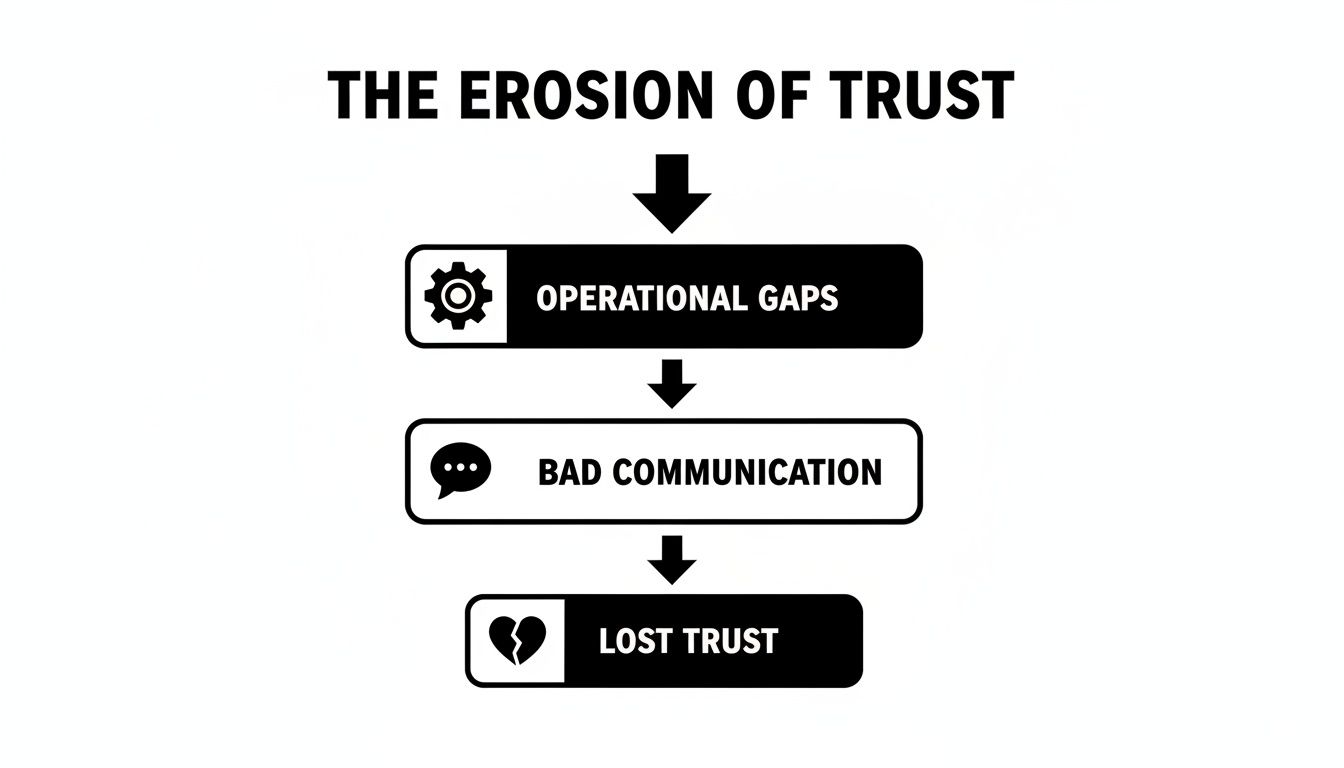
It is a clear visual reminder that trust erodes over time, drip by drip, because of preventable internal friction.
Pillar 1: Visibility
Visibility means eliminating the "black box" of home construction. Anxious buyers do not just want to be told things are moving along; they need to see it for themselves.
This means giving them a single, reliable portal where they can track milestones, view progress photos, and find documents. When buyers have a clear line of sight into their home’s journey, they feel a sense of control. This transparency dramatically cuts down on the “just checking in” calls that bog down your team.
Pillar 2: Consistency
Consistency is the antidote to the chaos caused by fragmented systems. It ensures every buyer gets the same high-quality communication and brand experience, regardless of who they talk to on your team.
This only happens when you standardize workflows and centralize buyer communication.
A single source of truth is non-negotiable. When sales, construction, and closing teams work from the same playbook, buyers receive clear, unified answers that build confidence with every interaction.
This is the type of lifecycle gap modern customer experience management platforms are designed to solve. They bridge the gaps between your CRM, construction software, and ERP systems to create a seamless flow of information.
Pillar 3: Proactivity
Proactivity flips your team from a reactive posture to a forward-looking one. Instead of waiting for buyers to become anxious, you anticipate their needs and deliver answers before they ask.
This is where smart automation becomes a powerful operational lever.
You can set up automated workflows to:
Send Milestone Updates: Automatically notify buyers when stages like foundation, framing, and drywall are complete.
Deliver Weekly Progress Summaries: Send a consistent summary of the week's progress and what is planned for next week.
Remind Buyers of Upcoming Tasks: Proactively nudge them about deadlines for selections or financing paperwork.
Getting ahead of these common questions lightens the load on your team and demonstrates a level of professionalism that sets your brand apart. Social proof also plays a key role, as studies prove how online reviews boost trust conversions.
Putting this three-pillar framework into practice leads directly to better business outcomes. You will see fewer cancellations, shorter closing times, and more team capacity without adding headcount. This is how you build an operational foundation that thrives in any market.
Why First-Time Homebuyers Need More Reassurance
While market jitters affect everyone, first-time homebuyers feel it most acutely. This segment represents a massive opportunity, but their journey is often precarious. They are about to make the single biggest financial commitment of their lives with no prior experience.
This lack of experience makes them incredibly sensitive to market swings. Every interest rate hike feels personal. A process that feels confusing is not a minor hassle—it can be the final nudge that sends them retreating to the sidelines, damaging your sales pipeline.
The Financial Squeeze Magnifying Anxiety
The financial reality for first-time buyers only increases the pressure. They face serious headwinds, with their share of all home purchases hitting an all-time low of 21% in 2026 as the median buyer age climbed to 40. According to the National Association of Realtors, soaring rents and student loan debt make saving a down payment almost impossible. You can read more about these generational shifts and market forecasts on nar.realtor.
This financial strain creates a desperate need for reassurance. Their decision to buy is a leap of faith that you, their builder, will guide them safely. Any friction or communication breakdown gets amplified, feeding the fear of making a catastrophic financial mistake.
For first-time buyers, confidence is not just about the market—it is about trusting that you have a stable, predictable process to protect their life savings. Your operational excellence becomes your most powerful sales tool.
Capturing Market Share Through a Superior Experience
Builders who understand this vulnerability and respond with a supportive, transparent experience will capture significant market share. Winning this segment is not about offering the biggest discounts. It is about providing a level of guidance and stability that other builders cannot deliver.
Here is how a focused approach can turn this anxious group into an engine for growth:
Proactive Education: Automate the delivery of helpful content explaining each stage of the buying and building process. Demystify financing, inspections, and closing.
Constant Visibility: Give them a dedicated digital portal where they can see construction progress, pull up documents, and track milestones 24/7. This sense of control is a powerful antidote to anxiety.
Unified Communication: Ensure every touchpoint, from the sales office to the construction site, delivers consistent information from a single source of truth.
By engineering a journey that systematically builds buyer confidence in home sales, you are doing more than just closing a deal. You are creating a loyal advocate who will become a source of referrals. This focus extends beyond closing; a positive first experience transitions into a rewarding long-term relationship, which is why a dedicated ownership experience platform is vital.
Orchestrating Confidence Across The Buyer Journey
Fixing the operational cracks that kill buyer confidence in home sales requires more than another checklist or team meeting. It requires a dedicated system to orchestrate the entire customer journey. A modern customer experience layer acts as the critical connective tissue between your siloed platforms.
This is not about replacing your CRM, construction management software, or ERP. Those are essential systems of record. The solution is a platform that sits on top of them, pulling data from each to create a unified view of the buyer’s world. Its job is to orchestrate workflows and visibility—automating communication, centralizing information, and standardizing processes.
This is the type of lifecycle gap modern customer experience platforms are designed to solve.
Moving From Fragmentation to Orchestration
Shifting from a fragmented process to an orchestrated one addresses the root causes of buyer anxiety. When you connect your separate systems, you create a single source of truth that powers consistent, proactive communication. Leadership gains a clear line of sight into every customer interaction, swapping anecdotal feedback for measurable engagement data.
This approach delivers tangible results:
Increased Team Capacity: Automating routine updates frees your sales and construction teams from administrative tasks, allowing them to focus on high-value activities.
Reduced Manual Errors: Standardized workflows eliminate the inconsistencies that arise from reliance on memory or manual checklists.
Scalable Brand Experience: You can deliver the same high-touch, transparent journey to every buyer, in every community, without scaling your headcount.
A dedicated customer experience layer fundamentally changes your operating model. It transforms disjointed, manual handoffs into a seamless, automated, and fully branded journey that actively builds trust at every milestone.
The Power of a Unified Customer Hub
The core of this strategy is a centralized, builder-branded hub for each homebuyer. It is a single destination for everything related to their new home, from contract through closing and into ownership. For an anxious buyer, this central resource is a powerful source of reassurance.
From this single hub, you can automate critical communications, ensuring every buyer gets timely updates, reminders, and easy access to documents. This proactive communication eliminates the information vacuums where fear and doubt grow. To see how a system can manage this process, view the Foundation buyer experience platform.
Orchestrating the journey is about taking control of the narrative. Even small details, like using effective home staging strategies, set a professional tone. By providing a consistent, transparent experience powered by the right technology, you create an environment where buyer confidence is actively built, insulating your sales pipeline from market volatility.
Answering Your Questions About Buyer Confidence
Even with a clear strategy, homebuilder executives often have practical questions about what it takes to boost buyer confidence in home sales. Here are a few common ones we hear from leaders evaluating their operating model.
How Can We Measure Buyer Confidence In Our Sales Pipeline?
It is easy to fixate on lagging indicators like conversion rates and cancellations. They tell you what already happened.
To get ahead of the problem, you must look at buyer engagement. Are buyers opening your automated updates? How quickly do they complete required tasks? A drop in engagement is a powerful early warning sign that a buyer's confidence is wavering.
A dedicated customer experience platform provides the granular visibility needed to spot at-risk buyers based on their digital body language, long before they consider canceling.
Can We Just Solve This with Price Reductions?
Incentives and price drops can help with affordability, but they do not address the core problem: a lack of trust. In an uncertain market, buyers crave stability and transparency as much as a good deal.
Leaning too heavily on incentives can appear as desperation, which may erode confidence further. A stronger strategy is to pair competitive pricing with a superior, transparent buying experience. This demonstrates your operational stability and professionalism, building long-term brand equity.
How Can We Implement This Without Overwhelming Our Sales Team?
The answer is to use technology to scale consistency, not to create more manual work. A customer experience platform should do the heavy lifting by automating routine communication like construction updates, milestone notifications, and document reminders.
The goal is to improve operating leverage through automation, not by adding staff or increasing workloads.
When you automate the administrative grind, you free your sales team to focus on what they do best: building relationships and selling homes. You turn a manual, time-consuming process into a scalable system that strengthens the buyer's journey and makes your team more efficient.
A fragmented buyer journey creates unnecessary risk and drains your team's resources. Foundation is the customer experience layer that connects your systems, automates communication, and delivers a consistent, branded journey from contract through ownership. Learn how Foundation helps you build confidence and scale growth.
More from Foundation

Technology
What's New - September 2026
WarrantyOS, from work order to payment. September’s updates bring more of the day-to-day warranty workflow into one connected experience.
Sep 30, 2026

Marketing
New Home Portal: A Builder's Guide to the Buyer Journey
Learn what a new home portal is, the core features builders need, and how it shapes the buyer-to-owner experience across closing and early ownership.
Sep 16, 2026

Marketing
Home Warranty Software: A Practical Buyer's Guide
Compare home warranty software for homebuilders. Evaluate work orders, vendor coordination, customer communication, integrations, and implementation.
Sep 15, 2026