Feb 22, 2026
When your sales, construction, and warranty teams operate in silos, it creates more than just internal friction. It quietly drags down sales velocity, erodes brand trust, and kills your referral pipeline. Implementing a disciplined branded customer communication strategy is how homebuilding leaders reverse that trend and unlock scalable growth.
This isn't about technology features; it's about business outcomes. A unified communication model directly impacts sales velocity, team capacity, and long-term brand equity over the next 6 to 18 months.
The True Cost of Fragmented Customer Communication
For homebuilder executives, the cost of fragmented communication doesn't appear on a single line item. It's a systemic problem that creates operational drag and erodes customer experience. When teams operate from different playbooks, the result is a cascade of missed handoffs, conflicting updates, and inconsistent messages that undermine buyer confidence.
This breakdown forces your teams into a constant state of reaction. Instead of proactively guiding the customer journey, they are trapped answering repetitive questions, chasing down information from other departments, and putting out fires. This isn't just inefficient; it's a direct path to employee burnout and a tarnished brand reputation.
The Downstream Impact on Growth and Profitability
The fallout from this chaos creates measurable business risks that directly threaten your ability to scale.
Consider the all-too-common pain points that arise when communication is a free-for-all:
Slower Sales Velocity: Anxious buyers hesitate. Inconsistent communication creates anxiety, leading to delayed decisions and higher cancellation rates that directly stall revenue.
Increased Operational Drag: Every time a buyer calls for an update that should have been automated, it consumes your team's capacity. This inbound volume prevents sales, construction, and closing coordinators from focusing on high-value activities.
Eroded Brand Trust: When a homebuyer hears one thing from sales and another from the construction manager, their trust in your operation crumbles. This damage is difficult to repair and often results in negative online reviews.
Lost Referral Opportunities: The experience doesn't end at closing. A clunky warranty process caused by poor information handoffs eliminates the chance of turning a happy homeowner into a brand advocate who drives new business.
A disorganized communication strategy signals to customers that your internal operations are just as chaotic. This perception directly undermines the premium quality and reliability your brand is supposed to represent.
Connecting Communication to Customer Loyalty
The link between a structured communication plan and long-term loyalty is clear. For example, a 2025 Homebuyer Experience Trend Guide found that regions with structured post-close communication lead the U.S. in referral intent.
Conversely, areas where builders went silent after closing saw a 10% drop in homebuyer satisfaction. The data confirms that consistent, on-brand communication isn’t a "nice-to-have"—it's a core operational discipline that drives measurable financial outcomes.
To learn more about getting your teams aligned, check out our guide on enhancing communication in the construction industry. Building a unified strategy is the only way to scale a consistent experience without scaling your headcount.
What Is Branded Customer Communication For Homebuilders?
For homebuilding executives, branded customer communication is more than just adding a logo to an email. It’s a deliberate operating model for delivering consistent, proactive, and on-brand messages at every stage of the customer lifecycle, from contract to post-warranty.
This represents a fundamental shift away from relying on the individual efforts of star employees. It establishes a scalable system that protects your brand, increases team efficiency, and ensures every homebuyer receives the same high-quality experience, regardless of which team member they interact with.
The Customer Experience Layer
At its core, branded communication requires a new layer in your technology stack. Most builders already have a CRM for sales, construction software for project management, and an ERP for financials. The problem is these systems don't communicate, creating the experience gaps that frustrate buyers and bog down your teams.
This is where a customer experience layer comes in. It serves as the connective tissue that links your existing systems of record.
It doesn't replace your CRM or construction management software.
Instead, it orchestrates communication workflows between them.
It pulls a construction milestone from your project management tool and automatically triggers a pre-approved, on-brand update to the homebuyer.
When a closing date is locked in your ERP, it ensures the customer gets a clear, celebratory message with next steps.
This layer becomes the single source of truth for customer interactions, ensuring that you—the builder—own the relationship, the data, and the brand narrative from start to finish.
Owning The Narrative And The Relationship
A true branded communication strategy is about exercising control and consistency. It ensures every text, email, and portal update reinforces the quality and reliability your brand promises. Inconsistent communication doesn't just send mixed signals; it dilutes your brand value with every confusing email and missed follow-up.
This is why a builder-first, white-labeled approach is critical. By implementing a system that is entirely yours, you guarantee the brand experience remains consistent. You can explore how platforms designed for brand ownership work in our guide on what is white-label software.
Ultimately, branded customer communication is an operating model. It’s a strategic decision to apply the same discipline to customer interactions as you do to build quality or financial reporting. The result is a stronger brand, more efficient teams, and a customer experience that drives referrals.
The Three Pillars Of A Scalable Communication Strategy
Transforming branded communication from an idea into a scalable operation requires a clear framework. For homebuilding leaders, this strategy stands on three pillars: Governance, Automation, and Visibility. Mastering these is how you move from fragmented, ad-hoc messages to a system that delivers measurable business results.
This framework isn’t about adding complexity; it’s about creating order. It provides a blueprint for delivering a consistent brand experience that builds trust and loyalty, directly fueling sales velocity and long-term profitability.
Pillar 1: Governance
Governance is the strategic rulebook for your entire communication plan. This is where leaders define the rules of engagement to ensure every email, text, and update reinforces the builder's brand promise.
Think of it less as micromanagement and more as creating a unified voice. It's how you eliminate the conflicting updates and radio silence that erode a buyer's confidence.
Effective governance means answering a few key questions:
What is our brand's voice? Is it formal and professional, or modern and energetic?
What are our key messages? What exactly do we communicate when the foundation is poured or a closing date is confirmed?
What is the communication rhythm? How often do buyers hear from us, and through which channels?
Standardizing these elements creates a playbook. This ensures a buyer in one community receives the same high-quality communication as a buyer in another, building brand equity with every interaction.
Pillar 2: Automation
Once your governance playbook is established, automation is how you execute it at scale without scaling headcount. This is the engine of your branded customer communication strategy. It uses technology to handle routine, predictable updates, freeing your team to focus on high-value, personal interactions.
Automation is not about replacing people; it's about increasing their leverage and capacity.
Consider the hours your teams spend answering repetitive questions like, "When is my next walkthrough?" or "What do I need for the design center?"
Technology can handle these predictable updates, freeing your team to manage complex negotiations, build relationships, and solve unique customer problems. That’s a direct boost to your operating leverage, enabling you to grow volume without a one-to-one increase in staff.
This is the type of lifecycle gap modern customer experience platforms are designed to solve. By connecting to your core construction and ERP systems, a platform can trigger pre-approved, on-brand messages based on real-time project milestones. Every buyer gets the right information at the right time. To see how this works across the entire journey, explore our guide to building a unified customer experience.
Pillar 3: Visibility
The final pillar, visibility, provides the executive command center. It offers a single, data-driven view of your entire communication ecosystem. Without it, you are flying blind, with no reliable way to know what’s working, what isn’t, or where the process is breaking down.
A unified platform provides a dashboard to:
Track customer engagement: Are buyers opening your construction updates? Are they completing pre-closing tasks on time?
Identify at-risk buyers: Which customers have gone quiet or are showing signs of frustration?
Measure team performance: Which message sequences drive the highest satisfaction? How are different divisions performing against brand standards?
This visibility transforms communication from a "soft skill" into a measurable business function. It allows leaders to draw a direct line from specific communication strategies to outcomes like higher CSAT scores, faster closings, and increased referrals.
How To Build Your Communication Playbook
Adopting a structured branded customer communication model is an exercise in operational discipline, not a technology project. It requires a step-by-step plan that your teams can execute consistently. This playbook serves as your roadmap from fragmented, reactive messaging to a proactive system that strengthens your brand and improves efficiency.
You can begin this process today, regardless of your current technology stack. The initial goal is to establish a foundation of governance and consistency; technology can be layered on to scale it. This approach ensures every customer interaction is intentional, on-brand, and designed to achieve a specific outcome.
Step 1: Audit Your Current Communication Touchpoints
Before building a new process, you must understand the current state. Map every interaction a buyer or homeowner has with your company, from their first inquiry to their one-year warranty check-in. This is a critical diagnostic.
Gather real emails, texts, and phone scripts from your sales, construction, and warranty teams. As you review them, ask:
Where are the gaps? Identify moments of radio silence, such as the period between contract signing and construction start.
Where are the inconsistencies? Look for conflicting information or different tones between teams.
Where is the friction? Pinpoint the repetitive questions that clog your teams' inboxes and phone lines.
This audit will illuminate where communication breakdowns are costing you time, money, and customer trust. These are your biggest opportunities for improvement.
Step 2: Assemble A Cross-Functional Governance Team
Branded communication cannot exist in a departmental silo. Success requires buy-in from sales, marketing, construction, and warranty. The first action step is to create a governance team with senior leaders from each of these functions.
This team is responsible for creating and enforcing the rules of engagement. Their primary task is to take the audit findings and build the official playbook, defining the brand voice, standardizing key messages, and setting the communication rhythm at critical milestones.
This cross-functional ownership is non-negotiable. Without it, departments will inevitably revert to old habits, and the communication silos you are working to dismantle will re-emerge.
Step 3: Standardize Message Templates and Channels
With a governance team in place, begin standardizing templates for high-impact communications. Don’t try to script every interaction at once. Focus on the most critical touchpoints first:
Contract ratification welcome message
Key construction stage updates (e.g., foundation, framing, drywall)
Pre-closing walkthrough confirmation and prep guide
Post-move-in check-ins (e.g., 7-day, 30-day)
These templates should be clear, simple, and reflect the brand voice defined by your governance team. Once the core strategy is solid, you can refine details like applying principles of good newsletter design to maintain a professional look.
The channel is as important as the message. When team members rely on personal email or text, consistency is impossible to enforce. This is why many leading builders transition to a white-labeled customer portal—a single, builder-controlled channel that ensures every customer receives the right message, every time.
Step 4: Integrate Workflows With Core Systems
The final step is operationalizing your playbook through automation. This involves connecting your communication workflows to existing systems, like your CRM and ERP. When your systems communicate, you can trigger messages automatically based on real-time data. For example, a milestone update in your project software can instantly send a pre-approved update to the homebuyer.
This integration builds trust during the long construction phase, leading to higher sales velocity and reduced buyer anxiety. Builders who use digital portals for real-time updates see a 15-25% improvement in on-time delivery perception. This is precisely the type of gap that integrated, white-labeled platforms are designed to solve, making consistency scalable without adding manual work for your team.
Extending The Brand Experience Beyond Closing
For many builders, the customer relationship effectively ends when keys are handed over. This is a significant strategic blind spot. The first year of ownership is a powerful, yet often overlooked, asset for reducing warranty volume, improving operating efficiency, and unlocking new revenue opportunities.
The warranty period frequently becomes a reactive fire drill, damaging your brand and causing team burnout.
What if you could transform this major cost center into a proactive, relationship-building engine?
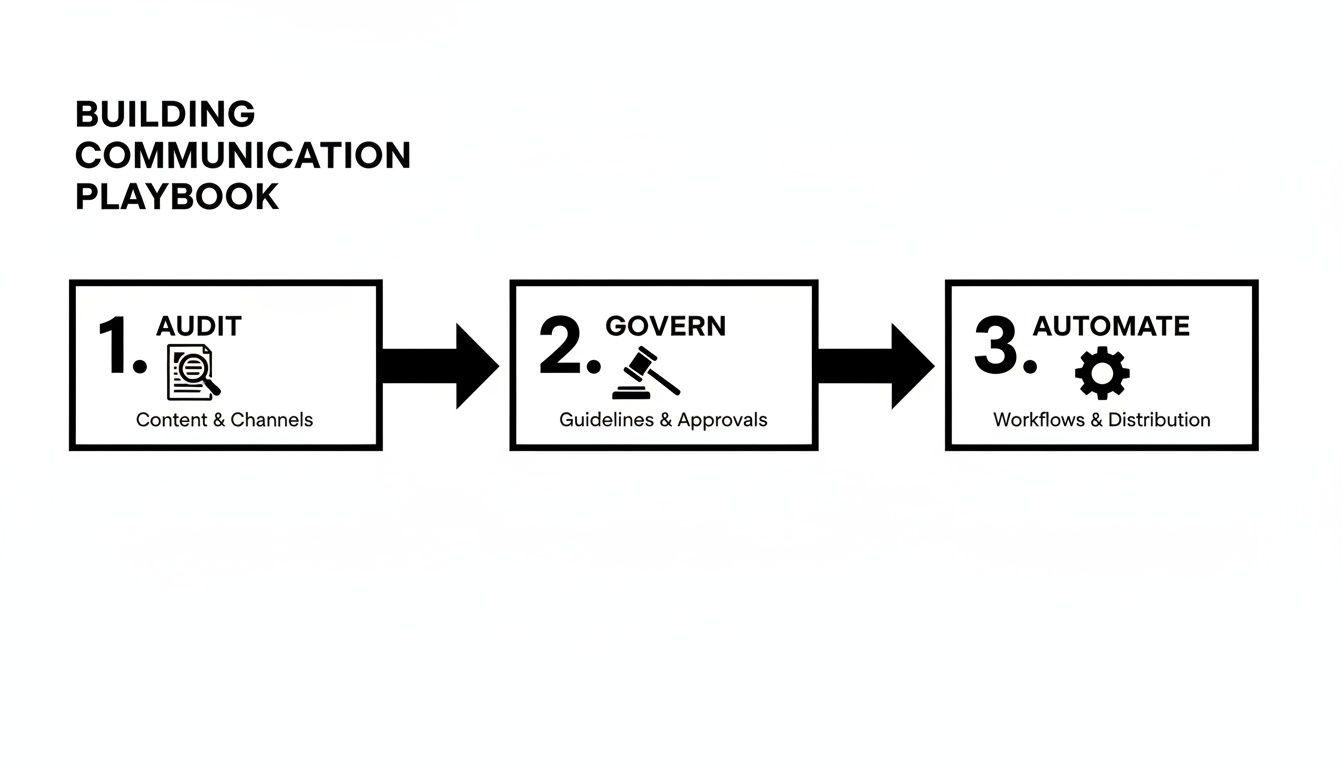
The process is systematic: audit your current post-close experience, establish clear governance rules, and leverage technology to automate workflows. This is how you build a post-close experience that strengthens your brand and scales efficiently.
From Reactive Service to Proactive Relationship
The strategic shift is from a reactive service model to a proactive ownership experience. It requires owning the homeowner relationship long after closing with the right infrastructure to prevent it from creating more manual work.
Instead of waiting for frustrated calls, you can get ahead of problems with an automated communication cadence that builds homeowner confidence. A simple playbook might include:
A 30-day automated check-in: A simple, branded message to see how they are settling in and proactively offer help.
A 90-day satisfaction survey: A structured touchpoint to gather feedback and identify potential issues before they escalate.
A one-year anniversary message: A chance to celebrate their milestone and keep your brand top-of-mind.
This isn't just about sentiment; it's an operational lever. Builders using structured 30-, 90-, and 365-day check-ins see direct improvements in their first-year anniversary scores. More importantly, builders who centralize this in an ownership hub report 30-50% fewer service requests by providing homeowners with instant access to documents, warranties, and service contacts.
The Strategic Value of an Ownership Hub
Attempting to manage this with spreadsheets and manual emails is unsustainable and impossible to scale. This level of proactive engagement depends on a centralized, white-labeled platform—an Ownership Experience hub—that serves as the homeowner’s single source of truth.
An ownership hub is more than a document folder. It's the builder-owned infrastructure that automates proactive communication, intelligently manages service requests, and turns the first year of homeownership into a measurable, positive brand experience.
This approach transforms the warranty period from a logistical headache into a powerful engine for referrals and repeat business. When homeowners have a single, branded place to find answers and submit requests, the "warranty noise" that bogs down your team disappears. See how a dedicated Ownership Experience hub makes this a reality for forward-thinking builders.
Extending your brand beyond closing is a strategic decision to protect and grow the lifetime value of every customer. It’s how you build a brand that people not only trust but actively recommend.
The Role Of A Customer Experience Platform
A communication playbook provides the strategy, but a dedicated customer experience platform is the operational engine that executes that strategy at scale. It is the missing link that connects your existing systems and solves the painful fragmentation of the buyer journey.
This is not about replacing your core software. You need your CRM for sales, construction software for project management, and an ERP for financials. A true customer experience platform is the connective tissue between them—it orchestrates communication and workflows, rather than replacing your systems of record.
This is a strategic shift, not a feature comparison. It's an investment in a purpose-built system designed to automate your playbook, deliver executive visibility, and ensure every buyer interaction is perfectly white-labeled under your brand.
The Connective Tissue for Your Tech Stack
Most homebuilders operate with a disconnected tech stack. The sales team lives in the CRM, the construction team in project management software, and the warranty team in yet another system. This is the root cause of communication breakdowns that erode buyer trust and create massive operational drag.
A customer experience platform is built to bridge these gaps. It integrates with your core systems to:
Pull data automatically: When a construction milestone is updated in your project software, the platform can instantly trigger a pre-approved, on-brand message to the homebuyer. No more manual updates.
Push data intelligently: When a buyer completes a pre-closing task in their portal, that status is immediately pushed back to your CRM, keeping your team aligned without manual effort.
Centralize all communication: Every message—automated or manual—is logged in one place, creating a single source of truth for every customer interaction from contract through warranty.
This orchestration enables you to scale a consistent brand experience without scaling headcount. It transforms your communication strategy from a manual, error-prone effort into an automated, measurable system. This is what a modern branded customer communication strategy looks like in practice.
This type of lifecycle gap is precisely what a modern customer experience platform is designed to solve. It provides the infrastructure to execute your playbook at scale, ensuring every message reinforces your brand, not the brand of a third-party app.
Strengthening Brand Ownership and Data Control
A true customer experience platform is always white-labeled. It is built to put your brand front and center, ensuring the builder—not a software vendor—owns the customer relationship. For leaders focused on long-term enterprise value, this is a non-negotiable distinction. The right platform strengthens your control, it doesn't dilute it.
It also gives you complete ownership of your customer engagement data. For the first time, you can see exactly how buyers are interacting with your communications, which messages are working, and which customers might be at risk. As you evaluate your options, it's critical to understand these differences. You can dive deeper in our complete guide to choosing a customer experience platform for homebuilders.
This level of visibility turns communication from a "soft skill" into a hard business metric. It gives you the data needed to make strategic decisions that improve sales velocity, reduce service friction, and ultimately drive more referrals.
Frequently Asked Questions
As a homebuilding leader, you are likely evaluating a modern branded customer communication strategy with pragmatic questions. Any strategic investment must be tied to clear, measurable business outcomes. Let's address the most common questions from executives.
How Do We Implement This Without Disrupting Our Teams?
The key is a phased implementation that starts with immediate wins. You don't need to overhaul your entire operation overnight. Begin by targeting the most repetitive, low-value communications that drain your team's time, such as routine construction updates or pre-closing questions.
A modern customer experience platform should integrate with your existing CRM and construction software. This allows your teams to continue working in the systems they know while the platform orchestrates communication in the background. The goal is not to force a new process on your team, but to make them dramatically more efficient.
Can We Actually Measure The ROI Of A Communication Platform?
Absolutely. The ROI is measured in tangible results that impact your bottom line, not vague brand metrics.
Key metrics to track include:
A 30-40% reduction in inbound buyer questions and manual follow-ups.
Faster time to close, driven by clearer communication and task management.
Increased sales team capacity as they are freed from administrative tasks.
Higher customer satisfaction scores (NPS) and a direct lift in referral leads.
By centralizing communication, you draw a straight line from consistency and buyer engagement to real financial results.
How Can A Platform Maintain Our Unique Brand Voice?
This is precisely why a fully white-labeled, enterprise-grade platform is essential. It should be completely yours—from the domain and logos to the tone of every message. Your team controls the templates, workflow logic, and communication cadence.
The platform's job is to be the engine that delivers your brand experience at scale. It ensures every single buyer gets the consistent, approved message you've defined, wiping out the brand risk that comes with random emails and texts from individual employees.
This way, the builder—you—always owns the brand, the data, and the customer relationship.
Foundation is the customer experience platform built for homebuilders to orchestrate a consistent, measurable, and white-labeled experience from contract through ownership. See how we help leading builders scale growth, efficiency, and customer satisfaction by visiting https://buildwithfoundation.com.
More from Foundation

Technology
What's New - September 2026
WarrantyOS, from work order to payment. September’s updates bring more of the day-to-day warranty workflow into one connected experience.
Sep 30, 2026

Marketing
New Home Portal: A Builder's Guide to the Buyer Journey
Learn what a new home portal is, the core features builders need, and how it shapes the buyer-to-owner experience across closing and early ownership.
Sep 16, 2026

Marketing
Home Warranty Software: A Practical Buyer's Guide
Compare home warranty software for homebuilders. Evaluate work orders, vendor coordination, customer communication, integrations, and implementation.
Sep 15, 2026