Sep 9, 2026

Home Builder Solutions That Connect the Buyer Journey
A buyer signs a contract, then the customer experience starts moving across the systems supporting it. Sales has the customer record, construction has the schedule, finance has the closing information, and Customer Care has a separate process. The customer has an inbox full of partial answers and no reliable view of what happens next.
Market Research Future's house-building market analysis
The gap is not always missing software. It is the work required to turn information from different departments into one clear customer experience.
When evaluating home builder solutions, start with the journey you need to deliver, not another feature list. Identify what the customer needs at each stage, which system provides the information, and who handles the next action. Then decide what to connect, what to automate, and where people should remain directly involved.
This guide focuses on that post-contract journey: construction, closing, ownership, and warranty. The goal is to make those transitions easier for customers while giving teams more time to sell homes, build homes, and provide meaningful customer care.
Find the Friction Between Customer Touchpoints
Consider a customer preparing for a construction walkthrough. The date is on an internal calendar, the preparation instructions are in a salesperson's email template, and the meeting location sits in a text thread. Each piece exists. The customer still has to ask someone to assemble the answer.
After closing, the same pattern can appear when a customer needs an appliance manual or an update on a service appointment. Employees search for information the company already has instead of moving the request forward.
Before shopping for software, trace a recent customer journey with sales, construction, closing, and Customer Care. Look for the points where someone had to copy information, chase a status, repeat an explanation, or reconstruct a previous conversation.
Separate three kinds of gaps: information that was never captured, information that exists but is inaccessible, and information that is available but never prompts the right action. A new portal cannot solve all three by itself.
A connected journey should answer two questions: What does the customer need next, and what work must happen inside the builder to deliver it?
Use the answers to prioritize a specific workflow, rather than treating every department's wish list as the starting scope.
Give Each System a Clear Role
A useful framework separates the systems managing sales, construction, and finance from the platform coordinating the customer experience. These are responsibilities, not a requirement to buy exactly four separate applications.
System or capability | Primary responsibility | Connection to the customer journey |
|---|---|---|
CRM | Leads, sales activity, and customer relationships | Supplies relevant customer and contract context and supports follow-up by the sales team. |
Construction management | Schedules, field progress, and production coordination | Supplies verified milestones and approved information about the build. |
ERP | Accounting, purchasing, and financial or operational records | Supplies relevant home, transaction, vendor, and closing information. |
Customer experience platform | Communication, customer tasks, documents, and continuity across stages | Turns selected operational information into customer-facing guidance and coordinated follow-through. |
Define the authoritative source for each important field. A contract date may come from the ERP rather than the CRM. Construction information may reach the experience platform through an existing back-office integration rather than directly from the field system. Map the actual data flow instead of assuming a standard diagram matches every division.
Decide where warranty operations belong
Warranty is an operating workflow, not necessarily a separate system that must stay outside the customer experience platform. A builder may retain an existing warranty tool, or move service requests, work orders, scheduling, and related work into a platform such as WarrantyOS.
Those choices require different implementation plans. Routing a customer's submission to an existing team or system is not the same as managing the request through resolution. Identify where the work will happen and how the customer will receive updates.
Preserving a useful CRM, ERP, or construction system does not mean preserving every disconnected warranty spreadsheet or legacy process.
Connect the Customer Experience to the Tools Behind It
Customers need a consistent way to find updates, complete tasks, access documents, and reach the right team. Employees need tools that make those interactions easier to deliver and maintain.
The two experiences should connect, but they should not expose the same information. A customer needs an understandable construction update. The team may also need an internal note, a source-system reference, or an unresolved issue that is not ready for customer communication.
One relationship, different needs at each stage
Foundation's product structure illustrates this distinction. Closing Concierge supports the contract-to-close experience with builder-branded apps and a portal for updates, messaging, milestones, documents, and customer action items.
Ownership Experience continues the relationship after closing, including access to home-specific product information, documents, maintenance guidance, and service request submission. The customer should not have to start over simply because the home has closed.
Behind that experience, Operator and automation give builder teams tools to manage customer communication and home information from the office or field. Integrations and backend workflows help turn operational information into repeatable customer updates and actions.
WarrantyOS manages warranty and Customer Care operations, including service requests, work orders, vendor coordination, scheduling, purchase orders, approvals, and communication. It is more than a form that forwards a request into someone else's inbox.

A branded app is only part of the work
A useful customer experience also needs an accessible web option, clear notification expectations, and a manageable process for keeping information current. Publishing an app does not complete that work.
Define which content is supplied by connected systems, which recurring messages can use approved templates, and which moments need a personal update. Teams should understand their responsibilities without having to maintain a second version of every operational record.
For the broader automation approach, see Put Your Post-Contract Experience on Autopilot. The journey map below turns that strategy into a practical planning exercise.
Map the Journey From Contract Through Ownership
Build the map around customer questions, not your software menu. For each stage, define the information needed, the customer-facing action, and the internal check that confirms the handoff worked.
The following examples are planning prompts to adapt to your operation, not a list of features every platform provides automatically.
Journey stage | What the customer needs | What the builder should confirm |
|---|---|---|
Contract and welcome | A clear introduction, the next task, and the right contact | The correct customers are associated with the home, invited, and assigned to the appropriate journey. |
Selections and decisions | Applicable deadlines, instructions, and approved documents | Requirements match the home and contract; completed or irrelevant decisions are not requested again. |
Construction progress | An understandable update and what happens next | The source is current, the milestone is verified, and the message does not imply an unapproved closing date. |
Walkthrough and closing preparation | Confirmed appointments, preparation instructions, and remaining tasks | Dates and responsibilities are agreed, and a checked task is not confused with full closing readiness. |
Move-in and ownership | Home details, useful documents, maintenance guidance, and service access | Relevant information remains accessible after closing and Customer Care can see the context it needs. |
Warranty service | Confirmation of receipt, a next step, and updates through resolution | The request has an owner; open items, vendor work, and customer communication stay coordinated. |
Ongoing relationship | Useful follow-up and an appropriate way to share feedback or referrals | Communication reflects the customer's preferences and current relationship, including unresolved concerns. |
Quick move-in homes need a different starting point
A customer purchasing a completed home should not receive the same sequence as someone buying before construction begins. Selection deadlines may no longer apply, while closing preparation may be urgent.
Test how the journey starts from the home's actual stage. Make useful existing photos and home information available without sending a backlog of milestone notifications as though construction just occurred. Confirm what should happen to incomplete tasks when a contract or closing date changes.
Also test a canceled contract or a customer changing homes. The next customer needs the right home information, not another customer's messages or private documents. Treat access and customer-to-home assignments as part of the workflow review, not just account setup.
The closing handoff should preserve context, not every screen
Before closing, ask Customer Care which information will help them support the customer afterward. Relevant home details, documents, open commitments, and communication history should have a defined destination and appropriate access.
A customer looking for a paint color should be able to find the home's information. A customer reporting a problem needs a clear service path. Self-service should make routine answers easier to find without creating barriers to reporting a genuine issue.
Evaluate Home Builder Solutions With Real Workflow Tests
Use the journey map to guide demonstrations and implementation planning. The objective is not to prove that software can display a feature. It is to prove that the full interaction works for the customer and the employee responsible for it.
Integration fit. Trace one event from its authoritative source to the customer-facing result. Confirm the fields, update frequency, error handling, and maintenance owner. An API, scheduled data feed, or managed workflow can be appropriate depending on the need. Do not assume a connector name guarantees every field, real-time updates, or two-way synchronization.
Brand and communication. Review the app, web portal, notifications, and message tone together. Test what happens when a customer does not download the app or has not enabled a notification channel. Confirm which information is public, customer-visible, or internal. A delivery event alone does not establish that a customer understood the next step.
Division and home differences. Test a build-to-order home and a quick move-in home. Check which templates, tasks, milestones, and contacts can vary by division or community, and who maintains those differences. Shared standards should not force inaccurate instructions onto a different process.
Team adoption. Ask the people doing the work to complete an update and handle a customer reply without vendor assistance. Identify what automation supplies, what employees still contribute, and which old steps can stop. A customer-facing improvement that creates duplicate office or field work needs a better design.
Automation and AI boundaries. Ask vendors to distinguish available functionality from planned features. Test how an incorrect input or changed date is handled. Where AI drafts content or work orders, identify who reviews the result. Keep sensitive commitments and service decisions with the responsible team rather than treating generated text as an approval.
Reporting and ownership. Confirm that leaders can investigate missed communication, incomplete tasks, and unresolved work in the implemented workflow. Also confirm access controls, export options, and the builder's rights to its data. Avoid assuming a broad analytics promise means every requested report exists today.
Implementation and total cost. Document who configures workflows, maps data, prepares content, trains staff, and supports changes after launch. Clarify subscription scope, any usage or integration charges, and the cost of retaining parallel systems. Include the builder's own implementation effort in the comparison.
Require one complete demonstration: the operational event, the customer's experience, the employee's next action, and the response when something goes wrong.
Measure Capacity and Customer Outcomes Together
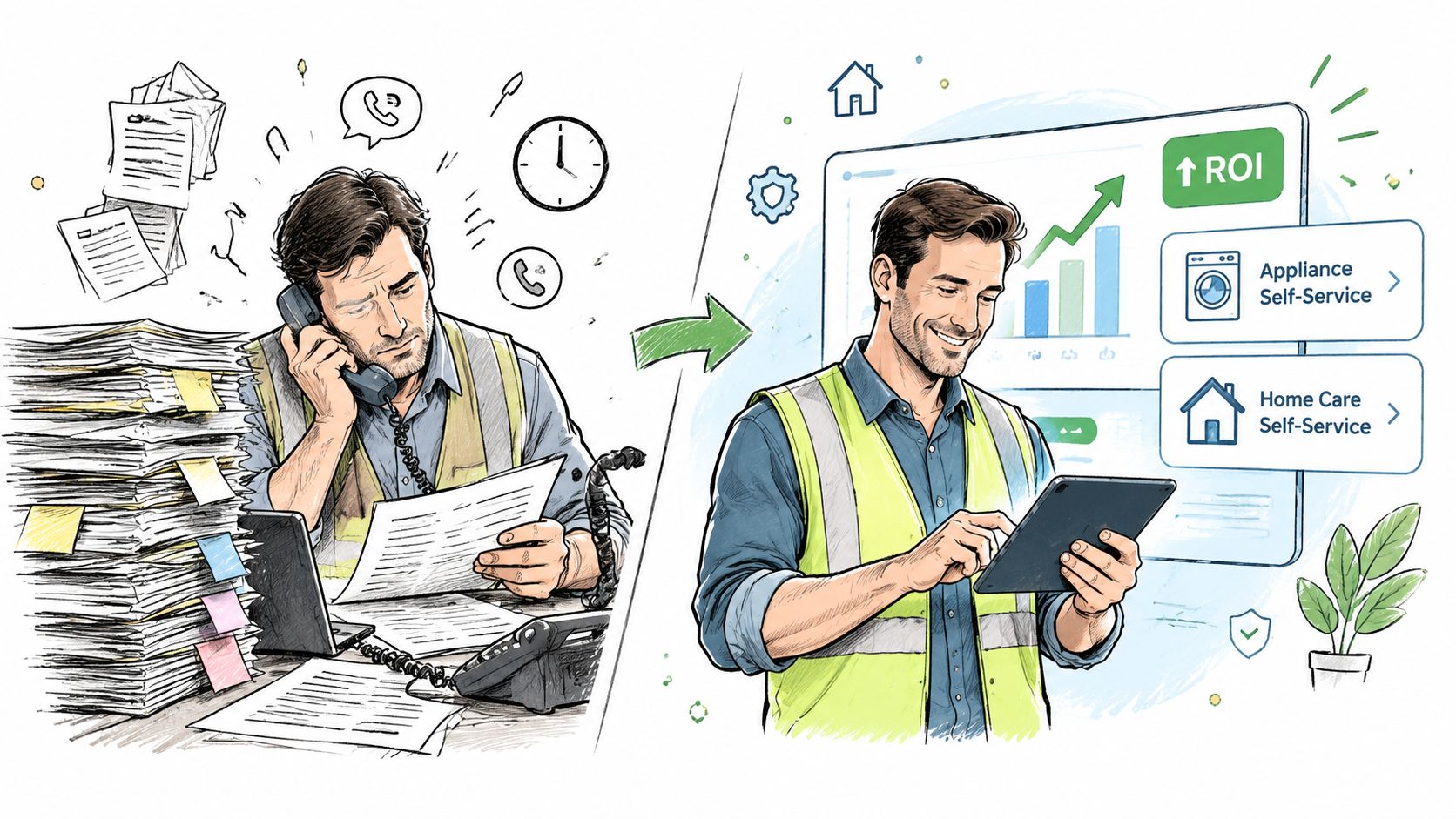
Build the business case from the work the selected workflow changes. Broad market forecasts and another vendor's results do not establish what your team will gain.
For a pilot, record the time spent preparing updates, locating documents, answering repeated status questions, and transferring information. Compare similar homes and stages after launch, including the time spent maintaining content, checking exceptions, and correcting data.
The improvement is the net work removed, not the number of messages sent automatically.
Connect recovered time to a business priority
For sales, the opportunity may be more time for lead follow-up, appointments, or Realtor relationships. For closing, it may be more capacity to prepare customers and resolve exceptions. For Customer Care, it may be less coordination work before diagnosis, scheduling, and resolution can begin.
Treat those as outcomes to verify. Recovered capacity is not automatically payroll savings or additional revenue. Confirm how the team uses the time and avoid counting the same benefit twice.
Protect the quality of the experience
Review whether customers understand their next step, whether required tasks are complete, and whether service issues remain open or need to be reopened. Compare those observations with customer feedback.
Fewer calls are not a success if customers find it harder to get help. More app logins are not a success if the information is out of date. Referrals and repeat business should be tracked as longer-term outcomes, not promised as an immediate result of implementing software.
Roll Out the Journey in Manageable Phases
A phased rollout should follow operational readiness rather than a fixed transformation calendar. Integration availability, content preparation, staff training, and the chosen warranty model will shape the sequence.
Phase one: agree on the starting workflow
Select a handoff with clear ownership and visible friction. Define the customer outcome, source data, required content, and work that should disappear. Establish a baseline before changing the process.
Phase two: prove the experience with a small group
Configure the journey for a representative set of homes and train the employees responsible for it. Test normal interactions and exceptions, including changed dates, missing information, customers entering at different construction stages, and customer replies.
Do not expand simply because the app is live. Confirm that people can operate the workflow and customers can use it.
Phase three: plan the warranty transition explicitly
Decide whether warranty operations stay in an existing tool or move into WarrantyOS. Define which homes and open requests are included, where older cases remain, and who owns status updates during the transition. Avoid leaving coordinators responsible for maintaining the same service record in two places indefinitely.
Foundation's community-level WarrantyOS rollout controls allow builders to enable WarrantyOS in selected communities. That supports a staged adoption approach without requiring every community to change at once.
Phase four: expand what has earned its place
Use the pilot findings to refine templates, ownership, data connections, and support before expanding across communities or divisions. Add ongoing maintenance education and relationship-building communication where it provides customer value.
The point of connected home builder solutions is not to make every department use the same screen. It is to make the transitions between departments feel consistent, while removing the repetitive work required to hold them together.
Start with the next customer handoff. Make it clearer, easier to operate, and less dependent on someone remembering to follow up. Then build from there.
More from Foundation

Marketing
Home Warranty Software: A Practical Buyer's Guide
Compare home warranty software for homebuilders. Evaluate work orders, vendor coordination, customer communication, integrations, and implementation.
Sep 15, 2026

Marketing
How to Improve Team Accountability in Homebuilding
Improve team accountability in homebuilding with clear owners, reliable handoffs, practical metrics, and less manual follow-up from contract through warranty.
Sep 14, 2026

Marketing
Construction Progress Tracking Software for Homebuilders
Evaluate construction progress tracking software for homebuilders: field updates, integrations, customer communication, and a practical pilot to measure ROI.
Sep 10, 2026