Feb 16, 2026

For most homebuilders, the homeowner warranty experience is a cost center—a reactive, fragmented process that creates operational drag and puts brand reputation at risk. It’s often viewed as a necessary evil, an obligation to fulfill rather than the strategic asset it can be.
This outdated approach impacts brand trust, team capacity, and long-term profitability more than most leaders realize. A poor post-close experience doesn't just create an unhappy customer; it erodes the trust you spent months building and actively suppresses referral-driven growth.
Moving from Reactive Service to Proactive Engagement
The post-close phase is where brand promises are either kept or broken. When a homeowner finds a settling crack or a cabinet door that won't close, their first interaction with your warranty team defines their entire perception of your company.
A slow or confusing process creates a breeding ground for negative online reviews. This friction is also an internal problem. A disconnected warranty process buries your team in repetitive calls, manual scheduling, and endless follow-ups, pulling skilled members away from proactive quality control and back into a reactive fire-drill cycle.
The True Cost of a Fragmented Warranty Experience
The fallout from an outdated warranty model extends far beyond the direct cost of repairs. The real business impact shows up in operational and financial metrics:
Increased Operational Drag: Teams burn hours answering the same questions, tracking claims in spreadsheets, and chasing trade partners by phone. This model doesn't scale; it requires adding headcount to handle more volume.
Erosion of Brand Trust: A single bad warranty interaction can erase the goodwill built during sales and construction. Homeowners who feel ignored are vocal and quick to share negative stories online.
Missed Referral Opportunities: A smooth, supportive warranty experience is one of the most powerful drivers of homeowner referrals. A difficult process doesn't just lose an advocate—it can create an active detractor.
Limited Lifecycle Visibility: Without a connected system, you lack insight into recurring issues, trade partner performance, or homeowner sentiment. This data blindness makes it impossible to fix root causes and improve future builds.
The warranty isn’t just a contract; it’s a promise. It represents an opportunity to build trust, offer guidance, and ensure homeowners feel confident in their investment long after move-in day.
Reframing the warranty experience is a critical strategic decision. By shifting from a reactive service model to a proactive engagement strategy, builders can turn this function from a painful cost center into a powerful competitive advantage.
This shift means seeing the post-close journey not as the end of a transaction, but as the beginning of a long-term relationship. Builders who excel in this phase build unshakable brand loyalty. This is where a dedicated platform can streamline the entire ownership experience and help turn homeowners into lifelong brand advocates.
Mapping Your Current Homeowner Warranty Journey
Before you can build a better warranty experience, you must be brutally honest about the one you deliver today. This isn’t about what your process documents say, but what the homeowner actually goes through.
Most builders have a process on paper, but few have mapped the journey from the buyer's perspective. This leaves dangerous gaps where frustration builds and trust erodes. A real audit isn't about pointing fingers; it's about finding the hidden friction dragging down operations and hurting your brand.
The goal is to move out of reactive, fire-fighting mode and build a proactive system that creates loyalty. This flow illustrates the shift from merely reacting to problems to actively building brand advocates.
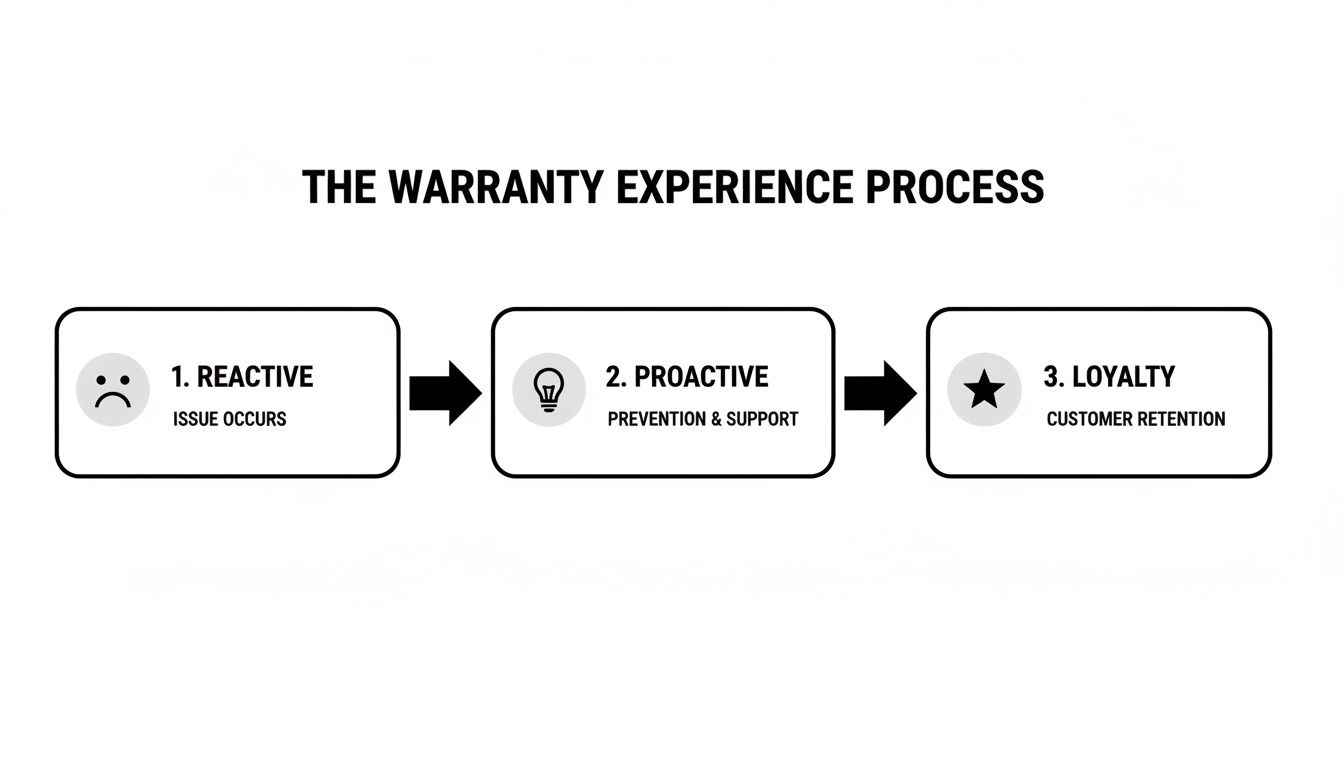
The key is moving beyond simple issue resolution (Reactive) and toward proactive education (Proactive) to create true brand advocates (Loyalty).
Deconstructing the Homeowner Journey
Mapping this journey requires a hard look at every touchpoint. It’s a diagnostic exercise meant to expose the inconsistencies and manual workarounds that have become "business as usual."
Start by breaking the experience down into its core phases.
Homeowner Education and Orientation: How do you teach buyers about their warranty? A thick stack of papers at closing creates mismatched expectations, which are the root cause of 40% or more of future warranty headaches.
Claim Submission: How easy is it for a homeowner to submit a claim? Must they hunt for a number and sit on hold, or can they submit a request with photos from their phone? Every piece of friction removed is one less frustrated call to your office.
Triage and Assignment: When a claim comes in, who owns it? How is it triaged and assigned to a trade or in-house tech? This internal handoff is a notorious black hole where requests are delayed.
Scheduling and Communication: This is where many builders fail. The homeowner is often left in the dark, waiting for a call from an unknown subcontractor. A lack of proactive updates is the #1 reason for "what's the status?" calls.
Service and Resolution: What is the experience when the technician arrives? Is the work done right the first time? A low First-Time Fix Rate signals poor diagnostics or unqualified trades, leading to costly, frustrating return visits.
Post-Service Follow-Up: After work is completed, how do you close the loop? A simple, automated survey provides priceless feedback and makes the homeowner feel heard. Skipping this step means you're flying blind on trade performance.
The biggest gaps in the warranty experience aren’t failures of intent; they're failures of process. They happen in the silent spaces between handoffs—from the homeowner to your coordinator, from the coordinator to the trade, and back again.
Pinpointing Critical Friction Points
As you walk through these stages, specific pain points will emerge. These aren't just minor inconveniences; they are direct costs to your business in wasted time, rework, and a tarnished reputation.
Look for these common patterns of breakdown:
Inconsistent Communication: Does every homeowner receive the same level of communication, or does it depend on which warranty manager handles their case?
Lack of Visibility: Can a homeowner easily check their claim status online, or are they forced to call your team for every update?
Disjointed Handoffs: Does your warranty team have the home's full construction history, or are they digging through spreadsheets to diagnose a recurring leak?
Manual Follow-Ups: Is your team spending its day chasing trade partners for updates instead of analyzing trends to prevent the next claim?
Identifying these gaps is the first step toward building a scalable system. Understanding your current state allows you to see how a connected homebuilder warranty platform is designed to solve these exact lifecycle challenges, connecting teams and systems to create a seamless journey.
Designing a Scalable Warranty Operating Model
A great warranty experience doesn't happen by accident. It isn't the result of good intentions or heroic team members putting out fires. It’s built on a well-defined operating model connecting people, processes, and technology.
Without a solid framework, service levels are inconsistent, costs spiral, and brand reputation is left to chance. For homebuilder executives, designing this model is a strategic imperative—the blueprint for delivering a consistently high-quality experience, even as home deliveries scale.
The financial stakes are significant. In a recent year, 27 major U.S. builders paid out $1.071 billion in warranty claims and hold over $2.2 billion in warranty reserves. This data, highlighted in a recent analysis of homebuilder warranty spending, underscores the need for an efficient, scalable system to manage post-close financial risk.
Core Components of a Modern Warranty Operating Model
Component | Objective | Key Action Items |
|---|---|---|
People & Roles | Establish clear ownership and accountability. | - Define specific responsibilities (e.g., Coordinator, Technician). |
Processes & Workflows | Standardize responses for consistency and efficiency. | - Develop distinct workflows for different claim types (cosmetic, functional, emergency). |
Technology & Systems | Create a single source of truth for all stakeholders. | - Implement a central platform that connects warranty, CRM, and construction systems. |
Data & Measurement | Drive continuous improvement through insights. | - Track Key Performance Indicators (KPIs) like first-response time and first-time fix rate. |
Each of these pillars supports the others. Great people cannot succeed with broken processes, and even the best technology is ineffective without clear roles and a commitment to measuring what matters.
Defining Roles and Responsibilities
Clarity is the foundation of a scalable operation. When accountability is fuzzy, handoffs are dropped and homeowners become frustrated. Every team member needs to know their precise role and how it contributes to the overall homeowner experience.
Warranty Manager/Coordinator: The air traffic controller for all incoming claims. They triage requests, verify coverage, assign the job to the appropriate resource, and serve as the primary point of contact for the homeowner.
Field Technician/Superintendent: The face of your brand after closing. Their role is to provide professional service, accurately diagnose issues to ensure a high first-time fix rate, and meticulously document every step.
Trade Partner Manager: Manages the performance and accountability of subcontractors. They enforce service level agreements (SLAs), review post-service satisfaction scores, and address recurring quality issues with specific trades.
Standardizing Workflows and Escalation Paths
A nail pop is not a water leak. Your warranty process must reflect this reality. Standardized workflows based on claim type and severity are essential to delivering a consistent, appropriate response every time.
Your model should have distinct playbooks for different categories:
Minor Cosmetic Issues: Low-urgency items like paint touch-ups. The workflow should focus on grouping these repairs for efficiency, often scheduled for 30-day or 11-month service checkpoints.
Functional System Failures: HVAC, plumbing, or electrical problems. This workflow must immediately trigger assignment to the correct trade partner with a strict SLA for homeowner contact and diagnosis.
Emergency or High-Priority Claims: For critical issues like active leaks or safety hazards, a clear escalation path is non-negotiable. This workflow should bypass the normal queue, automatically notify senior leadership, and trigger an immediate response.
A well-designed operating model removes ambiguity. It ensures a homeowner in one community receives the same high-quality service and communication as a homeowner in another, regardless of which team members are involved.
Structured pathways take the guesswork out of warranty management for your team and set clear expectations for the homeowner. This is where a dedicated system like a builder-focused warranty OS becomes a game-changer. It orchestrates these complex workflows automatically, providing the visibility needed for every stakeholder to execute their role effectively.
Using Automation to Tame Inbound Warranty Volume
Much of the friction in a typical warranty process boils down to poor communication and a high volume of repetitive questions. Every call asking, "What's the status of my claim?" is a drain on your team's time and capacity.
The solution isn't just hiring more people; it's using technology to handle routine tasks and empower homeowners to self-serve. A modern warranty experience anticipates homeowner needs before they feel the need to call.
It starts with a centralized, builder-branded homeowner portal. This single source of truth gives homeowners on-demand access to critical information, deflecting common questions before they become phone calls. When a homeowner can instantly find their closing documents, warranty details, or appliance manuals, they feel in control.
Orchestrating Workflows with Automated Communication
A dedicated platform can trigger communication workflows at key moments in the warranty journey, ensuring no homeowner feels left in the dark. These automated touchpoints build confidence and significantly reduce "just checking in" calls.
Consider the impact of automated templates at these critical milestones:
Instant Claim Confirmation: The moment a homeowner submits a request, an automated email and push notification confirms receipt, immediately assuring them their issue is in the queue.
Assignment Notifications: When a claim is assigned, another message informs the homeowner who to expect a call from and when, setting clear expectations from the start.
Scheduling Updates: As appointments are confirmed or rescheduled, the system automatically keeps the homeowner in the loop, creating a transparent timeline without manual effort.
Post-Resolution Surveys: A day after a work order is closed, an automated survey can gather immediate feedback, making the homeowner feel heard and providing priceless performance data on trade partners.
These automated sequences are the backbone of a scalable operation.
Empowering Homeowners with Self-Service Resources
Beyond automating messages, a homeowner portal acts as a permanent, living library for the home. It becomes the first place owners turn for answers, further reducing inbound volume.
A well-equipped homeowner portal deflects up to 30% of routine service inquiries by providing instant answers to common questions about home maintenance, troubleshooting, and warranty coverage.
This digital hub should be populated with practical, easy-to-find content:
Interactive Maintenance Guides: Replace static PDFs with seasonal checklists and how-to videos for common tasks like changing HVAC filters or winterizing hose bibs.
Troubleshooting Wizards: A simple step-by-step diagnostic tool can guide homeowners to resolve common issues like a tripped GFCI outlet themselves.
A Complete Document Vault: All closing documents, floor plans, paint colors, and appliance model numbers should be organized and searchable.
By providing these tools, you change the dynamic from dependency to partnership. Implementing strategies for closing the feedback loop with AI and automation can help you preemptively solve common issues before they become claims. This is the type of lifecycle gap modern customer experience platforms are designed to solve.
Measuring the Metrics That Actually Matter
To manage the homeowner warranty experience effectively, you must measure it correctly. Many builders track vanity metrics like total open claims, which reveal little about team performance or homeowner sentiment. This surface-level tracking keeps teams in a reactive mode, blind to trends that could prevent future issues.
Shifting to a data-driven strategy means focusing on key performance indicators (KPIs) that reflect the health of your post-close operations. These numbers show where the friction is, how the team is performing, and whether you're delivering on brand promises. When you track what matters, you stop guessing and start managing.
Moving Beyond Simple Claim Counts
A dashboard with the right data provides a clear pulse on the health of your warranty program. It turns anecdotal feedback into actionable insights that help pinpoint recurring construction defects, evaluate trade partner performance, and improve quality on the job site.
These essential metrics should be front and center on your warranty dashboard:
First Response Time: How long does it take your team to acknowledge a new claim and contact the homeowner? A slow first response immediately signals that the homeowner is not a priority.
Time to Resolution: What is the average time from claim submission to final closure? Breaking this down by claim type helps spot bottlenecks in your workflow.
First-Time Fix Rate (FTFR): What percentage of issues are fully resolved on the first service visit? A low FTFR drains resources and frustrates homeowners, indicating problems with diagnosis, skills, or parts availability.
Customer Satisfaction (CSAT) Score: How satisfied are homeowners after the work is done? An automated survey sent immediately after job completion is the best way to get unfiltered feedback.
The goal isn't just closing tickets faster. It's about solving the right problems, the right way, the first time. Effective measurement is what separates a world-class warranty operation from a perpetual cost center.
Building a Dashboard for Executive Visibility
Once you track these core metrics, analyzing them for trends is where the strategic value emerges. A great dashboard tells a story about your business and empowers leaders to answer critical questions.
Organize your data to reveal insights like:
Trends by Community: Is one community generating a disproportionate number of HVAC claims? This could point to an installation issue with a specific crew or faulty equipment.
Trade Partner Performance: Which plumbing contractor consistently achieves the fastest resolution times and best CSAT scores? This data is invaluable for contract negotiations and accountability.
Recurring Defect Types: Is there a spike in window leaks across multiple projects? This is an immediate signal for your construction team to investigate and fix the root cause, directly reducing future warranty costs.
Industry data confirms that streamlined operations deliver results. Among approved claims, nearly 50% of repairs are completed within one week, and 90% of claims receive provider approval, indicating high homeowner satisfaction when the process is efficient. You can discover more insights on home warranty survey data that highlight how claims handling shapes homeowner perception.
Tracking these KPIs creates a powerful feedback loop for continuous improvement. You won't just enhance the warranty experience—you'll build a better product and a stronger brand. For a deeper look, see our guide on how to measure customer engagement.
Turning Warranty Into a Long-Term Value Driver
For many builders, the warranty experience is viewed as the messy end of the customer journey. Forward-thinking leaders see it differently. For market-winning builders, the post-close phase is the beginning of a long-term relationship that pays dividends far beyond the initial sale.
This is a builder's single greatest opportunity to prove their commitment, secure brand trust, and turn happy homeowners into their most effective sales team. When warranty is treated as a strategic tool, it evolves from a cost center into a powerful engine for referrals and repeat business. A seamless, responsive process builds brand loyalty that advertising cannot buy.
From Obligation to Opportunity
The market confirms this strategic shift. The home warranty service industry is projected to grow. This trend signals a massive change in homeowner expectations; post-close support is no longer a bonus but a core demand. You can explore the details on the growing home warranty market and its implications for builders.
This presents a clear opportunity to differentiate by owning this crucial phase of the customer lifecycle.
The builder who truly owns the customer relationship—from the first sales meeting through years of ownership—is the builder who wins the market.
Ultimately, a modern warranty program is about more than operational efficiency. It’s about building a brand that homeowners trust and recommend for years to come. This is where integrated, white-labeled customer experience platforms offer a decisive advantage, enabling a consistently exceptional experience at scale that strengthens your brand and fuels future growth.
Still Have Questions About Homeowner Warranties?
Overhauling warranty operations is a significant strategic decision. Below are answers to the most common questions from homebuilder executives.
How Can We Reduce Warranty Claims Without Sacrificing Homeowner Satisfaction?
The answer lies in shifting from reactive service to proactive engagement. The best way to reduce claims is to empower homeowners with information from day one through a digital hub with maintenance guides, video tutorials, and clear warranty documents.
When a homeowner can easily find the answer to a common question, they are far less likely to file a preventable claim. This self-service approach sets clear expectations and builds their confidence. Furthermore, analyzing warranty data allows you to spot recurring defects, address root causes in construction, and permanently lower claim volume.
What Is the Role of Technology in the Warranty Experience?
Technology is the connective tissue that transforms a disjointed process into a seamless, scalable warranty experience. A dedicated customer experience platform connects the systems you already use—CRM, construction software, and ERP—into a unified view of the homeowner's journey.
The goal is to give your team the tools to deliver a consistent, high-quality experience to every homeowner without being buried in manual, repetitive tasks.
This technology automates routine communication, provides homeowners a self-service portal to submit and track claims, and feeds your team the real-time data needed to manage workflows. It orchestrates the process so your people can focus on high-value problem-solving. This is the kind of lifecycle gap modern customer experience platforms are built to fill.
How Do We Measure the ROI of a Better Warranty Experience?
The return is visible in two areas: immediate cost reduction and long-term revenue generation.
Cost Reduction: Track key operational metrics. You should see a drop in inbound call volume, a lower cost-per-claim due to increased efficiency, and a decrease in claim frequency as you address root-cause construction issues.
Revenue Generation: Monitor the impact on growth. Track the increase in homeowner satisfaction scores (CSAT/NPS), positive online reviews, and—most importantly—the rate of homeowner referrals and repeat buyers.
A superior post-close experience builds unshakable brand loyalty. That loyalty translates directly into future sales, turning a former cost center into one of your most reliable growth engines.
A modern, connected warranty experience is a competitive necessity. Foundation provides the customer experience layer that connects your systems, automates your workflows, and turns every new homeowner into a lifelong advocate for your brand.
Learn how Foundation can transform your ownership experience
More from Foundation

Technology
What's New - September 2026
WarrantyOS, from work order to payment. September’s updates bring more of the day-to-day warranty workflow into one connected experience.
Sep 30, 2026

Marketing
New Home Portal: A Builder's Guide to the Buyer Journey
Learn what a new home portal is, the core features builders need, and how it shapes the buyer-to-owner experience across closing and early ownership.
Sep 16, 2026

Marketing
Home Warranty Software: A Practical Buyer's Guide
Compare home warranty software for homebuilders. Evaluate work orders, vendor coordination, customer communication, integrations, and implementation.
Sep 15, 2026